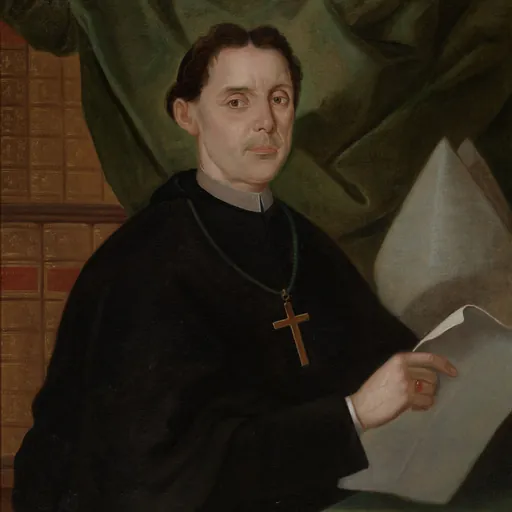
Manuel do Cenáculo
18th-century Portuguese prelate and antiquarian
About Manuel do Cenáculo
Lived 1724 – 1814 (aged 89). Manuel do Cenáculo was a catholic priest and catholic bishop.
Dom Frei Manuel do Cenáculo, T.O.R. (né Manuel de Vilas-Boas Anes de Carvalho; 1 March 1724 – 26 January 1814) was a Portuguese Franciscan prelate, who served as the first Bishop of Beja (1770–1802) and as Archbishop of Évora (1802–1814).
One of the country's leading intellectuals at the time, Manuel do Cenáculo was aligned with the novel ideas of the Enlightenment and the Pombaline reforms of public instruction in Portugal: he played a leading role in the reform of the University of Coimbra, he directed the Royal Censorship Board (with which deposits he for the first time proposed to create a national library), and gathered a vast collection of books, antiquities, and works of art.
Following Pombal's fall from grace in 1777, Manuel do Cenáculo lost much of his influence at court and directed his attention to ecclesiastical life while, at the same time, spearheading the creation of public schools, libraries, and academies across the country; chief among them are the Évora Public Library, the Library of the Lisbon Academy of Sciences, and the art and archaeology collection that nowadays comprises the Frei Manuel do Cenáculo National Museum.
Early life Of humble origins, Manuel de Vilas-Boas Anes de Carvalho was born in Lisbon, the son of José Martins, a metalsmith from the village of Constantim in Vila Real, and Antónia Maria. He was brought up in the spirit of the prevalent Christian principles and values: his mother was the first to educate him in religion, instilling in him the virtues of charity and piety; his paternal uncle, Caetano Jerónimo, was a familiar of the Holy Office of the Inquisition. According to Francisco Manuel Trigoso writing shortly after Manuel do Cenáculo's death, the seemingly unassuming family had illustrious forebears. Cenáculo showed a great deal of ingenuousness about his upbringing: Father José Agostinho de Macedo once inquired about a scar on his face and he candidly replied that it was a burn from a spark that had generated as his father was hammering a red-hot iron rod on an anvil. The atmosphere in Rome was one of great transformation as even Pope Benedict XIV was promoting the implementation of modern teaching reforms. By his own admission, this voyage, with its many visits to libraries, museums, universities and direct contact with many foreign thinkers, left a lasting impression on his ideas on culture and teaching; the Enlightenment principles would be fully incorporated in his later activities as a reformer and as a pedagogue.
Upon his return to Portugal in 1751, he published Conclusiones de Logicæ ("Conclusions on Logic"), which became the first wide-ranging official Franciscan essay published in the country, applying modern philosophical ideas to the teaching of Logic; his consideration of History as a propaedeutic to Philosophy already shows the influence of Johann Jakob Brucker's chief work Historia Critica Philosophiæ ("Critical History of Philosophy"). He, however, remained at court in Lisbon.
In 1777, the death of King Joseph I meant the accession of his eldest daughter and heiress Queen Maria I: in a period that became known as "the Turnabout" ("a Viradeira"), the Marquis of Pombal and his political allies all fell from power — as the fervently religious Maria I was staunchly opposed to Pombal and his policies. Manuel do Cenáculo soon was banished to his bishopric in Beja, where he stayed for the next twenty-five years.
After the Battle of Vimeiro in August put an end to the French invasion, there were instructions issued in the name of John, Prince Regent to restitute the Archbishop to his diocese in the most dignified way possible: Manuel do Cenáculo made his solemn re-entrance in Évora on 17 October 1808, escorted by a guard of honour comprising the Regiments of Estremoz, Évora, Olivença, and Moura, and was welcomed back with cheers, the chime of the bells, and pyrotechnics.
Legacy
Manuel do Cenáculo was one of the most prolific writers of his time, on a vast array of subjects. Among them, a work in defence of the educational reform doctrines of Luís António Verney, the great enemy of the methods of the Jesuits; a dissertation on the definability of the dogma of the Immaculate Conception of Mary (only defined after Cenáculo's death by Pope Pius IX in Ineffabilis Deus, 1854); Memórias Históricas do Ministério do Púlpito ("Historical Memoirs on the Ministry of the Pulpit", 1776), one of his most celebrated works, a contribution of great importance to the history of religious oratory in Portugal; Cuidados Literários do Prelado de Beja em Graça do seu Bispado ("Literary Cares of the Prelate of Beja on the Behalf of his Bishopric", 1791), detailing his pedagogical concerns and his archaeological endeavours in the south of the country.
As bishop and archbishop, he published twenty-eight pastorals on different subjects; while Provincial of the Third Order of Saint Francis in Portugal, he wrote important dispositions on regular observance and instruction (1790), and an extensive historical memoir (1794) of that religious congregation.
A recurring theme in Manuel do Cenáculo's writings is that libraries constitute a privileged means to further the cause of education, and striving to establish them is therefore a patriotic duty when such efforts are guided by the love of knowledge and public usefulness. Cenáculo was well-versed in the most widely circulated bibliothecography treatises of his time, such as those of Pierre Le Gallois (Traité des plus belles bibliothèques de l'Europe, 1680), Daniel Georg Morhof (Polyhistor, sive de auctorum notitia et rerum commentarii, 1707), and Johannes Lomeier (De bibliothecis liber singularis, 1680). One of his greatest legacies remains his close association with the creation of what still are some of the most important public libraries in Portugal: he was the first to devise the Royal Public Library of Lisbon (the modern-day National Library of Portugal), he endowed the Convent of Our Lady of Jesus in Lisbon with a condign library (this is now the Library of the Lisbon Academy of Sciences), and founded Évora Public Library. He is also credited with suggesting Diogo Barbosa Machado, the author of first great bibliographical reference book published in Portugal (Bibliotheca Lusitana) and founder of the Royal Academy of Portuguese History, to donate his valuable personal library to King Joseph I, to make up for the loss of the Royal Library in the 1755 Lisbon earthquake.
Manuel do Cenáculo's important antiquities collection in Évora was severely depauperated during the Napoleonic invasions of Portugal during the Peninsular War, still during his lifetime. This did not prevent Emil Hübner on remarking on the importance and worth of the surviving collection. Fortunately, Cenáculo had Félix Caetano da Silva draw faithful reproductions of his every epigraphic specimen; these have survived to this day in the collections of the Évora Public Library.
Manuel do Cenáculo was very well-connected with leading intellectuals in Europe; his collected correspondence of more than five-thousand letters is kept at the Évora Public Library, where a significant amount of the drafts of Cenáculo's replies are also preserved. Gabriel Pereira, in his important reference work on the local history of Évora, Estudos Eborenses (1886–96), writes: "Cenáculo's correspondence fills an entire cabinet; among these stacks of letters, there are precious autographs; the great archbishop corresponded with scholars, artists, bibliophiles, princes, humble friars and missionaries; hundreds of protégés in all social strata in Spain, Italy, India, Brazil."
Don’t just read it —
keep it.
Full-length biographies made to live with: read them, listen on the way to work, watch them tonight.
- E-book
- Audio
- Video
Instant download · yours to keep · every purchase keeps this site free
Important facts
People in Manuel do Cenáculo's life
Named in this biography and alive at the same time



Related people
Same field, nearest in time


Contemporaries
People whose lives overlapped Manuel do Cenáculo's



Frequently asked questions
Who was Manuel do Cenáculo?
18th-century Portuguese prelate and antiquarian
When was Manuel do Cenáculo born?
Manuel do Cenáculo was born on 1 March 1724 in Lisbon.
When did Manuel do Cenáculo die?
Manuel do Cenáculo died on 26 January 1814 in Évora.
What was Manuel do Cenáculo's occupation?
Manuel do Cenáculo was a catholic priest and catholic bishop.
What nationality was Manuel do Cenáculo?
Manuel do Cenáculo's recorded nationality: Kingdom of Portugal.
Sources & further reading
· Wikipedia: Manuel do Cenáculo
Cite this page
APA: Biography.guide. (2026). Manuel do Cenáculo. https://biography.guide/manuel-do-cenaculo/
MLA: "Manuel do Cenáculo." Biography.guide, https://biography.guide/manuel-do-cenaculo/.
Chicago: "Manuel do Cenáculo." Biography.guide. https://biography.guide/manuel-do-cenaculo/.
Data last updated: 2026-09-23 · Spot an error? Report a correction.
Portrait: Wikimedia Commons · author & licence
Page generated 2026-09-27 05:07 UTC