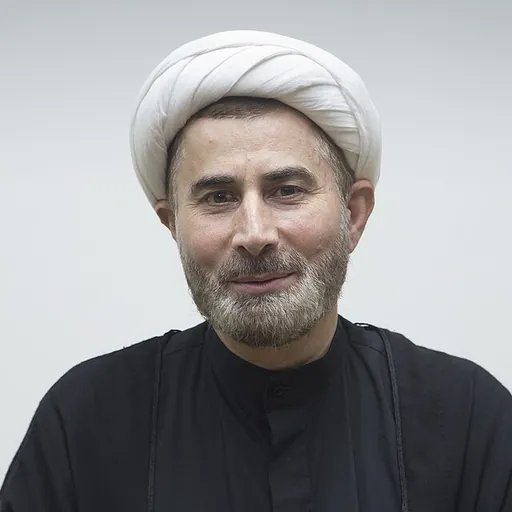
Mansour Leghaei
Australian Imam
About Mansour Leghaei
Born 1962. Mansour Leghaei is an Australian imam.
Dr Sheikh Mansour Leghaei (born 1962) is the founder and a director of the Imam Husain Islamic Centre and the School of Islamic Theology in Earlwood, Australia, serving as the imam from 1997 to 2010. He previously served in Nigeria, where in 1992 he opened an Education Centre called Ahul Bayt.
Leghaei is known in Australia and in the international media for his drawn out legal battle, spanning more than a decade, with the Australian Government and its Security Services. Leghaei challenged the government's security assessment of him in his bid to gain permanent residency. The case often draws parallels in the media and by his lawyers as a real life narrative of the novel The Trial by Franz Kafka, because the allegations, or the nature of the allegations against him, have never been revealed by the authorities and became a subject of discussion within the UNSW Law Journal
Leghaei is seen as a prominent member within the interfaith communities and was the chairman of the Marrickville Interfaith Round Table. Leghaei has attended a number of seminars to provide an Islamic perspective, including the Ecumenical Service on the Dead Sea Scrolls held at the Sydney Art Gallery, "Religious Therapy" on the occasion of World Cancer Day at the University of Sydney and "Spirituality of Great Traditions" at St. James' Church.
Early life and education Leghaei was born in Abadan, Iran,
Nigeria In 1992, Leghaei began his overseas religious services in Kano, Nigeria where a significant Shia minority exists. During this period Leghaei founded an education centre called Ahlul Bayt. However, in 1993, due to increasing violence in Nigeria, Leghaei returned to Iran with his family.
Australia According to documents rendered to the Federal Court of Australia, Leghaei with his family first arrived in Australia in 1994 under a Short Stay Business Visa and was employed as a Halal meat supervisor. The following year, he applied and successfully received a Religious Worker Visa which allowed him to work as a Muslim leader and travel internationally.
In 1996, Leghaei applied for permanent residency for himself and his family, and received bridging visas whilst their applications for residency were being reviewed. These bridging visas did not permit international travel. who has been the Attorney-General of Australia, but at the time was an opposition backbencher. McClelland, described Leghaei as: "an erudite man, conciliatory in tone and demeanour" who would be an "asset" to both the Muslim and Australian communities.
In 1997, Leghaei was refused permanent residency on the grounds that he had been assessed as a “risk to the national security of Australia.” In his appeal, Leghaei obtained a second character reference from McClelland. Despite being aware of the security concerns surrounding Leghaei,
Between 1997 and 2002, Leghaei pursued review proceedings and a formal assessment was carried out by ASIO. The substance of the assessment was that Leghaei was "directly or indirectly a risk to Australian national security." These appeals failed because as a non-citizen of Australia, Leghaei was not entitled to natural justice or procedural fairness for the reason of national security considerations,
After the failed appeals, Leghaei's next option was ministerial intervention by the then Immigration Minister, Chris Evans. A number of support rallies were organised for Leghaei, including a rally outside the Parliament House of Australia in Canberra, where more than 1000 supporters attended. and the International Covenant on Civil and Political Rights (ICCPR) also informed the Australian Government that "deporting Dr Leghaei was contrary to the right to a fair hearing".
Nevertheless, in mid May 2010, Leghaei's bridging visa was not extended and he was given six weeks to leave Australia. Leghaei complied by leaving on 27 June 2010, along with his wife and youngest child.
In June 2015, the Imam Husain Islamic Centre was to host an overseas speaker, Farrokh Sekaleshfar, who supports the death penalty for homosexuals in certain cases. Sekaleshfar voluntarily left Australia.
Legal fight Due to the nature of the allegations and the law and rights entitled to individuals of non–permanent residency, ascertaining the particulars of the accusations against Leghaei has been limited to Freedom of Information requests Leghaei's legal challenge of the government security assessment has been limited to a case built by ASIO that centred on the basis that he is "suspected of acts of foreign interference", the details of which have never been disclosed to the public nor to Leghaei, and according to media analysis are "the stuff we are not allowed to know". The integral part of his judgement, dealing with the evidence, was kept secret.
Leghaei's future return to Australia rested with the appeal by his lawyers to the UN who investigated the case further.
The UN Human Rights Committee established Australia's actions constituted an arbitrary interference with Leghaei's family, in breach of the International Convention on Civil and Political Rights ICCPR and summarised in the Committee report, "In light of the 16 years of lawful resident and long-settled family life in Australia and the absence of any explanation from the state party on the reasons to terminate the author’s right to remain, except for the general assertion that it was done for ‘compelling reasons of national security’, the committee finds that the state party’s procedure lacked due process of law.”
The report further highlighted further breaches in particular article 17 of the ICCPR, which said Australia was obliged to provide Leghaei “with an effective and appropriate remedy, including a meaningful opportunity to challenge the refusal to grant him a permanent visa; and compensation”. President of the International Progress Organization, Hans Köchler noted, "There can be no fair hearing of the case if the authorities refuse to disclose the allegations against Sheikh Mansour. We appeal to the government of Australia to revoke this decision." Chandra Muzaffar, a Malaysian political scientist, Islamic reformist and activist said "The impending deportation of Sheikh Mansour Leghaei is a travesty of justice. There is no doubt at all that his human rights have been violated."
eHawza
In 2008, Leghaei founded eHawza, an electronic Hawza program (Islamic Seminary) in English, enabling students to study by distance education, for a Diploma in Islamic Theology.
It contains over 500 academic lectures presented in English by Leghaei on a wide variety of topics, as well as over 5,000 pages of written resources.
Awards and recognition Leghaei has received a number of accolades, including a Community Service Award from the Australian MEFF Consortium Inc in 2000. At Sydney Airport, before departure: "My body will depart Australia but definitely my soul and my spirit will remain here forever." Asked if he would ever return to Australia: "My family is there; my community is there; my heart is there. I consider myself Australian."
Don’t just read it —
keep it.
Full-length biographies made to live with: read them, listen on the way to work, watch them tonight.
- E-book
- Audio
- Video
Instant download · yours to keep · every purchase keeps this site free
Important facts
People in Mansour Leghaei's life
Named in this biography and alive at the same time



Related people
Same field, nearest in time

Contemporaries
People whose lives overlapped Mansour Leghaei's



Frequently asked questions
Who is Mansour Leghaei?
Australian Imam
When was Mansour Leghaei born?
Mansour Leghaei was born on 14 May 1962 in Abadan.
What is Mansour Leghaei's occupation?
Mansour Leghaei is an imam.
What nationality is Mansour Leghaei?
Mansour Leghaei is Australian.
Sources & further reading
Cite this page
APA: Biography.guide. (2026). Mansour Leghaei. https://biography.guide/mansour-leghaei/
MLA: "Mansour Leghaei." Biography.guide, https://biography.guide/mansour-leghaei/.
Chicago: "Mansour Leghaei." Biography.guide. https://biography.guide/mansour-leghaei/.
Data last updated: 2026-09-21 · Spot an error? Report a correction.
Portrait: Wikimedia Commons · author & licence
Page generated 2026-09-27 05:00 UTC