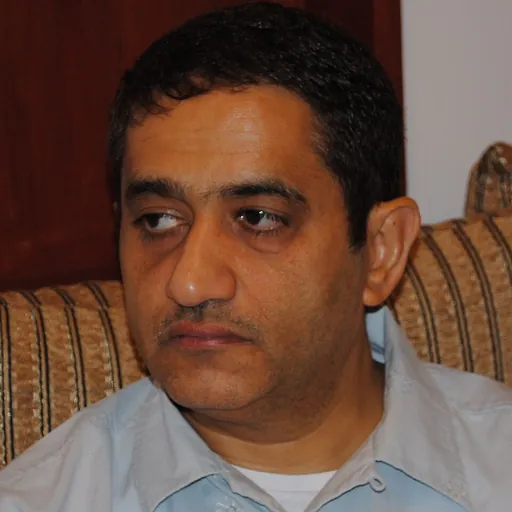
Mansoor Al-Jamri
Bahraini journalist, author, and activist (born 1961)
About Mansoor Al-Jamri
Born 1961. Mansoor Al-Jamri is a journalist and editor-in-chief.
organization = Al-Wasat awards = spouse = Reem Khalifa parents = party = relatives = children = education = Unbulleted list|PhD in Mechanical Engineering (Paisley University)|MSc in Management (Bristol University)
Early life and education
Mansoor al-Jamri was born in Bahrain on 17 December 1961. Al-Jamri's father Sheikh Abdul Amir is a Shia cleric who became the leader of the opposition and the spiritual father of the Shia during the 1990s uprising in Bahrain. His mother, Zahra' is the grand daughter of the renovator Shia khatib Mulla Atiya al-Jamri. They were married in Bahrain in 1957. Abdul Amir was 20 and Zahra', his cousin's grand daughter was 16.
In his book Non-scattered memories of Najaf, al-Jamri describes the dire situation in Iraq following the rise of Ba'ath party in 1968. He writes that the "biggest tragedy" he witnessed was the deportation of Iraqis of Iranian origins, some of whom were his neighbors. Al-Jamri and his school colleagues were often forced to take part in pro and anti-Ba'athist protests.
Al-Jamri's first memories in Bahrain were during a visit with father during the month of Ramadan. Although he was mocked by other kids due to his partly Iraqi accent, al-Jamri said he was very happy with the visit as he found his village Bani Jamra much more "open" than Najaf. In 1973, al-Jamri returned to Bahrain with his family, spending 11 years of his life in Iraq. He said his father's decision to return to Bahrain was the "best news I have ever received" and that to him Bahrain represented "freedom and eternal joy".
In 1978, al-Jamri graduated from high school, technical sector. He studied mechanical engineering at the University of the West of Scotland (Paisley University) of which he holds the doctorate degree. Trouble followed al-Jamri during his visits to Bahrain as he was questioned by security forces in 1980, his passport withdrawn for a year in 1982 and in 1987 he was not able to find a job.
Al-Jamri is married to Reem Khalifa, a columnist and reporter working for Al-Wasat and the Associated Press. Unlike Mansoor, she follows the Sunni branch of Islam. She was described by The New York Times as a "woman of Western tastes".
Founding of Al-Wasat
In 1999, then-Emir (now King) Hamad bin Isa Al Khalifa began a reform process and in 2001 exiles were told they could come back. Rejecting an offer to become a cabinet minister and leaving his leading position in the opposition, al-Jamri returned from the United Kingdom in December 2001, eight months after his father had obtained a consent from the Emir to establish two newspapers. but al-Jamri received a personal invitation by the king and was given a large margin of freedom of expression. Al-Jamri, backed by 39 other private investors (US$5.3 million capital) had initially planned to establish two independent newspapers, Al-Wasat in Arabic and Gulf Observer in English. and is also "widely credited with being the first Bahraini newspaper to voice opposition views". According to Margaret Warner of PBS NewsHour, Al-Wasat is the "most popular and profitable newspaper" in Bahrain and al-Jamri's column is a "voice for non-sectarian moderation". In March, martial law was declared and Saudi troops were called in. Despite the hard crackdown and official ban, the protests continued.
Role of al-Jamri and Al-Wasat
During the uprising, Al Wasat was a voice for "moderation and prudence" that urged compromise from both sides That day Al-Wasat was printed by another newspaper. and the IAA released a 30-page report "detailing Al Wasat'''s alleged transgressions". On 4 April, Al-Wasat resumed publishing under the supervision of two Iraqi editors. Al-Jamri said before a trial session on 19 June that the fabricated news articles were sent to Al-Wasat from a Saudi IP address and that they were not verified properly due to the previous attacks on Al-Wasat. "It was a setup. We were framed into it, and later on attacked, using – using it as a launching pad for closing down the newspaper," al-Jamri said in a press interview. The advocacy group added that following al-Jamri's resignation, Al-Wasat's coverage of human rights violations decreased significantly. On 11 October, al-Jamri and his colleagues were found guilty by the court and fined US$2,650 each. Subsequently, al-Jamri received two international awards; the CPJ International Press Freedom Award in 2011 Al-Jamri also writes a daily column in Al-Wasat'' and regular articles on politics and human rights for other publications such as Carnegie Endowment for International Peace.
Don’t just read it —
keep it.
Full-length biographies made to live with: read them, listen on the way to work, watch them tonight.
- E-book
- Audio
- Video
Instant download · yours to keep · every purchase keeps this site free
Important facts
Family & relationships
People in Mansoor Al-Jamri's life
Named in this biography and alive at the same time


Related people
Same field, nearest in time





Contemporaries
People whose lives overlapped Mansoor Al-Jamri's

Frequently asked questions
Who is Mansoor Al-Jamri?
Bahraini journalist, author, and activist (born 1961)
When was Mansoor Al-Jamri born?
Mansoor Al-Jamri was born on 17 December 1961 in Bahrain.
What is Mansoor Al-Jamri's occupation?
Mansoor Al-Jamri is a journalist and editor-in-chief.
What nationality is Mansoor Al-Jamri?
Mansoor Al-Jamri's recorded nationality: Bahrain.
Sources & further reading
Cite this page
APA: Biography.guide. (2026). Mansoor Al-Jamri. https://biography.guide/mansoor-al-jamri/
MLA: "Mansoor Al-Jamri." Biography.guide, https://biography.guide/mansoor-al-jamri/.
Chicago: "Mansoor Al-Jamri." Biography.guide. https://biography.guide/mansoor-al-jamri/.
Data last updated: 2026-09-22 · Spot an error? Report a correction.
Portrait: Wikimedia Commons · author & licence
Page generated 2026-09-27 05:00 UTC