
About Mako Idemitsu
Born 1940. Mako Idemitsu is an American and Japanese video artist and filmmaker.
is a Japanese experimental media artist whose work includes films, videos, and installations. Her work examines gender roles, domestic life, and female identity within Japanese society.
Early life Mako Idemitsu was born in Ōta, Tokyo, Japan. Her father, Sazō Idemitsu, was a Japanese businessman, art collector, and founder of Idemitsu Kosan. Traditional gender expectations during her upbringing contributed to tensions with her father. Her decision to study abroad and pursue an artistic career led to conflicts with him, resulting in her disinheritance.
In her autobiography, Idemitsu writes that her father’s traditional views limited her and her family's independence. She has two sons from her marriage with Sam Francis, named Osamu and Shingo, the latter also eventually becoming a painter.
New York and California From 1963 to 1964, Idemitsu attended Columbia University in New York City. In her autobiography, she writes that she appreciated the multicultural environment of New York and the autonomy she experienced there.
Around 1965, she moved to California, living in Santa Monica and Los Angeles, where she remained until 1972. In 1965, she married painter Sam Francis, becoming his fourth wife.
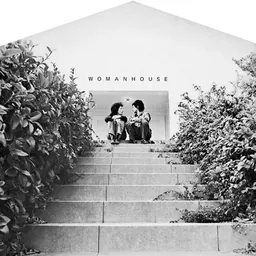
Her time in California exposed her to the counterculture of the 1960s. She later noted that gendered biases and male chauvinism persisted in these environments. She was associated with Womanhouse (1972), an art installation and performance project founded by Judy Chicago and Miriam Schapiro, marking the beginning of her engagement with the Women's Liberation Movement.
Tokyo Idemitsu returned to Japan with Francis and their sons in 1973, originally intending to remain for one year. Francis returned to the United States in 1974, while Idemitsu remained in Japan. The couple later divorced, and Francis remarried in 1985. After returning to Japan, she produced her At Santa Monica (1973-5) and At Any Place (1975-8) series, in which she makes use of and reflects on her earlier photographs taken in the United States. After switching from film to video, technical limitations of early video cameras encouraged a greater emphasis on narrative elements in her work. On her return to Japan, the cumbersome equipment and an inability to easily film outdoors led her to use indoor single-camera setups. and diary narration. Critics such as Scott Nygren have attempted to locate Japanese cultural origins within her work, claiming a similarity between her narrative form and that of Noh theatre.
Themes Idemitsu's work often incorporates feminist perspectives. Her art explores themes of gender roles, personal identity, and the construction of the self within societal frameworks. In particular, she critically examines the role of the modern Japanese family, highlighting how its traditional structure can contribute to the suppression of women's identities. Idemitsu cites Simone de Beauvoir as a major influence. Idemitsu's work, Kae, Act like a Girl (1993), was inspired by de Beauvoir's statement in The Second Sex that "People are not born as women. They become women." Idemitsu's early films include home movies of her sons and family life. This domestic setting remains a consistent theme in her films. A recurring motif in her works is disembodied forms; the television abstracting torsos, heads, or even eyes. These disembodied characters, usually female, may act indifferent to their protagonists or may actively oppress them. They can be interpreted both at face value as the mother, daughter, or wife of the protagonist or as a representation of their inner mind. For example, in Idemitsu's Great Mother trilogy, the disembodied women who represent the protagonist's mothers also represent the super-ego of the protagonist, personifying inescapable learned cultural values and societal norms.
Notable works Film and video What a Woman Made (1973) In What a Woman Made, a close up image of a tampon swirling in a toilet bowl slowly appears. Meanwhile, Idemitsu speaks about the roles, responsibilities, and expectations of women, which provides a critique of women's treatment in Japanese society. to construct a found-image video. Idemitsu balances images of Americana to suggest the journey of a foreigner through these iconic landscapes, searching for a place within them to belong. It reflects upon her own experiences moving from coast to coast.
Kiyoko's Situation (1989) The film Kiyoko's Situation depicts Kiyoko, a middle-aged housewife, whose repressed desire to express her identity emerges. Idemitsu portrays the struggle for housewives to be filial, care for their family's needs, and pursue their own creative ambitions. This film received awards from the Mention Special du Jury category "EXPERIMENTAL," La Mondiale de film et videos Quebec, Canada in 1991, and Prix Procirep Section Fiction, Festival International de Videos et Films, Centre Audiovisuels Simone de Beauvoir, Paris, France, in 1992.
Real? Motherhood (2000) Real? Motherhood is an installation that critically examines the myth of maternity. The single-channel installation repurposes Idemitsu's 1960s home movies, projecting images through a glass cradle. The moving images show Idemitsu holding one of her children, a baby suckling, mother and child looking at each other, and the baby's innocent smile. These are interspersed with black-and-white images of the ambiguous expression on the mother's face. Light falling from above onto the glass cradle conveys an impression of sanctity; the cradle is transmuted, for the mother, into an altar. However, Idemitsu suggests that this Western type of cradle also resembles a coffin, symbolizing mortality. 1993 "The First Generation, Women and Video,1970–75", Independent Curators, New York, US 2004 "Borderline Cases – Women On The Borderlines", Gallery A.R.T., Tokyo, Japan. A group exhibition featuring and thematising the negotiation of identities for female Asian diaspora artists; Park Young Sook and Yun Suk Nam (South Korea); and Theresa Hak Kyung Cha (South Korea-USA). 2018 "Institute of Asian Performance Art: Tokyo TOKAS Project Vol.1" (Curated by Victor Wang), Tokyo Arts and Space, Tokyo, Japan. A group exhibition with artists who utilised television, Zhang Peili and Park Hyun-ki.
Idemitsu's work has also been included in programmes for film festivals such as the Image Forum (1978, 1984, 1990), the Oberhausen Short Film Festival (1993), and the Singapore International Film Festival (1998). started collecting in 1979 Long Beach Museum of Art, Long Beach, US, started collecting in 1980 National Gallery of Canada, Ottawa, Canada Centre Georges Pompidou, Paris, France ZKM Centre for Art and Media, Karlsruhe, Germany University of Genova, Genova, Italy Fukuyama Museum of Art, Fukuyama, Japan Hiroshima City Museum of Contemporary Art, Hiroshima, Japan Kagoshima University, Kagoshima, Japan Kobe Design University, Kobe, Japan Mori Art Museum, Tokyo, Japan Meiji Gakuin University, Tokyo, Japan Miyagi Museum of Art, Miyagi, Japan Nagoya City Art Museum, Nagoya, Japan National Film Archive of Japan Museum of Modern Art, Toyama, Japan National Museum of Art, Osaka, Japan National Museum of Modern Art, Tokyo, Japan Tochigi Prefectural Museum of Fine Arts, Tochigi, Japan Tokushima 21st Century Cultural Information Center, Tokushima, Japan Tokyo Metropolitan Museum of Photography, Japan Ewha Womans University Museum, Seoul, Korea
Don’t just read it —
keep it.
Full-length biographies made to live with: read them, listen on the way to work, watch them tonight.
- E-book
- Audio
- Video
Instant download · yours to keep · every purchase keeps this site free
Important facts
People in Mako Idemitsu's life
Named in this biography and alive at the same time



Related people
Same field, nearest in time





Contemporaries
People whose lives overlapped Mako Idemitsu's



Frequently asked questions
Who is Mako Idemitsu?
experimental video art and film artist (born 1940)
When was Mako Idemitsu born?
Mako Idemitsu was born in 1940 in Tokyo.
What is Mako Idemitsu's occupation?
Mako Idemitsu is a video artist and filmmaker.
What nationality is Mako Idemitsu?
Mako Idemitsu is American and Japanese.
Sources & further reading
Cite this page
APA: Biography.guide. (2026). Mako Idemitsu. https://biography.guide/mako-idemitsu/
MLA: "Mako Idemitsu." Biography.guide, https://biography.guide/mako-idemitsu/.
Chicago: "Mako Idemitsu." Biography.guide. https://biography.guide/mako-idemitsu/.
Data last updated: 2026-09-22 · Spot an error? Report a correction.
Page generated 2026-09-27 05:23 UTC