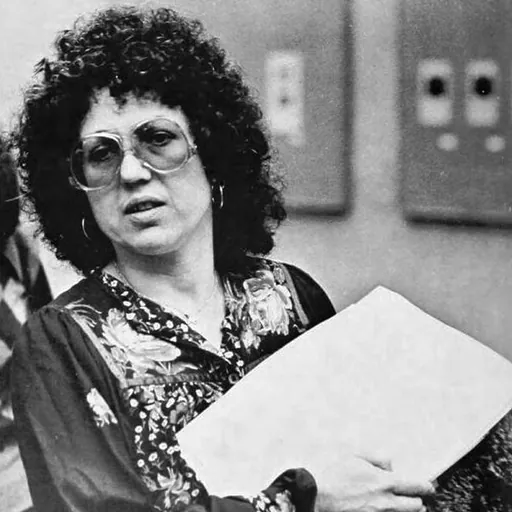
About Judy Chicago
Born 1939. Judy Chicago is an American painter, sculptor, writer, women's rights activist, serigrapher and installation artist.
Early life and family Judy Chicago was born Judith Sylvia Cohen to Arthur and May Cohen in Chicago, Illinois, in 1939. Her father came from a 23-generation-long lineage of rabbis, including the Lithuanian Jewish Vilna Gaon. Breaking family tradition, Arthur became a labor organizer and Marxist. During the American McCarthy era, Arthur was investigated, which made it difficult for him to find work and caused the family much turmoil.
May loved the arts and instilled her passion for them in her children. Aged three, Chicago began to draw and was sent to the Art Institute of Chicago to attend classes. By the age of five, Chicago knew that she "never wanted to do anything but make art" The couple lived in Greenwich Village for a time before returning in 1960 from Los Angeles to Chicago so she could finish her degree. Chicago married Gerowitz in 1961. She graduated with a Bachelor of Fine Arts degree in 1962 and was a member of Phi Beta Kappa society. Gerowitz died in a car crash in 1963, devastating Chicago and causing her to suffer an identity crisis for several years. She received her Master of Fine Arts from UCLA in 1964.
In 1968, Chicago was asked why she did not participate in the California Women in the Arts exhibition at the Lytton Center, to which she answered: "I won't show in any group defined as Woman, Jewish, or California. Someday, when we all grow up, there will be no labels." Chicago began working in ice sculpture, which represented "a metaphor for the preciousness of life," another reference towards her husband's death.
alt=Four octagonal shapes, each divided into 8 slices with gradating hues of red, pink, yellow, orange, purple.
In 1969, the Pasadena Art Museum exhibited a series of Chicago's spherical acrylic plastic dome sculptures and drawings in an "experimental" gallery. Art in America declared that Chicago's work was at the forefront of the conceptual art movement, and the Los Angeles Times described the work as showing no signs of "theoretical New York type art." Chicago would also experiment with performance art, using fireworks and pyrotechnics to create "atmospheres," which involved flashes of colored smoke being manipulated outdoors.
During this time, Chicago also began exploring her own sexuality in her work. She created the Pasadena Lifesavers, which was a series of abstract paintings that placed acrylic paint on Plexiglas. The works blended colors to create an illusion that the shapes "turn, dissolve, open, close, vibrate, gesture, wiggle," representing her own discovery that "I was multi-orgasmic." Chicago credited "Pasadena Lifesavers", as being the major turning point in her work in relation to women's sexuality and representation.
Name change As Chicago made her name as an artist and came to know herself as a woman, she no longer felt connected to the surname Cohen. This was due to her grief from the death of her father and the lost connection to her married name Gerowitz, after her husband's death. She decided to change her last name to something independent of being connected to a man by marriage or heritage.
Gallery owner Rolf Nelson nicknamed her "Judy Chicago" Chicago was appalled that her new husband's signature approval was required to change her name legally.
Career 1970s Chicago is considered one of the "first-generation feminist artists," a group that also includes Mary Beth Edelson, Carolee Schneeman, and Rachel Rosenthal. They were part of the feminist art movement in Europe and the United States in the early 1970s to develop feminist writing and art.
In 1970, Chicago began teaching full-time at Fresno State College, hoping to teach women the skills needed to express the female perspective in their work. At Fresno, she planned a class that would consist only of women and decided to teach off campus to escape "the presence and hence, the expectations of men." She taught the first women's art class in the fall of 1970 at Fresno State College. It became the Feminist Art Program, a full 15-unit program, in the spring of 1971. This was the first feminist art program in the United States.
Later, Judy Chicago and Miriam Schapiro reestablished the Feminist Art Program at California Institute of the Arts. After Chicago left for Cal Arts, the class at Fresno State College was continued by Rita Yokoi from 1971 to 1973, and then by Joyce Aiken in 1973, until her retirement in 1992.
Chicago's image is included in the iconic 1972 poster Some Living American Women Artists by Mary Beth Edelson.
With Arlene Raven and Sheila Levrant de Bretteville, Chicago co-founded the Los Angeles Woman's Building in 1973. This art school and exhibition space was in a structure named after a pavilion at the 1893 World's Colombian Exhibition that featured art made by women from around the world. This housed the Feminist Studio Workshop, described by the founders as "an experimental program in female education in the arts". They wrote: "our purpose is to develop a new concept of art, a new kind of artist and a new art community built from the lives, feelings, and needs of women." During this period Chicago began creating spray-painted canvases, primarily abstract, with geometric forms on them. These works evolved, using the same medium, to become more centered around the meaning of the "feminine". Chicago was strongly influenced by Gerda Lerner. Chicago thought that female students often approach art-making with an unwillingness to push their limits due to their lack of familiarity with tools and processes, and an inability to see themselves as working people. "The aim of the Feminist Art Program is to help women restructure their personalities to be more consistent with their desires to be artists and to help them build their art-making out of their experiences as women." It took her five years to create and cost about $250,000 to complete. The embroidered table runners are stitched in the style and technique of the featured woman's time. Numerous other names of women are engraved in the "Heritage Floor" upon which the piece sits. The project came into fruition with the assistance of over 400 people, mainly women, who volunteered to assist in needlework, creating sculptures and other aspects of the process. When The Dinner Party was first constructed, it was a traveling exhibition. Through the Flower, her non-profit organization, was originally created to cover the expense of the creation and travel of the artwork. Jane Gerhard dedicated a book to Judy Chicago and The Dinner Party, entitled "The Dinner Party: Judy Chicago and The Power of Popular Feminism, 1970–2007."
Many art critics, including Hilton Kramer from The New York Times, were unimpressed by her work. Mr. Kramer felt Chicago's intended vision was not conveyed through this piece and "it looked like an outrageous libel on the female imagination." She stated that she sought refuge from public attention by moving to a small rural community and that friends and acquaintances took on administrative support roles for her, such as opening her mail, while she threw herself into working on Embroidering Our Heritage, the book documenting the project. She further said,
In 1996, Chicago and Woodman moved into the Belen Hotel, an historic railroad hotel in Belen, New Mexico which Woodman had spent three years converting into a home. and Russell Sage College. Judy Chicago famously said "If men could give birth, there would be millions of representations of the crowning." The installation reinterpreted the Genesis creation narrative, which focused on the idea that a male god created a male human, Adam, without the involvement of a woman.
Overlapping with Birth Project, Chicago started working independently on PowerPlay in 1982: a series of large-scale paintings, drawings, cast paper reliefs and bronze reliefs. What both the series, however, have in common is that their subject matters deal with issues rarely depicted in Western art. The PowerPlay series was inspired by Chicago's trip to Italy, where she saw the masterpieces of Renaissance artists representing the Western artistic tradition. As Judy Chicago wrote in her autobiographical book: “I was to be greatly influenced by actually seeing the major Renaissance paintings. Looking at their monumental scale and clarity led me to decide to cast my examination of masculinity in the classical tradition of the heroic nude and to do so in a series of large-scale oil paintings.”
The titles of the works such as Crippled by the Need to Control/Blind Individuality, Pissing on Nature, Driving the World to Destruction, In the Shadow of the Handgun, Disfigured by Power, etc., indicate Chicago's focus on male violent behaviour. However, the brightly coloured images of facial expressions and parts of male bodies express not only aggression and power but also vulnerability. Chicago's husband Donald Woodman posed for the piece Woe/Man. She depended “upon [her] own sense of truth, working from observation, experience, and, of course, [her] rage at how destructively so many men seem to act toward women and the world at large.”
The Holocaust Project In the mid-1980s Chicago's interests "shifted beyond 'issues of female identity' to an exploration of masculine power and powerlessness in the context of the Holocaust." Chicago's The Holocaust Project: From Darkness into Light (1985–93)
Chicago used the Holocaust as a prism through which to explore victimization, oppression, injustice, and human cruelty.
Over the next six years Chicago created works that explored the experiences of concentration camp victims.
In 2004, Chicago received a Visionary Woman Award from Moore College of Art & Design. She was named a National Women's History Project honoree for Women's History Month in 2008.
To celebrate her 25th wedding anniversary with Woodman, she created a Renewal Ketubah in 2010. Chicago also donated her collection of feminist art educational materials to Penn State University.
Chicago had two solo exhibitions in the United Kingdom in 2012, one in London and another in Liverpool.
She was interviewed for the 2018 film !Women Art Revolution. In an interview with Gloria Steinem in 2018, Chicago described her "goal as an artist" has been “to create images in which the female experience is the path to the universal, as opposed to learning everything through the male gaze."
From September 19, 2019, to January 20, 2020, the National Museum of Women in the Arts exhibited Judy Chicago—The End: A Meditation on Death and Extinction. “In nearly 40 works of painted porcelain and glass, as well as two large bronze sculptures, Chicago tackles human mortality and species extinction.”
In 2021, she was inducted into the National Women's Hall of Fame. A major retrospective exhibition, titled Judy Chicago: A Retrospective, was displayed at the De Young Museum in San Francisco in 2021; it was Judy Chicago's first retrospective.
Chicago's work was included in the 2021 exhibition Women in Abstraction at the Centre Pompidou.
In 2022, Chicago collaborated with Nadya Tolokonnikova to transform her What if Women Ruled the World? series into a participatory art project, enabled by blockchain with the hopes of spawning a Web3 community dedicated to gender rights.
Chicago strives to push herself, exploring new directions for her art; early in her career, she attended car-body school to learn to air-brush and has expanded her practice to include a variety of media including glass.
Her work was included in the 2024 exhibition Making Their Mark: Works from the Shah Garg Collection at the Berkeley Art Museum and Pacific Film Archive (BAMPFA).
Collections (selection) Chicago's artwork is held in the permanent collections of several museums including The British Museum, The Brooklyn Museum, The Getty Trust, The Los Angeles County Museum of Art, New Mexico Museum of Art, The National Gallery of Art, The National Museum of Women in the Arts, The Pennsylvania Academy of the Fine Arts, the Pérez Art Museum Miami, and The San Francisco Museum of Modern Art. Her archives are held at the Schlesinger Library at Radcliffe College, and her collection of women's history and culture books are held in the collection of the University of New Mexico.
Style and work Chicago drew inspiration from the 'ordinary' woman, a central focus of the early 1970s feminist movement. This influenced her work, notably in The Dinner Party, reflecting her fascination with textile work and craft often culturally associated with women. Chicago trained herself in "macho arts", taking classes in auto body work, boat-building and pyrotechnics. Through auto body work she learned spray painting techniques and the skill to fuse color and surface to any type of media, which would become a signature of her later work. The skills learned through boat building would be used in her sculpture work, and pyrotechnics would be used to create fireworks for performance pieces. These skills allowed Chicago to bring fiberglass and metal into her sculpture, and eventually she would become an apprentice under Mim Silinsky to learn the art of porcelain painting, which would be used to create works in The Dinner Party. Chicago also added the skill of stained glass to her artistic tool belt, which she used for The Holocaust Project. Since 2003, Chicago has been working with glass.
Collaboration is a major aspect of Chicago's installation works. The Dinner Party, Birth Project, and Resolutions were all completed as a collaborative process with Chicago and hundreds of volunteer participants. Volunteer artisans skills vary, often connected to "stereotypical" women's arts such as textile arts.
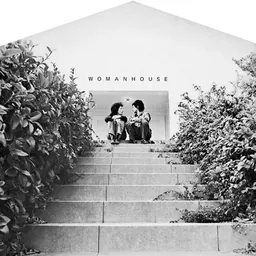
Through the Flower In 1978 Chicago founded Through the Flower, a non-profit feminist art organization. The organization seeks to educate the public about the importance of art and how it can be used as a tool to emphasize women's achievements. Through the Flower also serves as the maintainer of Chicago's works, having handled the storage of The Dinner Party, before it found a permanent home at the Brooklyn Museum. The organization also maintained The Dinner Party Curriculum, which serves as a "living curriculum" for education about feminist art ideas and pedagogy. The online aspect of the curriculum was donated to Penn State University in 2011. This awareness continued to grow as she recognized how society did not see women as professional artists in the same way they recognized men. Angered by this, Chicago channeled this energy and used it to strengthen her feminist values as a person and teacher. While most teachers based their lessons on technique, visual forms, and color, the foundation for Chicago's teachings were on the content and social significance of the art, especially in feminism. Stemming from the male-dominated art community Chicago studied with for so many years, she valued art based on research, social or political views, and/or experience. She wanted her students to grow into their art professions without having to sacrifice what womanhood meant to them. Chicago developed an art education methodology in which "female-centered content", such as menstruation and giving birth, is encouraged by the teacher as "personal is political" content for art. Chicago advocates the teacher as facilitator by actively listening to students in order to guide content searches and the translation of content into art. She refers to her teaching methodology as "participatory art pedagogy." In 1970 Chicago developed the Feminist Art Program at California State University, Fresno, and has implemented other teaching projects that conclude with an art exhibition by students such as Womanhouse with Miriam Schapiro at CalArts, and SINsation in 1999 at Indiana University, From Theory to Practice: A Journey of Discovery at Duke University in 2000, At Home: A Kentucky Project with Judy Chicago and Donald Woodman at Western Kentucky University in 2002, Envisioning the Future at California Polytechnic State University and Pomona Arts Colony in 2004, and Evoke/Invoke/Provoke at Vanderbilt University in 2005.
Books by Chicago The Dinner Party: A Symbol of our Heritage. Garden City, NY: Anchor Press/Doubleday (1979). . with Susan Hill. Embroidering Our Heritage: The Dinner Party Needlework. Garden City, NY: Anchor Press/Doubleday (1980). . The Birth Project. New York: Doubleday (1985). . Beyond the Flower: The Autobiography of a Feminist Artist. New York: Penguin (1997). . Kitty City: A Feline Book of Hours. New York: Harper Design (2005). . Through the Flower: My Struggle as a Woman Artist. Lincoln: Authors Choice Press (2006). . with Frances Borzello. Frida Kahlo: Face to Face. New York: Prestel USA (2010). . Institutional Time: A Critique of Studio Art Education. New York: The Monacelli Press (2014). . The Flowering: The Autobiography of Judy Chicago. Thames & Hudson USA (2021).
Explanatory notes
Don’t just read it —
keep it.
Full-length biographies made to live with: read them, listen on the way to work, watch them tonight.
- E-book
- Audio
- Video
Instant download · yours to keep · every purchase keeps this site free
Important facts
People in Judy Chicago's life
Named in this biography and alive at the same time





Related people
Same field, nearest in time

Contemporaries
People whose lives overlapped Judy Chicago's




Frequently asked questions
Who is Judy Chicago?
American artist, author, and teacher (born 1939)
When was Judy Chicago born?
Judy Chicago was born on 20 July 1939 in Chicago.
What is Judy Chicago's occupation?
Judy Chicago is a painter, sculptor, writer, women's rights activist, serigrapher and installation artist.
What nationality is Judy Chicago?
Judy Chicago is American.
Sources & further reading
Cite this page
APA: Biography.guide. (2026). Judy Chicago. https://biography.guide/judy-chicago/
MLA: "Judy Chicago." Biography.guide, https://biography.guide/judy-chicago/.
Chicago: "Judy Chicago." Biography.guide. https://biography.guide/judy-chicago/.
Data last updated: 2026-09-21 · Spot an error? Report a correction.
Portrait: Wikimedia Commons · author & licence
Page generated 2026-09-27 05:00 UTC