About Miriam Schapiro
Lived 1923 – 2015 (aged 91). Miriam Schapiro was an American painter, writer, printmaker, quiltmaker, graphic artist and sculptor.
Miriam "Mimi" Schapiro (November 15, 1923 – June 20, 2015) was a Canadian-born artist based in the United States. She was a painter, sculptor, printmaker, and a pioneer of feminist art. She was also considered a leader of the Pattern and Decoration art movement. Her artwork blurs the line between fine art and craft. She incorporated craft elements into her paintings due to their association with women and femininity. "The fan-shaped canvas, a powerful icon, gave her the opportunity to experiment … Out of this emerged a surface of textured coloristic complexity and opulence that formed the basis of her new personal style. The kimono, fans, houses, and hearts were the form into which she repeatedly poured her feelings and desires, her anxieties, and hopes". and manufactured "Teddy Bears". Schapiro later included dolls in her work, as paper cutouts and as photo reproductions of images from magazines, and in her statement accompanying an exhibition of her work at the Flomenhaft Gallery, she remarked that "In our country we don't feel about dolls as Europeans, Africans or Asians do," providing an anecdote that nuns at a Japanese temple explained their reason for being there was to care for the souls of the dolls. Her father, Theodore Schapiro, was an artist and an intellectual who was studying at the Beaux-Arts Institute of Design, in New York, when Schapiro was born. He was an industrial design artist who fostered her desire to be an artist and served as her role model and mentor. Her mother, Fannie Cohen, a homemaker, encouraged Schapiro to take up a career in the arts. At age six, Schapiro began drawing.
As a teenager, Schapiro was taught by Victor d’Amico, her first modernist teacher at the Museum of Modern Art. In the evenings she joined WPA classes for adults to study drawing from the nude model. In 1943, Schapiro entered Hunter College in New York City, but eventually transferred to the University of Iowa. At the University of Iowa, Schapiro studied painting with Stuart Edie and James Lechay. She studied printmaking under Mauricio Lasansky and was his personal assistant, which then led her to help form the Iowa Print Group. Lasansky taught his students to use several different printing techniques in their work and to study the masters' work in order to find solutions to technical problems.
At the State University of Iowa she met the artist Paul Brach, whom she married in 1946. After Brach and Schapiro graduated in 1949, Brach received a job in the University of Missouri as a painting instructor. Schapiro did not receive a position, and was very unhappy during their time there. By 1951 they moved to New York City and befriended many of the Abstract expressionist artists of the New York School, including Joan Mitchell, Larry Rivers, Knox Martin and Michael Goldberg. Schapiro and Brach lived in New York City during the 1950s and 1960s. Miriam and Paul had a son, Peter Brach, in 1955. Before and after the birth of her son Peter, Schapiro struggled with her identity and place as an artist. Miriam Schapiro's successive studios, after this period of crisis, became both environments for and reflections of the changes in her life and art.
Career
Miriam Schapiro's art career spanned over four decades. She was involved in Abstract expressionism, Minimalism, Computer art, and Feminist art. She worked with collage, printmaking, painting, – using women's craft in her artwork, and sculpture. Schapiro not only honored the craft tradition in women's art, but also paid homage to women artists of the past. In the early 1970s she made paintings and collages which included photo reproductions of past artists such as Mary Cassatt. In the mid 1980s she painted portraits of Frida Kahlo on top of her old self-portrait paintings. In the 1990s Schapiro began to include women of the Russian Avant Garde in her work. The Russian Avant Garde was an important moment in Modern Art history for Schapiro to reflect on because women were seen as equals.
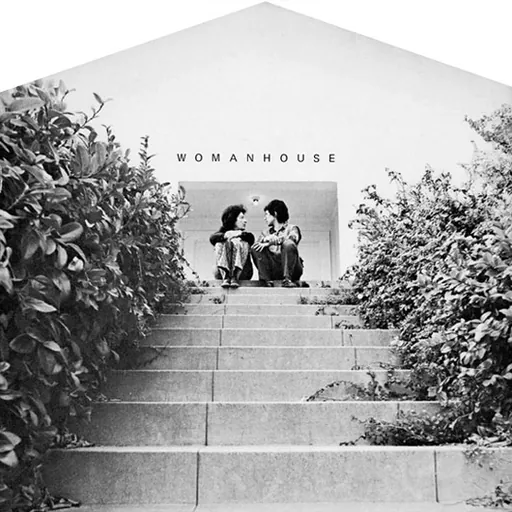
New York and Abstract Expressionism Paul Brach and Miriam Schapiro moved back to New York after graduate school in the early 1950s. Schapiro worked in the style of Abstract expressionism during this time period. Between 1953 and 1957, Schapiro created a substantial body of work. She created her own gestural language: "painting thinly and wiping out", in which the wiped area played a significant role as the painted area. Although these works were abstracted such as her work Beast Land and Plenty, Schapiro based them off of black and white illustrations of works by the "old masters". In December 1957, André Emmerich selected one of her paintings for the opening of his gallery. The Shrines enabled Schapiro to discover the multiple and fragmented aspects of herself. The O is also thought to symbolize the egg, which exists as the window into the maternal structure with outstretched limbs. "('House') became the repository of female fantasy and womanly dreams". Schapiro participated in the Womanhouse exhibition in 1972. Schapiro's smaller piece within Womanhouse, called "Dollhouse", was constructed using various scrap pieces to create all the furniture and accessories in the house. Each room signified a particular role a woman plays in society and depicted the conflicts between them.
Feminist Art Schapiro's work from the 1970s onward consists primarily of collages assembled from fabrics, which she called "femmages". In the early seventies, succeeding Schapiro's collaboration in Womanhouse, she made her first fabric collages in her studio in Los Angeles, which looked much like a room in a house. From the male technological world of computers Schapiro moved into a woman's decorated house. In this home-like studio, Schapiro monumentalized her fabric cabinet and its significance for women, in a number of large femmages, including A Cabinet for All Seasons.
After 1975, Schapiro returned to New York and with what she made after selling some paintings, she not only had a room but a studio of her own. Decoration and "collaboration," are central to her artwork and both play a significant role in her house as well as in her studio.
Collaborations and Identity In the process of taking on different projects, Schapiro's studio expanded and eventually became portable, following her as she traveled from place to place. It was during the same time of her Oregon collaborative project with the nine women that Schapiro also created her first "Collaboration Series" with women artists of the past. This series combined reproductions of the work of Mary Cassatt and Berthe Morisot with colorful and sensuous fabric borders in patterns inspired by quilts.
Schapiro's works are held in numerous museum collections including the Smithsonian American Art Museum, the National Gallery of Art, the Museum of Modern Art, the Pérez Art Museum Miami, in Florida, and the Pennsylvania Academy of the Fine Arts. Her awards include the Distinguished Artist Award for Lifetime Achievement from the College Art Association and a 1987 Guggenheim Fellowship.
In 2023 her work was included in the exhibition Action, Gesture, Paint: Women Artists and Global Abstraction 1940-1970 at the Whitechapel Gallery in London.
Awards and honors 1982: Skowhegan Medal for Collage 1983: Honorary Doctorate of Fine Arts, College of Wooster, Wooster, OH 1987: Guggenheim Fellowship for Fine Arts in US and Canada 1988: Honors Award, The Women's Caucus for Art 1989: Honorary Doctor of Fine Arts, California College of Arts and Crafts, Oakland, CA 1992: Honors Award, National Association of Schools of Art and Design 1994: Honors Award, New York State NARAL 1994: Honorary Doctorate Degree, Minneapolis and Design, Minneapolis, MN 1994: Honorary Doctorate Degree, Lawrence University, Appleton, WI 2002: Lifetime Achievement Award, Women's Caucus for Art
List of major works (1963) Shrines Grey Art Gallery (1968) Big Ox No. 1 Brooklyn Museum (1972) Womanhouse (1972) Dollhouse, with Sherry Brody, Smithsonian American Art Museum (1972) Lady Genji's Maze (1978) Connection (1983) Feathered Fan, Pérez Art Museum Miami (1990) Conservatory (Frida and Me)
Don’t just read it —
keep it.
Full-length biographies made to live with: read them, listen on the way to work, watch them tonight.
- E-book
- Audio
- Video
Instant download · yours to keep · every purchase keeps this site free
Important facts
People in Miriam Schapiro's life
Named in this biography and alive at the same time





Related people
Same field, nearest in time

Contemporaries
People whose lives overlapped Miriam Schapiro's

Frequently asked questions
Who was Miriam Schapiro?
Canadian artist (1923-2015)
When was Miriam Schapiro born?
Miriam Schapiro was born on 15 November 1923 in Toronto.
When did Miriam Schapiro die?
Miriam Schapiro died on 20 June 2015 in Hampton Bays.
What was Miriam Schapiro's occupation?
Miriam Schapiro was a painter, writer, printmaker, quiltmaker, graphic artist and sculptor.
What nationality was Miriam Schapiro?
Miriam Schapiro was American.
Sources & further reading
Cite this page
APA: Biography.guide. (2026). Miriam Schapiro. https://biography.guide/miriam-schapiro/
MLA: "Miriam Schapiro." Biography.guide, https://biography.guide/miriam-schapiro/.
Chicago: "Miriam Schapiro." Biography.guide. https://biography.guide/miriam-schapiro/.
Data last updated: 2026-09-24 · Spot an error? Report a correction.
Portrait: Wikimedia Commons · author & licence
Page generated 2026-09-27 05:08 UTC