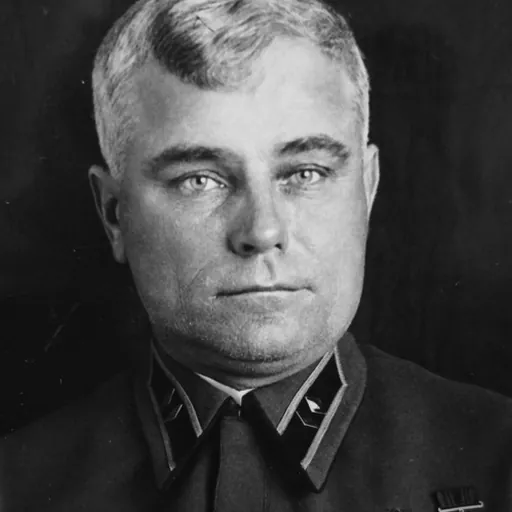
About Makar Teryokhin
Lived 1896 – 1967 (aged 71). Makar Teryokhin was a Russian military personnel.
Teryokhin became a non-commissioned officer in the Imperial Russian Army during World War I, then joined the Red Army during the Russian Civil War, becoming a platoon commander. He commanded companies and battalions during the interwar period and became a battalion, regiment and brigade commander in the Red Army's new mechanized forces. After serving in the Spanish Civil War as a Soviet advisor, Teryokhin commanded the 20th Tank Corps during the Battles of Khalkhin Gol in mid-1939 and was awarded the title Hero of the Soviet Union for his leadership. He commanded the 19th Rifle Corps during the Winter War, then returned to the Far East to command the 5th Mechanized Corps. During World War II he remained in the Far East, commanding the 2nd Red Banner Army. Teryokhin commanded the army during the Soviet invasion of Manchuria during August and September 1945. Postwar, he was a corps commander and assistant commander of two military districts before his retirement.
Early life, World War I, and Russian Civil War Teryokhin was born on 17 March 1896 in the village of Polyany in Ryazan Governorate to a peasant family. He graduated from seven grades, working as a shepherd and in a starch plant during his childhood and adolescence. In the winter he studied at a rural school, from which he graduated in 1910. From August 1915 he served in the Imperial Russian Army as a Ryadovoy and an Unteroffizier. Teryokhin was sent into combat in March 1917 in the Baltic, and reached the rank of Senior Unteroffizier before the Imperial Russian Army disintegrated following the Russian Revolution. He joined the Red Army in August 1918 and fought in the Russian Civil War. Teryokhin became a member of the Russian Communist Party (Bolshevik) in 1919. He successively served as a platoon instructor in a volost vsevobuch department, the armourer of a Cheka battalion in Kaluga, and a platoon commander, fighting against the Mamontov Raid, the Revolutionary Insurrectionary Army of Ukraine and the Tambov Rebellion. In 1920, he graduated from the Ryazan Infantry Courses.
Interwar period Teryokhin became commissar of the Kursk Military School in June 1921, and in October transferred to command a company of the 91st Preparatory Courses. He became a company commander in the 27th Oryol Rifle Regiment in December and became a battalion commander of the regiment in 1922. Teryokhin transferred to command a reconnaissance company in the 50th Rifle Regiment in May 1924 and became head of the regimental school in April 1926 after graduating from the Vystrel commander's improvement courses in 1925. In September 1927, he became a company commander in the 1st Moscow Rifle Division's 3rd Rifle Regiment.
World War II For the duration of World War II, Teryokhin remained in the Far East, commanding the 2nd Red Banner Army, which guarded the Manchurian border. It also formed units that were sent to the front. In early August 1945, it was transferred to the 2nd Far Eastern Front. He led the army during the Soviet invasion of Manchuria, which began on 9 August. Forward detachments from the army crossed the Amur on 9 and 10 August, capturing three bridgeheads. On 11 August, the army began crossing the Amur with assistance from the Amur Military Flotilla, and attacked the Japanese fortifications on the opposite bank. It fought in heavy fighting for the fortified regions of Sakhalian, Aihun, and Sunwu. On 17 August the Japanese troops surrendered, and around 17,000 men of the Japanese 123rd Infantry Division were captured. In the surrender ceremony, Japanese Lieutenant General Kitazawa Teijiro handed over his samurai sword to Teryokhin. After breaking through, the army crossed the Lesser Khingan and advanced to Qiqihar, where it linked up with the Transbaikal Front on 21 August, surrounding the Japanese Fourth Army.
Postwar Postwar, Teryokhin commanded the army until December 1945, then became commander of the 36th Guards Rifle Corps from July 1946 to 20 May 1948. In 1949, he graduated from Higher Academic Courses at the Higher Military Academy (formerly the Military Academy of the General Staff), after which he became assistant commander of the troops of the Belomorsky Military District and then the Northern Military District. Teryokhin retired in August 1954 and moved to Ryazan, where he died on 30 March 1967. He was buried at the city's Skorbyashchensky Cemetery.
A street in Polyana was named for Teryokhin.
Awards Teryokhin received the following awards and decorations: Hero of the Soviet Union Order of Lenin (3) Order of the Red Banner (2) Order of Kutuzov, 1st class Order of the Red Banner (Mongolian People's Republic) (1939)
Don’t just read it —
keep it.
Full-length biographies made to live with: read them, listen on the way to work, watch them tonight.
- E-book
- Audio
- Video
Instant download · yours to keep · every purchase keeps this site free
Important facts
Related people
Same field, nearest in time





Contemporaries
People whose lives overlapped Makar Teryokhin's


Frequently asked questions
Who was Makar Teryokhin?
Soviet general during Second World War
When was Makar Teryokhin born?
Makar Teryokhin was born on 17 March 1896 in Ryazan Governorate.
When did Makar Teryokhin die?
Makar Teryokhin died on 30 March 1967 in Ryazan.
What was Makar Teryokhin's occupation?
Makar Teryokhin was a military personnel.
What nationality was Makar Teryokhin?
Makar Teryokhin was Russian.
Sources & further reading
Cite this page
APA: Biography.guide. (2026). Makar Teryokhin. https://biography.guide/makar-teryokhin/
MLA: "Makar Teryokhin." Biography.guide, https://biography.guide/makar-teryokhin/.
Chicago: "Makar Teryokhin." Biography.guide. https://biography.guide/makar-teryokhin/.
Data last updated: 2026-09-22 · Spot an error? Report a correction.
Portrait: Wikimedia Commons · author & licence
Page generated 2026-09-27 05:01 UTC