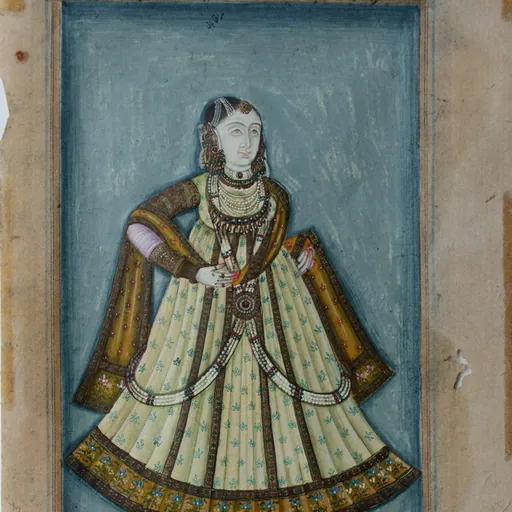
About Mah Laqa Bai
Lived 1768 – 1824 (aged 56). Mah Laqa Bai was a politician, singer, courtesan, poet, soldier and writer.
Mah Laqa Bai (7 April 1768 – August 1824), born Chanda Bai, and sometimes referred to as Mah Laqa Chanda, was an Indian 18th century Urdu poet, tawaif and philanthropist based in Hyderabad. In 1824, she became the first female poet to have a diwan (collection of poems) of her work, a compilation of Urdu Ghazals named Gulzar-e-Mahlaqa, published posthumously. She lived in a period when Dakhini (a version of Urdu) was making its transition into the highly Persianized Urdu. Her literary contributions provide insight into such linguistic transformations in southern India.
Mah Laqa Bai was an influential tawaif of the Deccan; the Nizam, ruler of Hyderabad, appointed her to the omarah (the highest nobility), and as a close affiliate at the court, she was discussed on state policies and accomplished assigned diplomatic engagements. An expert in spear throwing, tent pegging and archery, she accompanied Nizam II in three battles, hunting expeditions and camping. She moved in palanquin with guards and drummers announcing her arrival.
In 2010, her memorial in Hyderabad, which houses her tomb, caravanserai and a mosque, was restored using funds donated by the Federal government of the United States.
Life Mah Laqa Bai was born as Chanda Bibi on 7 April 1768 in Aurangabad in the present-day Maharashtra. Her mother was Raj Kunwar (born Mida Bibi) – a tawaif who migrated from Rajputana, and father was Bahadur Khan, who served as a Mansabdar (military official) at Mughal Emperor Muhammad Shah's court. Khan migrated from Delhi to Hyderabad Deccan where he met and married Raj Kunwar. Chanda Bibi was adopted by Kunwar's childless sister Mehtaab Ma who was the favored courtesan - almost a regular consort - of Nawab Rukn-ud-Daula, a Prime Minister of Nizam of Hyderabad.
Nawab Rukn-ud-Daula took a personal interest in Chanda Bibi's training and provided her with the best teachers. While growing up, she had access to a well-endowed library and was exposed to the vibrant culture of Hyderabad. By the time she was 14, she excelled in horse riding and archery. It was second Nizam (Mir Nizam Ali Khan) who conferred her the title "Mah Laqa Bai". Due to her skills, she accompanied the Nizam II in three wars; dressed in male attire, she was noted for bow and javelin skills in the wars. Owing to her contributions, the Nizams awarded her with Jagir (lands) on various occasions, that include the neighborhoods of Hyderguda, Chanda Nagar, Syed pally and Adikmet. On one occasion, she was conferred the title of Mah Laqa — meaning "Visage of the Moon". Though she never married, she was in love with Raja Rao Ranbha Bahadur (the Maratha military chief who led a cavalry of 20,000 army men, fought against Maratha Empire under the second Nizam and became his favourite Amir-ul-Umra), and used to admire Captain Sir John Malcolm (an assistant of James Achilles Kirkpatrick, the British Resident at Hyderabad).
Mah Laqa Bai (left) and Raja Rao Ranbha (right) playing Holi. All three, including Khushhal Khan, are identified by inscriptions. From the Ragadarshan (c. 1804).
She was an influential woman in the court of the second and third Nizam of Hyderabad. At that time, she was the only woman to be given recognition publicly in Hyderabad State. In addition, she was appointed to the omarah, the highest nobility. Mah Laqa was frequently consulted by the rulers of the state on policy matters. She was also a tawaif while the Nizams held court. She was a mistress of the Prime Ministers of the Nizams. She died in Hyderabad in August 1824.
Accomplishments Poetry
Mah Laqa was influenced by the literary work of mystic poet Siraj Aurangabadi (1715–1763), and learned poetry from Nawab Mir Alam who later became the Prime Minister of Hyderabad State. Her first language was Urdu, and she was also fluent in Arabic, Persian and Bhojpuri languages. The Diwan e Chanda is a manuscript collection of Mah Laqa's 125 Ghazals, compiled and calligraphed by her in 1798. It was signed and gifted to Captain Malcolm on 18 October 1799, during a dance performance at Mir Alam's residence. It is now preserved in the British Museum.
Her pen name was Chanda. The Urdu words Bulbul (songbird), Gul (rosebud) and Saqi (one who serves wine) recurred as themes in her ghazals. and a great-grandson of the Tansen, the maestro of the Mughal court. She excelled in Ghazal singing in multiple raga (melodic modes) and Taal (rhythms); she was adept at the Yaman raga and Khayal Tappa which she used to sing at special occasions. Mah laqa preferred using Bhimpalasi raga in romantic Ghazals. When singing Sufi songs she used Dhrupad raga mixed with taal chautala and raga Bhairavi. According to Pallabi Chakravorty and Nilanjana Gupta suggests in their book Dance Matters Too–(2018), there is no specific written work of Mah Laqa Bai's dance form, various poses captured in her portraits, her miniature paintings and based on the modern research she practised Deccan style of Kathak dance form, which does not exist in present times. Mah Laqa Bai patronised dance and music training centers, she endowed an institute led by her adopted daughter “Husn Laqa Bai” to continue a lineage of dance performers to learn Deccan style of Kathak. According to the miniature paintings exhibited and displayed by Salar Jung Museum at Google Arts & Culture in 2016, Mah Laqa Bai learned dance from master Panna Maharaj and Khushhal Khan.
Mah Laqa Bai established a cultural centre in which 300 girls were trained by her along with other masters. She sponsored and supervised the publication of Mahnama, a historical book about the revival period of Hyderabad State. Although Mah Laqa practiced Islam, she was influenced by the understanding of Hindu books and philosophy. One author studied her writings and said that "her verses had a distinct darbari ring in which she eulogized the king and nobles, a common style employed by poets during the 17th and 18th centuries."
Battles and expeditions Mah Laqa Bai mastered spear throw, tent pegging and archery at the age of fourteen, for which she is known as a brilliant performer and a skilled warrior. She participated in the three battles fought by Nizam II (Battle of Kolar—1781 AD, Battle of Nirmal—1782 AD and Battle of Pangal—1789 AD) mostly dressed up in a male battle attire and showing exceptional spear throw skills. She accompanied Nizam II on multiple hunting expeditions.
Mah Laqa Bai had expertise in diplomatic negotiations, for which the then Prime Minister of Hyderabad Mir Alam could not overturn her. She was very fond of horses, and her attachment with Maratha General Raja Rao Ranbha was culminated due to both's fondness of horses. Once on a diplomatic mission to the Maratha rulers court in Pune, Maratha Chief Minister—Nana Phadnavis was astonished by Mah Laqa Bai's profound understanding of Arabian horses, which she purchased from a French trader for herself and as a gift for Rao Ranbha The tomb was constructed in the Mughal and Rajasthani architectures style in the Char Bagh pattern. Along with mausoleum, the complex contains a pavilion in centre that is decorated intricately with stucco work, a Caravanserai, a mosque and two stepwells.
Legacy and influence
According to Sajjad Shahid, Mah Laqa Bai was the inspiration for Mirza Hadi Ruswa's famed novel Umrao Jaan Ada (1899), Umrao Jaan Ada is referred to as the first true novel of Urdu literature. Abdul Halim Sharar presented Mah Laqa Bai in his Urdu novel Husan Kay Dakoo (the robbers of beauty) (1913–1914) as a well-informed lady who got benefits from the modern educational system. Narendra Luther, posits that Mah Laqa Bai, the first women poet of India whose anthology was ever published "brought much pride to Hyderabad". EFLU Hyderabad heritage well was named after her. It was originally called as Mah Laqa Chanda Bai's well.
Don’t just read it —
keep it.
Full-length biographies made to live with: read them, listen on the way to work, watch them tonight.
- E-book
- Audio
- Video
Instant download · yours to keep · every purchase keeps this site free
Important facts
People in Mah Laqa Bai's life
Named in this biography and alive at the same time

Related people
Same field, nearest in time



Contemporaries
People whose lives overlapped Mah Laqa Bai's




Frequently asked questions
Who was Mah Laqa Bai?
poet
When was Mah Laqa Bai born?
Mah Laqa Bai was born on 7 April 1768 in Aurangabad.
When did Mah Laqa Bai die?
Mah Laqa Bai died on 1 August 1824 in Hyderabad.
What was Mah Laqa Bai's occupation?
Mah Laqa Bai was a politician, singer, courtesan, poet, soldier and writer.
What nationality was Mah Laqa Bai?
Mah Laqa Bai's recorded nationality: Hyderabad State.
Sources & further reading
Cite this page
APA: Biography.guide. (2026). Mah Laqa Bai. https://biography.guide/mah-laqa-bai/
MLA: "Mah Laqa Bai." Biography.guide, https://biography.guide/mah-laqa-bai/.
Chicago: "Mah Laqa Bai." Biography.guide. https://biography.guide/mah-laqa-bai/.
Data last updated: 2026-09-24 · Spot an error? Report a correction.
Portrait: Wikimedia Commons · author & licence
Page generated 2026-09-27 05:09 UTC