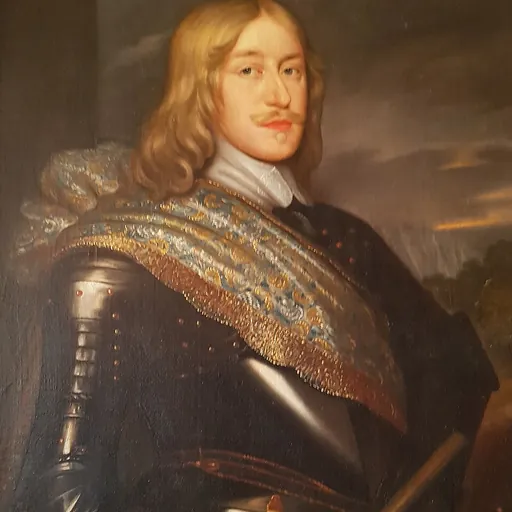
Magnus Gabriel De la Gardie
Swedish count, general and politician
About Magnus Gabriel De la Gardie
Lived 1622 – 1686 (aged 63). Magnus Gabriel De la Gardie was a Swedish politician, judge, land owner, military personnel, military leader and writer.
Count Magnus Gabriel De la Gardie (15 October 1622 – 26 April 1686) was a Swedish statesman and military man. He became a member of the Swedish Privy Council in 1647 and came to be the holder of three of the five offices counted as the Great Officers of the Realm, namely Lord High Treasurer, Lord High Chancellor and Lord High Steward. He also served as Governor-General in the Swedish dominion of Livonia.
Birth and ancestry
Magnus Gabriel De la Gardie was born on 15 October 1622. The place of his birth was Reval (present-day Tallinn), Estonia, which at the time was a Swedish dominion where Magnus Gabriel's father Jacob De la Gardie served as governor. Jacob De la Gardie, Count of Läckö, was a prominent military commander who served as Lord High Constable of Sweden from 1620 until his death in 1652. Father of Jacob, and grandfather of Magnus Gabriel, was Baron Pontus De la Gardie, a French mercenary who had been in Danish service but made a career in Sweden after having been captured by Swedish troops in 1565. Pontus married Sofia Gyllenhielm, the daughter of King John III, in 1580.
Magnus Gabriel's mother was Ebba Brahe, daughter of Lord High Steward Magnus Brahe and Brita Leijonhufvud. Ebba had a relationship with young King Gustavus Adolphus, probably during the years 1613–1615. Gustavus's mother, Christina of Holstein-Gottorp, ruined her son's wish to marry Ebba Brahe, who in 1618 instead married Jacob De la Gardie. Ebba and Jacob had 14 children, of whom seven lived to maturity. These seven were Magnus Gabriel, Maria Sofia, Jacob Casimir, Pontus Frederick, Christina Catharina, Axel Julius and Ebba Margaretha.
Career Being a member of a wealthy family of the highest esteem, De la Gardie was predestined for an eminent career. He received a thorough education from his teacher Mattias Björnklou, and was in 1639 elected rector illustris at Uppsala University, thanks to his ancestry; this position put a student on a board that oversaw the university, in the hopes that he could influence the government on economic matters favor of university through his relatives and other high level contacts. The next year, he travelled abroad to complete his training. Much of this period was spent in France and the Netherlands. When the Torstenson War between Sweden and Denmark broke out in 1643, De la Gardie returned to his native Sweden, and learned about warfare under the command of Field Marshal Gustav Horn. The mission was a success for De la Gardie, who upon his return to Sweden received distinctions of an unparalleled amount. At the coronation in 1650, De la Gardie was entrusted with carrying the royal banner. A year later, in 1651, he ended his first term in Livonia and was appointed Marshal of the Realm (riksmarskalk). Also in 1652, De la Gardie was appointed lawspeaker (lagman) of Västergötland and Dalsland.
Falling out of favor In 1653, De la Gardie fell out of favor with the queen. He and his family had to leave the court and for the rest of Christina's reign, De la Gardie lived on his manors in some kind of an exile. However, Queen Christina abdicated soon thereafter and was replaced on the throne by Charles Gustav, the brother of De la Gardie's wife Maria Eufrosyne. In a Sweden with great financial problems, these subsidies was, in Count De la Gardie's thinking, a more attractive way to improve the state's finances than a reduction, which would mean that lands granted the nobility would be reclaimed by the Crown. In connection with King Charles's coronation the same year, De la Gardie was accused of high treason, an accusation that soon was judged as unjustified. In principle, the entire Swedish elite of nobles was demolished. De la Gardie had tried to rally the members of the Privy Council to withstand the development leading to absolutism, but in vain. Maria Eufrosyne was a cousin of Queen Christina and a sister of the future king Charles X Gustav. Sources describe her as a "poor princess" that "benefited greatly by her wedding with the richest of the Swedish magnates".
Property owner and constructor
During his life, De la Gardie succeeded in adding large numbers of estates and castles to his possession. In his prime, he owned estates and castles in the provinces of Uppland, Närke, Västmanland and Västergötland. Among these were Karlberg, Drottningholm, Jakobsdal (now: Ulriksdal), Venngarn, Ekholmen, Kägleholm, Läckö, Traneberg, Mariedal, Katrineberg and Höjentorp. Moreover, De la Gardie owned large properties in Livonia, Finland, Pomerania and Mecklenburg, at the time all parts of Sweden.
At Läckö, De la Gardie ordered considerable extensions, starting in 1654. For example, a fourth floor was added on the keep, as were a castle chapel. The staff of the castle increased from 83 employees to 222 between 1662 and 1678, a sign of the development of the nobility's estates into own societies which was not uncommon at that time.
In 1666, De la Gardie made sure Sweden got an organized heritage conservation, the first of its kind in Europe.
Codex Argenteus The Codex Argenteus, also known as the "Silver Bible", is a 6th-century manuscript that was brought as war booty from Prague to Sweden at the end of the Thirty Years' War in 1648. Isaac Vossius, a Dutch librarian of Queen Christina took it to his home town. In 1662, De la Gardie bought the codex and in 1669, he donated it to the university, after first having it bound in a chased silver binding.
Silver throne A silver throne donated by De la Gardie holds a central position in Rikssalen in Stockholm Palace. The throne was a gift from De la Gardie to Queen Christina for her coronation in 1650. De la Gardie engaged Abraham Drentwett of Augsburg to produce it.
Cultural reference De la Gardie's ancestral home provides a chilling backdrop for the short story "Count Magnus" by Montague Rhodes James. However, the title character of the story bears little resemblance to the historical figure.
Ancestry
Don’t just read it —
keep it.
Full-length biographies made to live with: read them, listen on the way to work, watch them tonight.
- E-book
- Audio
- Video
Instant download · yours to keep · every purchase keeps this site free
Important facts
Family & relationships
People in Magnus Gabriel De la Gardie's life
Named in this biography and alive at the same time
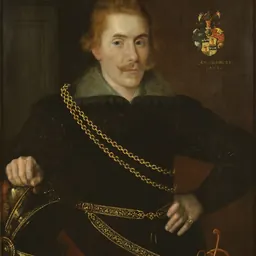



Related people
Same field, nearest in time

Contemporaries
People whose lives overlapped Magnus Gabriel De la Gardie's





Frequently asked questions
Who was Magnus Gabriel De la Gardie?
Swedish count, general and politician (1622-1686)
When was Magnus Gabriel De la Gardie born?
Magnus Gabriel De la Gardie was born on 15 October 1622 in Tallinn.
When did Magnus Gabriel De la Gardie die?
Magnus Gabriel De la Gardie died on 26 April 1686 in Venngarn Castle.
What was Magnus Gabriel De la Gardie's occupation?
Magnus Gabriel De la Gardie was a politician, judge, land owner, military personnel, military leader and writer.
What nationality was Magnus Gabriel De la Gardie?
Magnus Gabriel De la Gardie was Swedish.
Sources & further reading
· Wikipedia: Magnus Gabriel De la Gardie
· DBpedia: Magnus Gabriel De la Gardie
Cite this page
APA: Biography.guide. (2026). Magnus Gabriel De la Gardie. https://biography.guide/magnus-gabriel-de-la-gardie/
MLA: "Magnus Gabriel De la Gardie." Biography.guide, https://biography.guide/magnus-gabriel-de-la-gardie/.
Chicago: "Magnus Gabriel De la Gardie." Biography.guide. https://biography.guide/magnus-gabriel-de-la-gardie/.
Data last updated: 2026-09-21 · Spot an error? Report a correction.
Portrait: Wikimedia Commons · author & licence
Page generated 2026-09-27 05:00 UTC