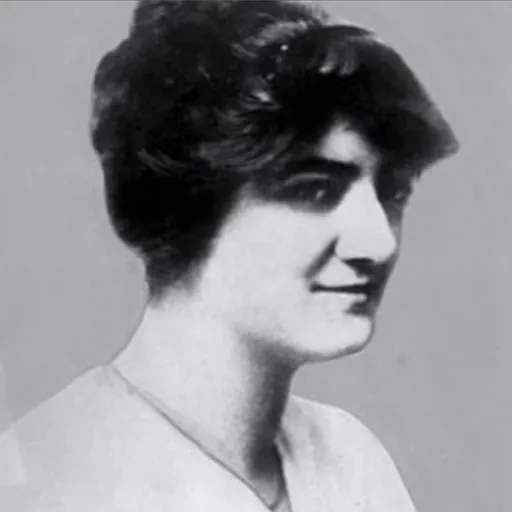
About Madge Oberholtzer
Lived 1896 – 1925 (aged 28). Madge Oberholtzer was an American teacher.
Madge Augustine Oberholtzer (November 10, 1896 – April 14, 1925) was an American woman whose rape and murder played a critical role in the demise of the second incarnation of the Ku Klux Klan. In March 1925, while working for the state of Indiana on an adult literacy campaign, Oberholtzer was abducted by D. C. Stephenson, Grand Dragon of the Indiana Klan. Holding her captive in his private train car, Stephenson raped and tortured her. Oberholtzer died from a combination of a staphylococcal infection from her injuries and kidney failure from mercury chloride poisoning, which she took while held captive in a suicide attempt.
Following the suicide attempt, Stephenson's men returned Oberholtzer to her home, assuming her injuries would soon prove fatal and believing their influential leader was immune to any prosecution. However, Oberholtzer regained consciousness long enough to give a signed statement to police. on January 12, 1925just three months before he murdered her. Gentry and Stephenson dressed Oberholtzer and told her they would be stopping in Hammond, where the three checked into the Indiana Hotel.
Trial Stephenson was indicted on April 3, 1925, on charges of rape, kidnapping, assault and battery with intent to murder, and malicious mayhem. Earl Gentry and Earl Klinck were charged with first degree murder and conspiracy to commit kidnapping. The doctor who had examined Oberholtzer testified that the injuries she received were sufficient to have killed her, as her wounds developed an infection that reached her lungs and kidneys. Stephenson's attorney claimed Oberholtzer had committed suicide, saying the rapist could not have anticipated her behavior. The prosecution countered to the effect that, based on medical testimony, prompt medical attention might have saved her life. During closing statements, prosecutor Charles Cox decried Stephenson as a "destroyer of virtue and womanhood". He said he wanted all three men to be found guilty of first degree murder: These men should be sent to the electric chair, the scaffold...The jury found Stephenson guilty of second degree murder, rape, and kidnapping, and the court sentenced him to life in prison. Gentry and Klinck were acquitted.
Aftermath The brutal attack on Oberholtzer so outraged most members of the Indiana Klan that entire lodges quit en masse, and membership dropped by the tens of thousands. The scandal destroyed the Klan in Indiana, and in the following two years, the KKK lost more than 178,000 members, nearly disappearing.
Denied a pardon in 1926, Stephenson started talking to the Indianapolis Times, giving the names of officials who had accepted bribes and payments from the Klan, prompting an investigation by the newspaper. The state of Indiana finally indicted several high-ranking officials, including Governor Edward L. Jackson and the head of the Republican Party in Marion County. Other local officials resigned when facing charges. The Times investigation revealed widespread political corruption, which helped destroy the Klan in Indiana and nationwide. By February 1928, Indiana Klan rosters had dropped to just 4,000, from a peak of more than 250,000 members in 1925.
In July 1934, Earl Gentry, 47, was shot and killed in Jefferson, Wisconsin. He had been living as a boarder with a woman named Carrie Gill for eight years. Carl Church, also known as George Slim King, confessed to having killed him after being paid $60 to do so by Gill. Church said he took Gentry "for a ride" and executed him gangland style. In his confession, he said he did not regret killing Gentry, who had been known as "Jefferson County's Public Enemy No. 1". Church said he was enraged after learning that Gentry had been mistreating Gill: During the time I was working for Carrie I knew that Earl Gentry was mistreating her and she had black eyes on various occasions. This I didn't like as she was extremely good to me and treated me like my own mother.
Gentry had repeatedly been arrested for various charges. He had once got angry at a drinking companion's remarks and stabbed him to death. However, every time, he was released after none of the witnesses were willing to testify against him out of fear for potential reprisals. In this regard, Church said he had performed a service for society by killing Gentry: He should have been killed a long time ago. I'm glad I did it I'd do it again. I got a million dollars worth of satisfaction out of removing him.Several days later, Church pleaded guilty to first degree murder and was sentenced to life in prison. In October 1934, a jury acquitted Gill of murder. In 1935, her brother, Ferdinand, pleaded guilty to being an accessory to murder for helping bury the body and was fined $100. In 1942, Church had his life sentence commuted by Governor Julius P. Heil to make him immediately eligible for parole. He was released in 1944 and moved to California.
In 1928, Klinck was arrested on charges of forging the name of fellow Klansman William Rogers in a false affidavit claiming that several men had paid Rogers to testify that he saw Senator James E. Watson with a Ku Klux Klan card. Klinck was found guilty of being an accessory before the fact to the false attesting of an affidavit. He was sentenced to one to three years in prison and fined $100.
Stephenson was paroled on March 23, 1950, but he violated the conditions of his parole by disappearing around September 25 of that year. He was captured in Minneapolis on December 15, and was ordered by the court in 1951 to serve another ten years. He was paroled on December 22, 1956, on the condition that he leave Indiana and never return.
In 1961, Stephenson was arrested in Missouri at age 70 on charges of sexually assaulting a 16-year-old girl, but the charges were dropped on grounds of insufficient evidence. He died five years later.
Representation in other media Actress Mel Harris portrayed Oberholtzer in the TV miniseries Cross of Fire (1989).
Don’t just read it —
keep it.
Full-length biographies made to live with: read them, listen on the way to work, watch them tonight.
- E-book
- Audio
- Video
Instant download · yours to keep · every purchase keeps this site free
Important facts
People in Madge Oberholtzer's life
Named in this biography and alive at the same time


Related people
Same field, nearest in time


Contemporaries
People whose lives overlapped Madge Oberholtzer's


Frequently asked questions
Who was Madge Oberholtzer?
American murder victim (1896–1925)
When was Madge Oberholtzer born?
Madge Oberholtzer was born on 10 November 1896 in Indianapolis.
When did Madge Oberholtzer die?
Madge Oberholtzer died on 14 April 1925 in Indianapolis.
What was Madge Oberholtzer's occupation?
Madge Oberholtzer was a teacher.
What nationality was Madge Oberholtzer?
Madge Oberholtzer was American.
Sources & further reading
· Wikipedia: Madge Oberholtzer
· DBpedia: Murder of Madge Oberholtzer
Cite this page
APA: Biography.guide. (2026). Madge Oberholtzer. https://biography.guide/madge-oberholtzer/
MLA: "Madge Oberholtzer." Biography.guide, https://biography.guide/madge-oberholtzer/.
Chicago: "Madge Oberholtzer." Biography.guide. https://biography.guide/madge-oberholtzer/.
Data last updated: 2026-09-22 · Spot an error? Report a correction.
Portrait: Wikimedia Commons · author & licence
Page generated 2026-09-27 05:03 UTC