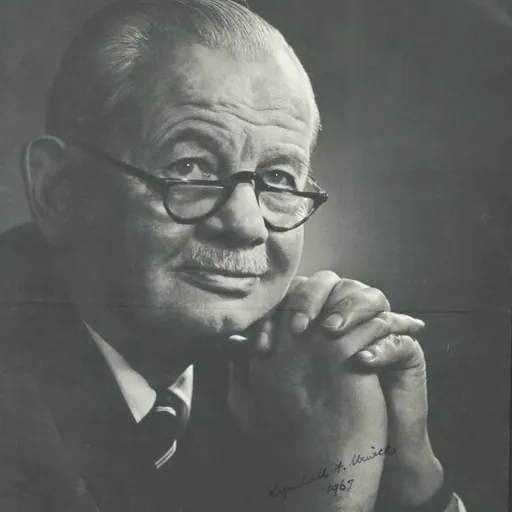
About Lyndall Fownes Urwick
Lived 1891 – 1983 (aged 92). Lyndall Fownes Urwick was a British economist, businessperson, author, intellectual and management consultant.
Lyndall Fownes Urwick (3 March 1891 – 5 December 1983) was a British management consultant and business thinker. He is recognised for integrating the ideas of earlier theorists like Henri Fayol into a comprehensive theory of management administration. He wrote an influential book called The Elements of Business Administration, published in 1943. With Luther Gulick, he founded the academic journal Administrative Science Quarterly.
Biography Youth and military service Urwick was born in Worcestershire, the son of a partner in Fownes Brothers, a long-established glove-making firm. He was educated at Boxgrove Primary School, Repton School and New College, Oxford, where he read History.
He saw active service in the trenches during the First World War, rising to the rank of Major, and being awarded the Military Cross. Though he did not himself attend the military Staff College at Camberley, his respect for military training would affect his outlook on management in later life. He attended the second conference of the International Industrial Relations Institute held at Girton College, Cambridge in 1928.
Urwick's own prolific writings on management truly began in this period. At this time, Urwick, along with his colleague at Rowntree's, Oliver Sheldon, became active members of the Taylor Society. but it provided Urwick the opportunity not only to lecture widely but to produce his books The Meaning of Rationalisation (1929) and The Management of Tomorrow (1933).
It was also this time that he became particularly keen to promote the writings of Henri Fayol to an English audience. UOP's slogan was Profit on Principle: A British Service for British Business in the application of the Principles of Direction and Control.
From the outset, UOP instituted a copy of the Bedaux System and Bedaux Unit, the Point System, in hundreds of factories and offices across Britain and further afield.
Urwick became a well-known enthusiast of management education and management history, and a public promoter of F.W. Taylor and scientific management. So much so that Harry Braverman attacked him in 1974's Labor and Monopoly Capital as the 'rhapsodic historian of the scientific management movement'.
In 1955 Urwick was awarded the Wallace Clark Award. In later years, Lyndall Urwick retired to Australia, where he died in 1983. His papers were donated to the Administrative Staff College, by then renamed Henley Management College. Using the work of General Sir Ian Standish Monteith Hamilton, Urwick maintained that limiting the number of subordinates reporting to an executive ( i.e. restricting the span of control) can do the following: improve executive effectiveness; reduce pressure, inefficiency and incompetence; produce better employee co-operation; and build morale and sense of unity within the organisation. His own view of the education required did not accord with the College as it was finally established, which concentrated on a three-month course for established executives. He would have preferred something much closer to the model of the American business school, involving a longer course and aimed at pre-experience students. It was a continuing frustration for Urwick that England's two ancient universities failed to promote management education.
Publications Books: Urwick, Lyndall Fownes. Organization as a technical problem. 1933. Metcalf, Henry C., and Lyndall Urwick, eds. Dynamic administration: the collected papers of Mary Parker Follett. Vol. 3. Routledge, 1942/2003. Urwick, Lyndall Fownes. The elements of administration. Harper & brothers, 1944. Urwick, Lyndall Fownes. Notes on the Theory of Organization. New York: American Management Association, 1952. Urwick, Lyndall Fownes and Edward Brech. The making of scientific management. University of Chicago Press Economics Books, 1954/1994. Urwick, Lyndall Fownes. The Pattern of Management. University of Minnesota Press, 1956. Urwick, Lyndall Fownes. The Golden Book of Management: A Historical Record of the Life and Work of Seventy Pioneers, 1956 Gulick, Luther, and Lyndall Urwick, eds. Papers on the Science of Administration. Routledge, 2012.
About Urwick Brech, Edward; Thomson, Andrew; Wilson, John F. Lyndall Urwick, Management Pioneer: A Biography. New York: Oxford University Press, 2010. ;
Don’t just read it —
keep it.
Full-length biographies made to live with: read them, listen on the way to work, watch them tonight.
- E-book
- Audio
- Video
Instant download · yours to keep · every purchase keeps this site free
Important facts
People in Lyndall Fownes Urwick's life
Named in this biography and alive at the same time






Related people
Same field, nearest in time


Contemporaries
People whose lives overlapped Lyndall Fownes Urwick's
Frequently asked questions
Who was Lyndall Fownes Urwick?
British management consultant (1891–1983)
When was Lyndall Fownes Urwick born?
Lyndall Fownes Urwick was born on 3 March 1891 in Malvern.
When did Lyndall Fownes Urwick die?
Lyndall Fownes Urwick died on 5 December 1983 in Sydney.
What was Lyndall Fownes Urwick's occupation?
Lyndall Fownes Urwick was an economist, businessperson, author, intellectual and management consultant.
What nationality was Lyndall Fownes Urwick?
Lyndall Fownes Urwick was British.
Sources & further reading
· Wikipedia: Lyndall Fownes Urwick
Cite this page
APA: Biography.guide. (2026). Lyndall Fownes Urwick. https://biography.guide/lyndall-fownes-urwick/
MLA: "Lyndall Fownes Urwick." Biography.guide, https://biography.guide/lyndall-fownes-urwick/.
Chicago: "Lyndall Fownes Urwick." Biography.guide. https://biography.guide/lyndall-fownes-urwick/.
Data last updated: 2026-09-22 · Spot an error? Report a correction.
Portrait: Wikimedia Commons · author & licence
Page generated 2026-09-27 05:00 UTC