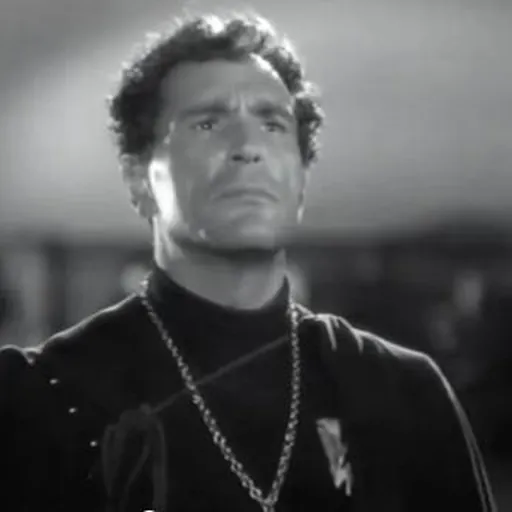
Luis Trenker
Italian-Austrian film director and actor
About Luis Trenker
Lived 1892 – 1990 (aged 97). Luis Trenker was an Italian and Austrian film director, screenwriter, film producer, writer, architect and film actor.
Luis Trenker (born Alois Franz Trenker, 4 October 1892 – 12 April 1990) was an Italian, South Tyrolean film producer, director, writer, actor, architect, alpinist, and bobsledder.
Biography Early life Alois Franz Trenker was born on 4 October 1892 in Urtijëi, Tyrol (, ) in the Austro-Hungarian Empire (in present-day northern Italy). His father Jacob Trenker was a painter from North Tyrol, and his mother Karolina (née Demetz) was from Urtijëi in Val Gardena. He grew up speaking two languages: German, the language of his father, and Ladin, the language of his mother. He attended the local primary school from 1898 to 1901, and then attended the Josefinum in Bolzano in 1902 and 1903. From 1903 to 1905, he attended the arts and crafts school in Bolzano, where he developed his skills as a woodcarver.
In 1912, he entered the Realschule in Innsbruck, where he studied Italian as a foreign language. There he began his middle school studies. During his high school years, he spent his holidays working for mountain guides and ski instructors. After his matriculation examinations in 1912, Trenker studied architecture at the Technical University in Vienna.
World War I At the start of World War I, Trenker fought as a cadet in an Austro-Hungarian heavy artillery unit on the Eastern Front in Galicia and Russisch-Polen. From 1915 to 1918, he fought in the mountain war against Italy, from 1916 in one of the Mountain Guide Companies in the Dolomites. At the end of the war he had achieved the rank of Lieutenant. He would write 23 books based on his war experiences, the most important of which were Fort Rocca Alta and Berge in Flammen, the latter of which was made into the 1931 film Mountains on Fire.
At the end of the war, Trenker made several unsuccessful attempts to start an architecture business in Bolzano. In 1924 he graduated from the Technical University of Graz, and then worked as an architect in Bolzano, forming a business partnership with the Austrian architect Clemens Holzmeister. In 1924, Trenker participated in the Winter Olympic Games in Chamonix as a member of the Italian five-man bobsled team. Under the leadership of Pilot Lodovico Obexer, they ended up in sixth place.
Film career Trenker's first contact with film came in 1921, when he helped director Arnold Fanck on one of his mountain films. The main actor could not perform the stunts required, and so Trenker assumed the leading role. He gradually assumed more roles on the set, and by 1928 was directing, writing, and starring in his own films. By then, he had abandoned his job as an architect to concentrate on his films.
In 1928 he married Hilda von Bleichert, the daughter of a fabrics manufacturer from Leipzig, with whom he had four children. In 1932 Trenker created (with Curtis Bernhardt and Edwin H. Knopf) a historical film The Rebel. Trenker stated that the film's plotline of a Tyrolean mountaineer Severin Anderlan leading a revolt against occupying French forces in 1809, during the Napoleonic Wars. The greatest Tirolean patriot Andreas Hofer was a proto-type of "Severin Anderlan" ... Trenker was designed to mirror what was happening in contemporary Germany as it rejected the terms of the Treaty of Versailles.
The main theme of Trenker's work was the idealization of peoples connection with their homeland and pointing out the decadence of city life (most clearly visible in his 1934 film Der verlorene Sohn (The Prodigal Son). This loosely played into the hands of Nazi propagandists, who seized upon the nationalistic elements of his work. However, Trenker refused to allow his work to be subverted as such and eventually moved to Rome in 1940 to avoid further governmental pressure. After a pair of documentary films, however, Trenker returned to Bolzano and stopped making films. The style he had developed in the thirties was not limited to nationalistic, folkloristic, and heroic clichés. His impersonation of a hungry, downtrodden immigrant in depression era New York was regarded as one of the seminal scenes for future Italian neorealism by the likes of Roberto Rossellini.
After World War II Trenker was accused of fascist opportunism after the war, but the charges were eventually dropped. In the 1950s, he returned to the movie industry, though by 1965 he was making primarily documentary films that focused on the Austrian province of Tyrol and South Tyrol (his homeland), which had become part of Italy. He also returned to writing about the mountains.
Later life In 1988 Hilda Trenker von Bleichert died. Luis Trenker died on 13 April 1990 in Bolzano at the age 97. He was buried in his family's plot at Urtijëi. In 1992, for the centennial of his birth, his native town of Ortisei dedicated a monument that shows him in mountaineer garb while looking at the Langkofel, a mountain he liked to climb. In March 2004, the Museum Gherdëina displayed a collection of Trenker's belongings from a bequest of his family.
Filmography Mountain of Destiny (1924), Der Berg des Schicksals, The Holy Mountain (1926), Der heilige Berg, The Great Leap (1927), Der große Sprung, Struggle for the Matterhorn (1928), Der Kampf ums Matterhorn, The Call of the North (1929), Der Ruf des Nordens, The Son of the White Mountain (1930), Der Sohn der weißen Berge, The Great Longing (1930), Die große Sehnsucht, Les Chevaliers de la montagne (1930), Knights of the Mountains, (1930), Mountains on Fire (1931), Berge in Flammen, Doomed Battalion (1932), The Rebel (1932), Der Rebell, The Prodigal Son (1934), Der Kaiser von Kalifornien (1936), Giovanni de Medici: The Leader (1937), Condottieri (1937), The Mountain Calls (1938), Der Berg ruft, The Challenge (1938), Love Letters from Engadin (1938), Liebesbriefe aus dem Engadin, Boundary Fire (1939), Urlaub im Schnee (1939 short), The Fire Devil (1940), Der König der Berge (1940 short), Pastor Angelicus (1942), Germanin (1943), Monte Miracolo (1945), Barrier to the North (1950), Barriera a settentrione, Duell in den Bergen, Aus König Laurins Rosengarten (1951), Bergsommer (1952 short), An der Dolomitenstraße (1952 short), (1952 short), Niemals mutlos (1952 short), Don't Surrender Never!, Gondelfahrt durch Venedig (1952 short), Venetian Walk, Lofotenfischer (1952 short), The Lofoten Fisher, Die Sphinx von Zermatt (1953 short), Kavaliere im Eis (1954 short), Escape to the Dolomites (1955), S.O.S. Zinnennordwand (1955 short), (1956), (1956), (1957), Unser Freund, der Haflinger (1957 short), Our Friend Haflinger, Zwei Wege, ein Gipfel (1961 short), His Best Friend (1962), His Best Friend, Vacanze scambio (1962), Luftsprünge (1969–70 television series), Skifreuden in den Dolomiten (1970 short), Ich filmte am Matterhorn (1970), Olympia (1971), Die Glückspirale (1971), Heimat aus Gottes Hand (1979), Hochkant (1982),
Don’t just read it —
keep it.
Full-length biographies made to live with: read them, listen on the way to work, watch them tonight.
- E-book
- Audio
- Video
Instant download · yours to keep · every purchase keeps this site free
Important facts
People in Luis Trenker's life
Named in this biography and alive at the same time



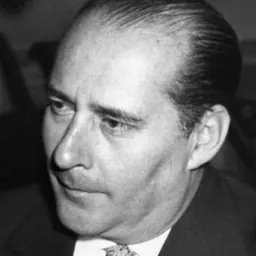
Related people
Same field, nearest in time


Contemporaries
People whose lives overlapped Luis Trenker's

Frequently asked questions
Who was Luis Trenker?
Italian-Austrian film director and actor (1892-1990)
When was Luis Trenker born?
Luis Trenker was born on 4 October 1892 in Urtijëi.
When did Luis Trenker die?
Luis Trenker died on 12 April 1990 in Bolzano.
What was Luis Trenker's occupation?
Luis Trenker was a film director, screenwriter, film producer, writer, architect and film actor.
What nationality was Luis Trenker?
Luis Trenker was Italian and Austrian.
Sources & further reading
Cite this page
APA: Biography.guide. (2026). Luis Trenker. https://biography.guide/luis-trenker/
MLA: "Luis Trenker." Biography.guide, https://biography.guide/luis-trenker/.
Chicago: "Luis Trenker." Biography.guide. https://biography.guide/luis-trenker/.
Data last updated: 2026-09-20 · Spot an error? Report a correction.
Portrait: Wikimedia Commons · author & licence
Page generated 2026-09-27 04:57 UTC