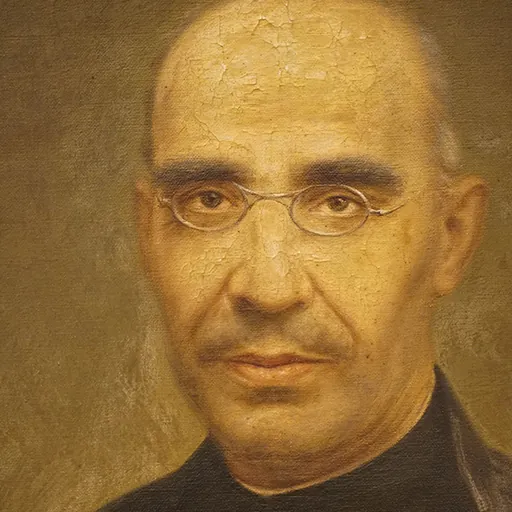
About Luis Martín
Lived 1846 – 1906 (aged 59). Luis Martín was a Spanish catholic priest and catholic theologian.
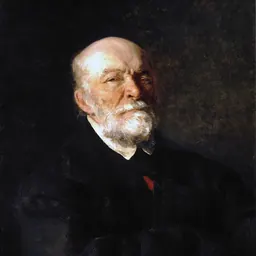
Luis Martín García (19 August 1846 – 18 April 1906) was a Spanish Jesuit, elected the twenty-fourth Superior General of the Society of Jesus.
Early years and formation The third of six brothers, Martín was born of humble parentage in Melgar de Fernamental. After primary education in his own village he entered the seminary of Burgos in 1858, where he spent six years. His intellectual inclination led him to join the Society of Jesus in 1864. He began his philosophy studies in Léon, but revolution in Spain and anti-clericalism forced him to move to France where he completed his courses, first in Vals, and then in Poyanne. There, he also taught humanities and rhetoric before doing his theology (1873–77). He was ordained on 14 September 1876.
Professor and rector Soon after the anti-religious law of Ferry (1880) compelled Jesuits to leave France. Fortunately the restoration of the Spanish monarchy in the 1870s had now made it possible to repatriate Jesuits back to Spain. On his return to Castile, Martín, though a man of letters, was redirected towards the Biblical studies and teaching. He became was made Rector of the Seminary of Salamanca from 1880 to 1884, then director of the journal El Mensajero del Corazon de Jesus, followed by the appointment as Superior of the Centre of Superior studies of Deusto-Bilbao (the future University of Deusto). He launched also the major projects of comprehensive history of the Society in Spain (Astrain), France (Fouqueray), England (Hughes), Germany , Italy (Tacchi-Venturi), Belgium-Netherlands (Poncelet), Portugal, etc. Towards the end of his life, after the election of Pope Pius X, Martin had to face the crisis of Modernism (Roman Catholicism). Modernists were hunted and expelled from the Church. So was it for George Tyrrell, English Jesuit, who was expelled from the Society and excommunicated in 1906 in spite of Martin's intervention. Many others were condemned if not expelled. The Bollandists were also in trouble. Membership of the Society steadily increased during his tenure: from 13,274 when Martin took office (1892) to 15,661 in 1906.
Illness and death Even at the beginning of his term Martín's physical health had been poor and it grew steadily worse with the years. In 1905, a tumor forced the amputation of his right arm. Pope Pius X granted him permission to celebrate mass despite his disability, a privilege for which he was most grateful. The cancer, however, soon invaded his lungs and he died in Rome, on 18 April 1906.
Writings Epistolae Selectae, Roma. Memorias del P. Luis Martin (ed. by J.R.Eguilor), 2 vol., Roma, 1988.
Don’t just read it —
keep it.
Full-length biographies made to live with: read them, listen on the way to work, watch them tonight.
- E-book
- Audio
- Video
Instant download · yours to keep · every purchase keeps this site free
Important facts
People in Luis Martín's life
Named in this biography and alive at the same time

Related people
Same field, nearest in time

Contemporaries
People whose lives overlapped Luis Martín's



Frequently asked questions
Who was Luis Martín?
Spanish author (1846-1906)
When was Luis Martín born?
Luis Martín was born on 19 August 1846 in Melgar de Fernamental.
When did Luis Martín die?
Luis Martín died on 18 April 1906 in Rome.
What was Luis Martín's occupation?
Luis Martín was a catholic priest and catholic theologian.
What nationality was Luis Martín?
Luis Martín was Spanish.
Sources & further reading
Cite this page
APA: Biography.guide. (2026). Luis Martín. https://biography.guide/luis-martin/
MLA: "Luis Martín." Biography.guide, https://biography.guide/luis-martin/.
Chicago: "Luis Martín." Biography.guide. https://biography.guide/luis-martin/.
Data last updated: 2026-09-23 · Spot an error? Report a correction.
Portrait: Wikimedia Commons · author & licence
Page generated 2026-09-27 05:06 UTC