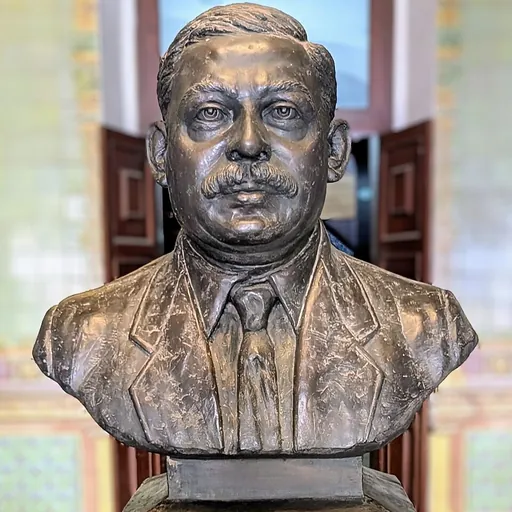
Luís de Menezes Bragança
Indo-Portuguese journalist, writer, politician and anti-colonial activist.
About Luís de Menezes Bragança
Lived 1878 – 1938 (aged 60). Luís de Menezes Bragança was a journalist and politician.
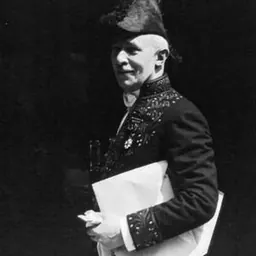
Luís de Menezes Bragança (15 January 1878 – 10 July 1938) was a Goan journalist, writer, politician and anti-colonial activist. He was one of the few Goan aristocrats who actively opposed the Portuguese colonisation of Goa. During his lifetime, Menezes Bragança was widely hailed around the Lusosphere (Portuguese speaking world) as "O Maior de todos" ("The Greatest of all Goans") and in the Indian mainland as "The Tilak of Goa".
Early life Luís de Menezes Bragança was born as Luís de Menezes on 15 January 1878 in Chandor, Salcette, to a Chardo family. His mother hailed from the illustrious Bragança clan of the same village.
He commenced his primary education in the Portuguese language in the town of Mapusa. He pursued his subsequent studies at the Rachol Seminary, where he studied philosophy and the tenets of the Catholic faith. After completing his higher secondary education at the Liceu de Goa with excellent grades, he joined the Escola Medico-Cirurgica de Goa. Although he initially found academic success there, poor health during his first year forced him to leave his medical studies unfinished. Following this, he dedicated himself to a deep study of economics, sociology, political philosophy, literature, and science, absorbing progressive ideas across these fields. Apart from his proficiency in Konkani and Portuguese, he possessed a strong command of English, French, and Marathi. Although raised a Roman Catholic, Menezes Bragança later became an agnostic.
In 1911, he founded O Debate (The Debate), of which he was the principal editor until 1921. During this period, he also strove to awaken the political consciousness and cultural identity of the Goan people. Menezes Bragança was a regular contributor to Pracasha (Light), a Konkani-language weekly wherein he wrote in great length on subjects such as freedom of thought, freedom of expression and freedom from oppression. His writings provided a great deal of information about the Indian independence movement to the Goan public, and as such, was avidly read by them for news about the Indian mainland.
From 1920 onwards, his articles, containing contemporary ideas, began appearing in the periodical O Pracasha. Through these publications, he championed human rights and emphasized that citizens must be free from social, political, and economic oppression to achieve comprehensive development. In this, he received the wide support of the Goan intelligentsia. He advocated the impartation of primary school education in Konkani, and blamed the Portuguese authorities' preoccupation with denationalisation of the Goan people for its failure to encourage the language. Menezes Bragança championed the cause of the less privileged sections of Goan society. In 1933, with the coming to power of the Estado Novo regime headed by António de Oliveira Salazar in Portugal, he placed himself at the head of the anti-colonialist movement in Goa. His brother-in-law, Tristão de Bragança Cunha, was also a prominent Indian nationalist. Some of his most notable works are Life of St. Luís de Gonzaga, Model and Protector of Youth (1893), The Neuter School (1914), The Comunidades and the Cult (1914), The Castes (1915), An Open Letter to Dr. Afonso Costa (1916), A Rev. Master Flayed (1916), India and her Problems (1924), Tourism in Goa (1927), Letter to an innocent (1927), and About an Idea (1928).
Death Towards the final years of his life, Menezes Bragança was persecuted by the Estado Novo regime for his outspoken criticism of their government. Fearing an outbreak of nationalist protests in Goa, the Portuguese government stationed troops at his grave to prevent any homage from being paid to his memory. A bust of Bragança exists in the Institute. Another bust of him is located in the Margao Municipal Garden. In 1965, the Bragança Memorial Committee published a volume of his selected writings under the title Prosas Dispersas. This book is based on the doctoral thesis of Mendes, awarded to her by the Goa University in 2012.
Don’t just read it —
keep it.
Full-length biographies made to live with: read them, listen on the way to work, watch them tonight.
- E-book
- Audio
- Video
Instant download · yours to keep · every purchase keeps this site free
Important facts
People in Luís de Menezes Bragança's life
Named in this biography and alive at the same time

Related people
Same field, nearest in time

Contemporaries
People whose lives overlapped Luís de Menezes Bragança's





Frequently asked questions
Who was Luís de Menezes Bragança?
Indo-Portuguese journalist, writer, politician and anti-colonial activist.
When was Luís de Menezes Bragança born?
Luís de Menezes Bragança was born on 15 January 1878 in Chandor.
When did Luís de Menezes Bragança die?
Luís de Menezes Bragança died on 10 July 1938 in Chandor.
What was Luís de Menezes Bragança's occupation?
Luís de Menezes Bragança was a journalist and politician.
What nationality was Luís de Menezes Bragança?
Luís de Menezes Bragança's recorded nationality: Portuguese India.
Sources & further reading
· Wikipedia: Luís de Menezes Bragança
· DBpedia: Luís de Menezes Bragança
Cite this page
APA: Biography.guide. (2026). Luís de Menezes Bragança. https://biography.guide/luis-de-menezes-braganca/
MLA: "Luís de Menezes Bragança." Biography.guide, https://biography.guide/luis-de-menezes-braganca/.
Chicago: "Luís de Menezes Bragança." Biography.guide. https://biography.guide/luis-de-menezes-braganca/.
Data last updated: 2026-09-22 · Spot an error? Report a correction.
Portrait: Wikimedia Commons · author & licence
Page generated 2026-09-27 05:02 UTC