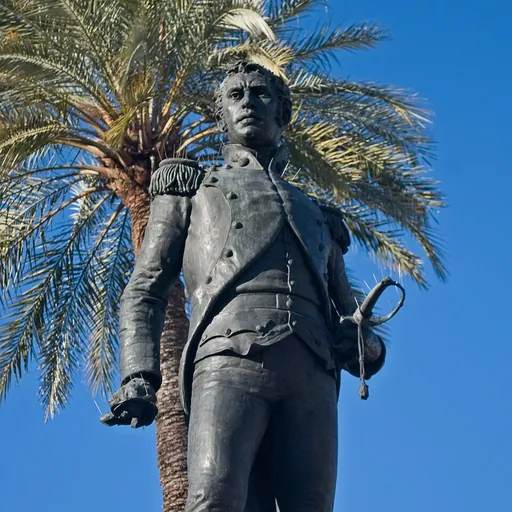
About Luis Daoíz y Torres
Lived 1767 – 1808 (aged 41). Luis Daoíz y Torres was a Spanish military personnel and military officer.
Captain Luis Daoiz y Torres (10 February 1767 – 2 May 1808) was a Spanish Army officer who was one of the leaders of the Dos de Mayo Uprising which resulted in the outbreak of the Spanish War of Independence. His surname was derived from the town of Aoiz in Navarre and he was descended from a long line of Spanish gentry with military service dating to the Reconquista. Daoíz's great grandfather married the daughter of the Count of Miraflores de los Angeles and he spent much of his early life in palaces owned by the family.
Born in Seville, after receiving a Catholic education Daoiz trained at the Royal School of Artillery in Segovia. He saw action against Moroccan forces in North Africa, where Daoiz was commended for his bravery and promoted to lieutenant. After serving against the French in the short-lived War of the Pyrenees, he was captured. After refusing to serve in the French army, Daoiz was imprisoned.
After his release he served on secondment to the Spanish Navy during the Anglo-Spanish War, participating in the defence of Cádiz and on convoy duty in the Atlantic Ocean, for which Daoiz was promoted to captain. Tiring of naval service, he rejoined his artillery regiment. His subsequent duties included assisting in the manufacture of new guns for horse artillery units, attending the signing of the Treaty of Fontainebleau with France and participating in the invasion of Portugal in 1807.
Daoiz returned to Madrid in 1808 and was a leader of the uprising on 2 May in which he assisted civilians resisting French efforts to forcibly relocate the Spanish royal family. His defence of the barracks at Monteleón was the only instance on that day in which the Spanish army fought the French and, although ultimately unsuccessful, it inspired a country-wide uprising against France. Daoiz died in the fighting and was subsequently commemorated as a national hero.
Ancestry
Luis's oldest known ancestor is Don Berenguer D'Aoiz, who was named for the town of Aoiz in Navarre and fought in the Reconquista of Spain from the Moors. Members of the family subsequently served in the militia, including Don García Garcés D´Aoiz who fought at the Battle of Las Navas de Tolosa in 1212, a decisive Christian victory and a turning point in the Reconquista. Other ancestors fought in the 15th century Granada War, the 16th century conquest of Naples and in 17th century Flanders. Daoíz's father was able to arrange the necessary paperwork for him to enter the elitist artillery corps which only permitted noblemen to take commissions. According to his entrance report he had a dark complexion, brown hair, large eyes and a small stature, being less than five feet tall. At the school Daoíz excelled at mathematics and sports, in particular saber fencing and was able to speak French, English, Italian and Latin in addition to his native Spanish. After Spain joined the First Coalition against the French First Republic, Daoíz begin fighting in the War of the Pyrenees in March 1794 but was captured in a French counterattack on 25 November. Later that year he was seconded to the Spanish Navy, which was short of trained officers, for service aboard the 74-gun ship of the line San Ildefonso. It is not known how the fighting started, but British consul John Hunter recorded that by 11 am French troops were firing musket volleys into the crowded square and fighting had spread across Madrid. French troops were dispatched to take possession of the Spanish barracks to secure their arms and ammunition.
Daoíz, the highest-ranking officer at the Monteleón barracks found himself in command of just 4 officers, 3 NCOs and 10 men.
According to Hunter, when the first French troops advanced up the street to take possession of the barracks, they were fired upon and several were killed before they halted to await reinforcements and occupy neighbouring buildings. Hunter claimed that Daoíz, who had been shot in the hip, continued to issue orders despite his wound and was wounded twice more whilst fighting the French with his sabre. Daoíz was 41 years old when he died, and had over 26 years of continuous service in the Spanish Army.
Aftermath
The French surgeon is said to have insisted on treating Daoíz before tending to his own men, but his efforts were in vain and Daoíz was buried in the Church of St Martin alongside his men. Members of the Junta went around the city asking for resistance to stop, and by 2am the next morning calm had been restored. After Daoíz's death his wife entered a convent in Seville. The monument originally served as a memorial to those who lost their lives on the Dos de Mayo but on 22 November 1985 King Juan Carlos I redesignated it in memory of all Spaniards who died in war and it now serves as Spain's national Tomb of the Unknown Soldier.
In 1852 a plaque was erected on the spot where Daoíz's house stood in Seville, being replaced in 1869 by a twice lifesize statue depicting the pivotal moment of the Dos de Mayo when Daoíz decided to disobey his orders and resist the French. A monument to Daoíz also stands in Segovia, where he studied at the artillery academy and in Madrid the two statues of lions that stand outside of the Spanish Congress of Deputies building are popularly known as Daoíz and Velarde. The Premio Daoíz military honour is awarded once every five years to an artillery officer in the Spanish Army. The award in memory of Daoíz is for services to the nation in the preceding five years and the honorary sabre is presented by the monarch in a ceremony held at the Alcázar of Segovia on 2 May.
Don’t just read it —
keep it.
Full-length biographies made to live with: read them, listen on the way to work, watch them tonight.
- E-book
- Audio
- Video
Instant download · yours to keep · every purchase keeps this site free
Important facts
People in Luis Daoíz y Torres's life
Named in this biography and alive at the same time

Related people
Same field, nearest in time


Contemporaries
People whose lives overlapped Luis Daoíz y Torres's





Frequently asked questions
Who was Luis Daoíz y Torres?
Spanish general (1767-1808)
When was Luis Daoíz y Torres born?
Luis Daoíz y Torres was born on 10 February 1767 in Seville.
When did Luis Daoíz y Torres die?
Luis Daoíz y Torres died on 2 May 1808 in Monteleón barracks.
What was Luis Daoíz y Torres's occupation?
Luis Daoíz y Torres was a military personnel and military officer.
What nationality was Luis Daoíz y Torres?
Luis Daoíz y Torres was Spanish.
Sources & further reading
· Wikipedia: Luis Daoíz y Torres
· DBpedia: Luis Daoíz y Torres
Cite this page
APA: Biography.guide. (2026). Luis Daoíz y Torres. https://biography.guide/luis-daoiz-y-torres/
MLA: "Luis Daoíz y Torres." Biography.guide, https://biography.guide/luis-daoiz-y-torres/.
Chicago: "Luis Daoíz y Torres." Biography.guide. https://biography.guide/luis-daoiz-y-torres/.
Data last updated: 2026-09-21 · Spot an error? Report a correction.
Portrait: Wikimedia Commons · author & licence
Page generated 2026-09-27 04:59 UTC