
About Ludwig von Siegen
Lived 1609 – 1680 (aged 70–71). Ludwig von Siegen was a German printmaker, graphic artist, mezzotinter, military personnel, painter and copper engraver.
Ludwig von Siegen (c. March 1609 Cologne – c. 1680 Wolfenbüttel, Germany) was a German soldier and amateur engraver, who invented the printmaking technique of mezzotint, a printing-process reliant on mechanical pressure used to print more complex engravings than previously possible. He was a well-educated aristocrat, and a Lieutenant-Colonel who commanded the personal guard of William VI, Landgrave of Hesse-Kassel (or Hesse-Cassel), and acted as a personal aide to the ruler, with the title kammerjunker or Chamberlain.
Early life Siegen came from an aristocratic family, and may have been born in the family castle of Von Sechten near Cologne, not in Utrecht, as traditionally believed, as he was baptised in Cologne March 1609. His mother had died (perhaps in his birth) and his father moved to Holland when Ludwig was young, apparently because of his Calvinist beliefs. Here his father remarried, to an Anna Perez, a widow from Spain, also adopting her son Marcus Perez. Anna died in 1619 leaving Johann to resolve the future of both boys (Ludwig and Marcus). He obtained a place in a German school for Marcus but Ludwig remained in Holland with his step-mother's family to avoid the dangers of the recently begun Thirty Years War in Germany.
Sechten was in Hesse-Kassel, and his father Johann von Siegen became an advisor to the Landgrave, Maurice, who in 1620 appointed him chancellor of the Collegium Mauritaneum, a school for young aristocrats which Siegen attended from 1621 to 1626. Then he studied law at the Hohe Schule in Herborn. His father moved to Holland again in 1627, when the new Landgrave William V dissolved the Collegium Mauritaneum.
Little is known about Siegen's life between 1629 and 1639, when he asked William V's widow, now Regent for her son William VI, for a position. He may have seen active military service in these missing years in the middle of the Thirty Years War. He was appointed kammerjunker, which as the Landgrave was a minor, may have been effectively a tutorial position, as well as head of the personal guard of the ruler.
By 1641 he had decided to convert to Catholicism, which in the atmosphere of the Thirty Years War would not have been compatible with his position in the strictly Calvinistic court of Hesse-Kassel. After some friction at court, he therefore repeated his father's move to Holland, although for the opposite reason. He moved to Amsterdam in 1641 and announced his conversion there, remaining in contact with his former employers and sending them works of art he produced, sometimes commissioned by them. His total mezzotint production was these seven plates, although he also produced paintings and medals.
Siegen's later career After he left Amsterdam in 1644, Siegen first entered the armies of the Catholic Bishop of Hildesheim, and then those of the Archbishop of Cologne. In 1654, he went into the service of the Archbishop-Elector of Mainz as a Colonel retired from active service and then to the Protestant Augustus the Younger, Duke of Brunswick-Lüneburg at Wolfenbüttel, where he remained after retirement. Most documents after this relate to lawsuits over estates and inheritances, the last mention being in 1676.
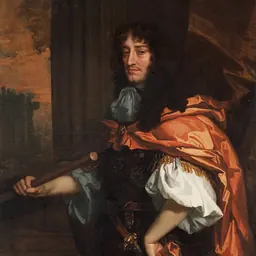
Prince Rupert of the Rhine Prince Rupert of the Rhine (i.e. of the Palatinate), a famous Royalist commander in the English Civil War, was the cousin of William VI of Hesse-Kassel, and the son of Elizabeth of Bohemia. Prince Rupert was also an amateur artist, and in about 1654 learned of the process, either from his cousin, or possibly from Siegen himself - whether they ever met is a point of scholarly controversy. A number of letters between Rupert and William referring to the technique survive from the period following 1654.
Rupert produced some stylish mezzotints himself, and through him, after his return to England with the English Restoration in 1660, the invention became known there, which was to be the main home of the technique. Rupert described it to John Evelyn, who published it (in very enigmatic terms) for the first time in 1662, crediting Rupert with the invention:
" Of the new way of Engraving, or Mezzo Tinto, Invented, and communicated by his Highnesse Prince RUPERT, Count Palatine of Rhyne, &c."
However Rupert probably did invent the "rocker", a wide curved tool with teeth, used to roughen a whole plate, which was an essential tool in the developed technique. Rupert's artistic assistant or tutor Wallerant Vaillant (1623–77) was the first to adopt the process commercially, in Amsterdam in the 1660s.
Don’t just read it —
keep it.
Full-length biographies made to live with: read them, listen on the way to work, watch them tonight.
- E-book
- Audio
- Video
Instant download · yours to keep · every purchase keeps this site free
Important facts
People in Ludwig von Siegen's life
Named in this biography and alive at the same time

Related people
Same field, nearest in time

Contemporaries
People whose lives overlapped Ludwig von Siegen's





Frequently asked questions
Who was Ludwig von Siegen?
German engraver (1609–1680)
When was Ludwig von Siegen born?
Ludwig von Siegen was born in 1609 in Cologne.
When did Ludwig von Siegen die?
Ludwig von Siegen died in 1680 in Wolfenbüttel.
What was Ludwig von Siegen's occupation?
Ludwig von Siegen was a printmaker, graphic artist, mezzotinter, military personnel, painter and copper engraver.
What nationality was Ludwig von Siegen?
Ludwig von Siegen was German.
Sources & further reading
· Wikipedia: Ludwig von Siegen
Cite this page
APA: Biography.guide. (2026). Ludwig von Siegen. https://biography.guide/ludwig-von-siegen/
MLA: "Ludwig von Siegen." Biography.guide, https://biography.guide/ludwig-von-siegen/.
Chicago: "Ludwig von Siegen." Biography.guide. https://biography.guide/ludwig-von-siegen/.
Data last updated: 2026-09-20 · Spot an error? Report a correction.
Page generated 2026-09-27 05:27 UTC