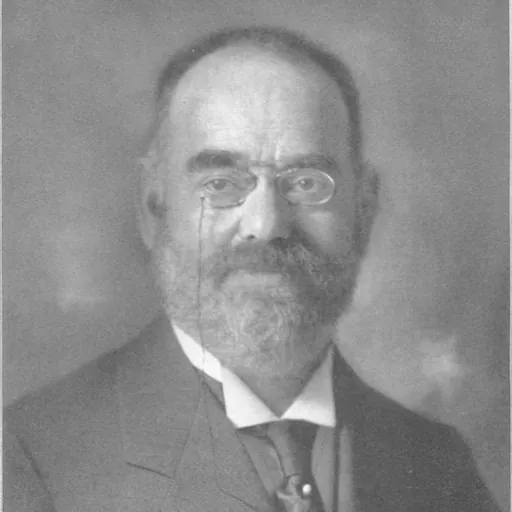
About Ludwig Edinger
Lived 1855 – 1918 (aged 62). Ludwig Edinger was a German anatomist, neurologist, psychiatrist, university teacher, physician and anatomy, known for Johann Wolfgang Goethe University Frankfurt am Main.
Ludwig Edinger (13 April 1855 – 26 January 1918) was an influential German anatomist and neurologist and co-founder of the University of Frankfurt. In 1914 he was also appointed the first German professor of neurology.
Biography Edinger was born into a Jewish family and grew up in Worms, where his father was a successful textile salesman and democratic congressman in the state parliament of Hesse-Darmstadt. His mother was the daughter of a physician from Karlsruhe. He was not ashamed that he started his career as a poor man. Indeed, he proposed free schooling for all children in 1873, but without success.
Edinger studied medicine from 1872 to 1877 in Heidelberg and Strasbourg. His studies into neurology began during his time as an assistant physician in Giessen (1877 - 1882). His habilitation was in 1881 about neurological researches. He became a docent for these themes. He worked in Berlin, Leipzig and Paris and opened his own practice for neurology in Frankfurt am Main in 1883.
Due to Edingers initiative in 1885, the pathologist Karl Weigert became director of the Dr. Senckenbergische Anatomie in Frankfurt. Weigert opposed antisemitism. Weigert gave his friend Edinger a place to work in his institute. In 1902, Edinger received enough space to start his own neurological department.
In 1909, after a dispute between Edinger and the Senckenberg foundation about the finances of the neurological institute, Edinger moved to the University of Frankfurt under the condition that he was responsible for the financing of the department. His problems had eased in 1886, when he married Anna Goldschmidt, the daughter of an old family of traditional Jewish bankers in Frankfurt; she received a large inheritance in 1906.
Edinger died suddenly on 26 January 1918 in Frankfurt of a heart attack. He had left instructions for his brain to be examined in his institute. The institute continued with the introduction of a foundation set-up by Edinger. The Neurology department of the Goethe University's Faculty of Medicine is named after him.
Edinger is credited with coining the terms "gnosis" and "praxis". These terms were later used in psychological descriptions of agnosia and apraxia. Also, he was the first to describe the ventral and dorsal spinocerebellar tracts and to distinguish the paleocerebellum from the neocerebellum.
Terms "Edinger's tract": Conductive pathway for basic perceptions of pain, temperature, pressure and touch. "Edinger-Westphal nucleus: The accessory nucleus of the 3rd oculomotor nerve. Named with Karl Friedrich Otto Westphal; Edinger described it in the human fetal brain (1885), while Westphal described it in the adult brain two years later.
Don’t just read it —
keep it.
Full-length biographies made to live with: read them, listen on the way to work, watch them tonight.
- E-book
- Audio
- Video
Instant download · yours to keep · every purchase keeps this site free
Important facts
People in Ludwig Edinger's life
Named in this biography and alive at the same time

Related people
Same field, nearest in time

Contemporaries
People whose lives overlapped Ludwig Edinger's





Frequently asked questions
Who was Ludwig Edinger?
German anatomist and neurologist (1855–1918)
When was Ludwig Edinger born?
Ludwig Edinger was born on 13 April 1855 in Worms.
When did Ludwig Edinger die?
Ludwig Edinger died on 26 January 1918 in Frankfurt.
What was Ludwig Edinger's occupation?
Ludwig Edinger was an anatomist, neurologist, psychiatrist, university teacher, physician and anatomy.
What was Ludwig Edinger known for?
Ludwig Edinger was known for Johann Wolfgang Goethe University Frankfurt am Main.
What nationality was Ludwig Edinger?
Ludwig Edinger was German.
Sources & further reading
Cite this page
APA: Biography.guide. (2026). Ludwig Edinger. https://biography.guide/ludwig-edinger/
MLA: "Ludwig Edinger." Biography.guide, https://biography.guide/ludwig-edinger/.
Chicago: "Ludwig Edinger." Biography.guide. https://biography.guide/ludwig-edinger/.
Data last updated: 2026-09-22 · Spot an error? Report a correction.
Portrait: Wikimedia Commons · author & licence
Page generated 2026-09-27 05:04 UTC