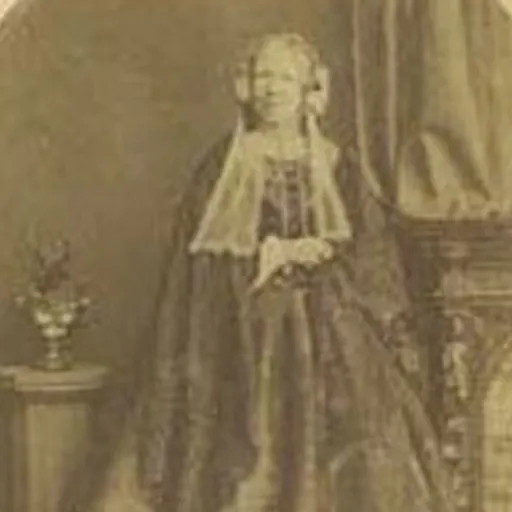
Lucy Sarah Atkins Wilson
British author and editor, specializing in children's scientific literature
About Lucy Sarah Atkins Wilson
Lived 1801 – 1863 (aged 61). Lucy Sarah Atkins Wilson was a writer.
Lucy Sarah Atkins Wilson (27 December 1801 – 25 January 1863) was a British writer and editor, specializing in scientific literature for children.
Life
Sarah Atkins was born to Samuel Atkins (d. 1821) and Ester Atkins (1776–1833) on 27 December 1801, in Chipping Norton, Oxfordshire, England. Born a Quaker, religion played a significant role throughout her life and had considerable influence in her writing. Her career as an author began in her early twenties, and focused on redacting and adapting literature regarding travel, history, and science for children. Her early works – The India Cabinet Opened (1821), Fruits of Enterprise (1821), and Botanical Rambles (1822), were successful, and remained in print for several editions. Their son, also called Daniel Frederick Wilson (1830–1918), was born on 10 November 1830 and baptized on 12 December 1830 at Worton.
Atkins changed her first name to Lucy upon being baptized for her marriage to a clergyman. Her books, therefore, are attributed to various combinations of her names, including Sarah Atkins, Lucy Wilson, and Sarah Atkins Wilson. Additionally, as was common at the time, many of her books were published under pseudonyms, such as 'A Lady,' or as the author of a previous one of her works, such as 'The Author of Botanical Rambles.' Her brief obituary in The Newcastle Courant remembers her contributions to literature, concluding that: "Her life was much devoted to works of piety and benevolence, and her loss will be deeply felt".
Literary influence Wilson was part of a small, British literary movement, led by women, to create instructional and amusing books regarding science, geography, and history, for children. Large type font and simple language gear the works towards younger readers, while her titles often explicitly address her audience. Like many other 19th century female writers, including Wakefield, Wilson was both driven and empowered by religion. Her Quaker upbringing and her eventual baptism into the Church of England, both brought her greater access to publishing and distributing. Quaker women had greater opportunity to exercise their voice, and Wilson capitalized on this, publishing at least ten works before converting to Anglicanism. This theme was common to the educational approach of the time period in Britain, and is confirmed by the relative popularity of Wilson's works: nearly all of Wilson's works published multiple editions and remained in print well into the Victorian period. Some were even translated into other languages; Fruits of Enterprise (1821) was translated into French two years after being published in English.
Publications Original Works
The India Cabinet Opened: In Which Many Natural Curiosities are Rendered a Source of Amusement to Young Minds (London: J. Harris and Son, 1821) Fruits of Enterprise Exhibited in the Travels of Belzoni in Egypt and Nubia (London: J. Harris and Son, 1821) Botanical Rambles: designed as an early and familiar introduction to the elegant and pleasing study of botany (London: Baldwin, Cradock, and Joy, 1822) A Visit to Grove Cottage for the Entertainment and Instruction of Children (London: J. Harris and Son, 1823) The Coral Necklace: Intended for the amusement of Children (London: J. & C. Evans, 1825) Relics of Antiquity: Exhibited in the Ruins of Pompeii and Herculaneum (London: John Harris, 1825) The Juvenile Rambler: in a series of easy reading lessons designed for children (London: John Harris, 1827) The Little Reader: a Progressive Step to Knowledge (London: John Harris, 1827) Real Stories: Taken from the narratives of Various Travelers (London: Harvey & Darton, 1827) Early Recollections (1828) Amusing Anecdotes of Various Animals: Intended for Children (London: J.E. Evans, 1829) The Pearl Bracelet: Intended for the Amusement of Children (London: J. E. Evans, 1829) Hints to a Clergyman's Wife (London: Holdsworth and Ball, 1832) Mamma's Bible Stories for Her Little Boys and Girls (London: John Harris, 1834) Fanny and Her Mamma, or, Easy Reading Lessons (London: Grant and Griffith, 1848) Sequel to Mamma's Bible Stories: chiefly in words not exceeding two syllables (New York: Robert Carter & Brothers, 1854) Scripture Histories for Little Children (New York: Evans and Dickerson, 1854)
Translations:
Don’t just read it —
keep it.
Full-length biographies made to live with: read them, listen on the way to work, watch them tonight.
- E-book
- Audio
- Video
Instant download · yours to keep · every purchase keeps this site free
Important facts
Family & relationships
People in Lucy Sarah Atkins Wilson's life
Named in this biography and alive at the same time





Related people
Same field, nearest in time




Contemporaries
People whose lives overlapped Lucy Sarah Atkins Wilson's





Frequently asked questions
Who was Lucy Sarah Atkins Wilson?
British author and editor, specializing in children's scientific literature
When was Lucy Sarah Atkins Wilson born?
Lucy Sarah Atkins Wilson was born on 27 December 1801 in Chipping Norton.
When did Lucy Sarah Atkins Wilson die?
Lucy Sarah Atkins Wilson died on 25 January 1863 in Greater London.
What was Lucy Sarah Atkins Wilson's occupation?
Lucy Sarah Atkins Wilson was a writer.
Sources & further reading
· Wikipedia: Lucy Sarah Atkins Wilson
· DBpedia: Lucy Sarah Atkins Wilson
Cite this page
APA: Biography.guide. (2026). Lucy Sarah Atkins Wilson. https://biography.guide/lucy-sarah-atkins-wilson/
MLA: "Lucy Sarah Atkins Wilson." Biography.guide, https://biography.guide/lucy-sarah-atkins-wilson/.
Chicago: "Lucy Sarah Atkins Wilson." Biography.guide. https://biography.guide/lucy-sarah-atkins-wilson/.
Data last updated: 2026-09-23 · Spot an error? Report a correction.
Portrait: Wikimedia Commons · author & licence
Page generated 2026-09-27 05:07 UTC