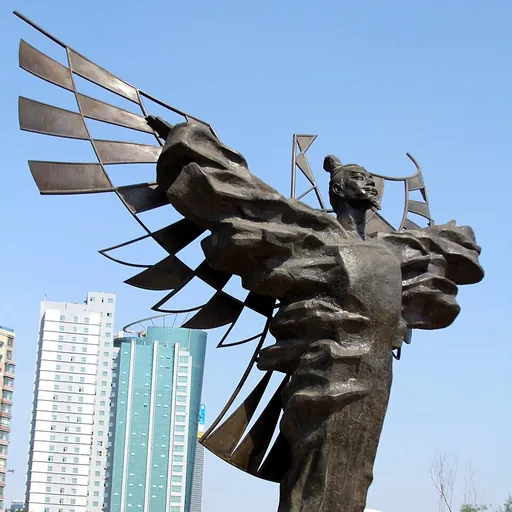
About Lu Ban
Lived 507 BC – 444 BC (aged 62–63). Lu Ban was an architect, engineer and philosopher.
Lu Ban (–444BC) was an ancient Chinese master carpenter, architect, structural engineer and inventor during the Spring and Autumn period of the Eastern Zhou Dynasty. He is revered as the Chinese Deity (Patron) of builders and contractors.
Life Lu Ban was born in the state of Lu; a few sources claim he was born further to the west, in Dunhuang, to a family of carpenters
Cloud ladder—a mobile, counterweighted siege ladder. Grappling hooks and ram—implements for naval warfare. Wooden bird—a non-powered, flying, wooden bird which could stay in the air for three days. It has been suggested to be a prototype of a kite. The saw—legend has it that when Lu Ban was grabbing hold of tree trunks in order to climb a steep slope while gathering firewood, his hand was cut by a leaf with spiny texture. He then realized that he could turn the leaf's texture into a more efficient tool for tree-cutting, namely the saw. The Lu Ban lock— a toy made of six interlocking wooden sticks using mortise techniques.
Other inventions were also attributed to him, such as a lifting implement to assist with burial, a wooden horse carriage and coachman, a pedal-powered cycle, and other woodworking mentioned in various texts, which thereafter led Lu Ban to be acknowledged as a master craftsman:
The Book of Lineages (Shiben), written c. the 3rd century BC. The Tales of the Marvelous , by Ren Fang, written c. the 5th century AD. The Records of Origin on Things and Affairs , by Gao Cheng, written c. the 11th century. The Origin on Things , by Luo Qi, written c. the 15th century. The Treatise of Lu Ban , attributed to Lu Ban, written in the 13th, 14th, or 15th century.
Legacy Lu Ban is revered as the god of carpentry and masonry in Chinese folk religion. His personality is assumed by the master carpenter involved in the construction of houses among the Kam people. He is sometimes counted among the Five Kings of the Water Immortals, Taoist water gods invoked by sailors for protection while carrying out journeys.
He is referenced in a number of Chinese idioms. The Chinese equivalent of "teaching one's grandmother to suck eggs" is to "brandish one's axe at Lu Ban's door" (班门弄斧 ). His cultural companion is the stone worker Wang Er, who lived around the same time.
The modern artist Shi Lu has claimed that Lu Ban was an alias of his contemporary Confucius, but this seems dubious.
Don’t just read it —
keep it.
Full-length biographies made to live with: read them, listen on the way to work, watch them tonight.
- E-book
- Audio
- Video
Instant download · yours to keep · every purchase keeps this site free
Important facts
People in Lu Ban's life
Named in this biography and alive at the same time

Related people
Same field, nearest in time

Contemporaries
People whose lives overlapped Lu Ban's

Frequently asked questions
Who was Lu Ban?
5th-century BC Chinese engineer and inventor
When was Lu Ban born?
Lu Ban was born in 507 BC.
When did Lu Ban die?
Lu Ban died in 444 BC.
What was Lu Ban's occupation?
Lu Ban was an architect, engineer and philosopher.
What nationality was Lu Ban?
Lu Ban's recorded nationality: Lu.
Sources & further reading
Cite this page
APA: Biography.guide. (2026). Lu Ban. https://biography.guide/lu-ban-architect/
MLA: "Lu Ban." Biography.guide, https://biography.guide/lu-ban-architect/.
Chicago: "Lu Ban." Biography.guide. https://biography.guide/lu-ban-architect/.
Data last updated: 2026-09-20 · Spot an error? Report a correction.
Page generated 2026-09-27 05:09 UTC