
Cincinnatus
Roman politician and military figure (c. 519 – c. 430 BC)
About Cincinnatus
Lived 519 BC – 430 BC (aged 88–89). Cincinnatus was a Roman farmer, politician and military personnel.
Lucius Quinctius Cincinnatus was a Roman patrician, statesman, and military leader of the early Roman Republic who became a famous model of Roman virtue—particularly civic virtue—by the time of the late Republic.
The most famous story related to Cincinnatus occurs after his retirement from public service to a simple life of farming. As Roman forces struggled to defeat the Aequi, Cincinnatus was summoned from his plough to assume complete control over the state. After achieving a swift victory in sixteen days, Cincinnatus relinquished power and its privileges, returning to labor on his farm.
Cincinnatus’s success and his immediate resignation of near-absolute authority at the end of the crisis (traditionally dated to 458 BC) has often been cited as a model of selfless leadership, civic virtue, and service to the greater good. The story has also been seen as an exemplar of agrarian virtues like humility, modesty, and hard work. Cincinnatus was also an opponent of the rights of the plebeians (the common citizens). His son, Caeso Quinctius, caused the plebeians to fall into poverty when he violently opposed their desire to have a written code of equally enforced laws.
Life
According to the traditional accounts, Lucius Quinctius Cincinnatus was probably born around 519BC, during the last decade of the Roman Kingdom. He would have been a member of the ancient patrician clan Quinctia, which predated the founding of Rome and was moved to Rome from the Latin city of Alba Longa by Tullus Hostilius. The clan's first consul was Titus Quinctius Capitolinus Barbatus, elected in 471BC. As both Titus and Lucius were recorded as the son and grandson of men named Lucius Quinctius, Titus is sometimes thought to have been Lucius's brother. This suggests Lucius was the first of his cognomen , meaning "the curly haired". The family was rich.
In the late 460sBC, Rome was fending off raids by the Aequi to their east. Beginning in 462BC, the tribune G. Terentilius Harsa began pressing for codification of the Roman laws to establish a kind of constitution that would check the near-regal power of the patrician consuls. In the years that followed, he and the other plebeians were ignored, fended off, rejected on procedural grounds, and finally beaten and driven from the streets by gangs of patricians and their clients, supposedly including Cincinnatus's son Caeso.
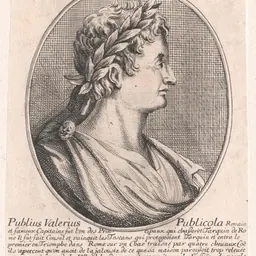
The violent resistance of the patricians prompted so much unrest that Appius Herdonius was able to seize the Capitoline Hill and hold it against the city with a gang of outlaws and rebel slaves (in Livy) or with an army of Sabines (in Dionysius). The consul Publius Valerius Poplicola was killed in its recovery in 460BC and Cincinnatus, probably illegally, which made no progress during his administration. His son was supposedly driven from town and killed Many of the details of the story are now assumed to be spurious and literary treatments of the era.
The Society of the Cincinnati was established by Henry Knox in 1783 to assist the officers of the Continental Army and Navy and their families, to preserve the ideals of the American Revolution, and to maintain the union of the former colonies. A French Society of the Cincinnati was founded soon afterward by King Louis XVI. Cincinnati, Ohio, and Cincinnatus, New York, in the United States, were named in his honor.
Cincinnatus is referenced in Book II, Chapter 1 of Thomas Carlyle's Sartor Resartus. The protagonist of Vladimir Nabokov's Invitation to a Beheading is named Cincinnatus C.
Whistleblower Edward Snowden used the nickname "Cincinnatus" when first contacting journalist Glenn Greenwald about releasing classified National Security Agency (NSA) documents.
British Prime Minister Boris Johnson referred to Cincinnatus in his farewell speech outside 10 Downing Street in London on 6 September 2022. Some commentators noted that while, as Johnson said, Cincinnatus returned to his plough, he was also later recalled to power.
When, in July 2024, United States President Joe Biden announced that he would not run for re-election, multiple political commentators compared him to Cincinnatus, though Biden later stated he was forced out due to pressure from his party.
Don’t just read it —
keep it.
Full-length biographies made to live with: read them, listen on the way to work, watch them tonight.
- E-book
- Audio
- Video
Instant download · yours to keep · every purchase keeps this site free
Important facts
Family & relationships
People in Cincinnatus's life
Named in this biography and alive at the same time

Related people
Same field, nearest in time



Contemporaries
People whose lives overlapped Cincinnatus's
Frequently asked questions
Who was Cincinnatus?
Roman politician and military figure (c. 519 – c. 430 BC)
When was Cincinnatus born?
Cincinnatus was born in 519 BC in Roman Kingdom.
When did Cincinnatus die?
Cincinnatus died in 430 BC in Roman Republic.
What was Cincinnatus's occupation?
Cincinnatus was a farmer, politician and military personnel.
What nationality was Cincinnatus?
Cincinnatus was Roman.
Sources & further reading
· DBpedia: Lucius Quinctius Cincinnatus
Cite this page
APA: Biography.guide. (2026). Cincinnatus. https://biography.guide/cincinnatus/
MLA: "Cincinnatus." Biography.guide, https://biography.guide/cincinnatus/.
Chicago: "Cincinnatus." Biography.guide. https://biography.guide/cincinnatus/.
Data last updated: 2026-09-20 · Spot an error? Report a correction.
Page generated 2026-09-27 05:18 UTC