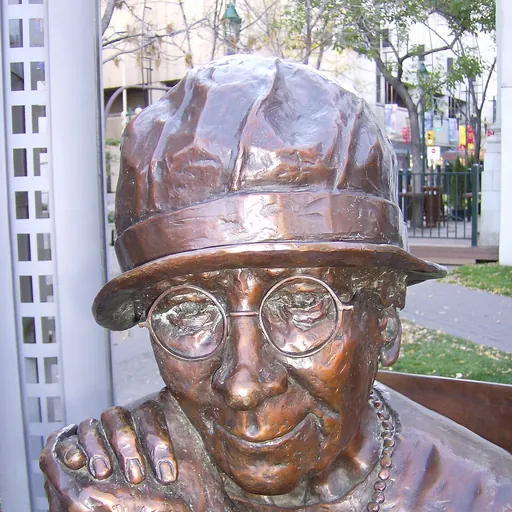
About Louise McKinney
Lived 1868 – 1931 (aged 62). Louise McKinney was a Canadian politician, human rights defender, suffragette and activist.
Louise McKinney (; 22 September 186810 July 1931) was a Canadian politician, temperance advocate, and women's rights activist. She was the first woman elected into the Legislative Assembly of Alberta and the first woman to serve in a legislature in the British Empire. She served in the Alberta legislature from 1917 to 1921 as a member of the Non-Partisan League. Later, she was one of the Famous Five who successfully campaigned for the right of Canadian women to be appointed to the Senate. A former schoolteacher and temperance organizer, she came to Alberta in 1903 as a homesteader.
McKinney was heavily involved in the Methodist Church and the Woman's Christian Temperance Union (Dominion WCTU). She served as president of the Alberta branch for 22 years, from 1908 to 1930. In 1930, she was elected president of the Dominion WCTU and organized the 1931 World Convention in Toronto. McKinney supported stricter immigration laws and the creation of institutions for "feeble-minded" people. In 2009, the Senate of Canada voted to make McKinney and other members of the Famous Five Canada's first honorary Senators.
Early life McKinney was born Louise Crummy on 22 September 1868 in Frankville, Ontario, the sixth of ten children of Richard Crummy and Esther Empey. Her father had emigrated from Ireland to settle in Upper Canada in 1842, later bringing his wife in 1857. McKinney graduated from Athens High School intending to become a physician but faced difficulty entering medical school due to her gender. Instead, she attended Ottawa Normal School to become a teacher. She taught for four years in Ontario before moving to North Dakota, where she taught for three more years.
Involvement in the Woman's Christian Temperance Union While teaching in North Dakota, McKinney became interested in the Woman's Christian Temperance Union. In 1894 she became one of the union's local organizers, travelling around the state to preach about the dangers of alcohol. They had one son, Williard, named after Frances Williard, the founder of the WCTU. She was elected as the North Dakota WCTU's District President in 1898 and represented her area at the National Convention the following year. McKinney served as president of the Alberta WCTU for 22 years, from 1908 to 1930. For the same period, she served as vice-president of the Dominion WCTU. In 1930, she was voted president of the Dominion WCTU and organized the 1931 World Convention in Toronto, where she was elected vice-president of the World WCTU. In winning the election, she became the first woman elected to a legislature in the British Empire.Efn|One other woman, Roberta MacAdams, was also elected in the 1917 general election, but McKinney holds the distinction of being first as she was sworn in before MacAdams. After passing, it became known as the Dower Act.
Several of her fellow Famous Five members, including Parlby, Murphy, and McClung, were supporters of the eugenics movement in Alberta. It is not known if McKinney supported mandatory sterilization of "mental defectives." She advocated the creation of institutions to care for feeble-minded people and to prevent their procreation. McKinney promoted stricter immigration laws.
She ran for a second term in the 1921 Alberta general election as a United Farmers candidate. She was defeated by independent candidate Thomas Milnes by a margin of 46 votes. She never ran for political office again.
She remained active in the social and political sphere, especially with the WCTU. She was one of four women, and the only woman from Western Canada, who signed the Basis of Union for the United Church of Canada in 1925.
Persons Case
McKinney was one of the Famous Five, along with Irene Parlby, Henrietta Muir Edwards, Emily Murphy and Nellie McClung, a group of five women who fought for the right to be considered "persons" and be eligible to serve in the Senate of Canada. The case is officially titled Edwards v Canada (AG) but is popularly known as the Persons Case. In 1927, the case was taken to the Supreme Court of Canada, which ruled that women were not eligible to serve in the Senate. In 1929, the Five appealed the ruling at the Judicial Committee of the Privy Council, Canada's highest court at the time. The Judicial Committee overturned the Supreme Court's decision, and the first woman, Cairine Wilson, was appointed to the Senate the following year.
Death McKinney fell ill during the WCTU World Convention in June 1931, and her sickness became worse after her return to Claresholm. She died after returning home the following month, less than two years after her victory in the Persons Case. Her death came as a shock to the WCTU, and tributes came from across the country and the world.
Honours
National recognition In 1939, the government of Canada recognized McKinney as a Person of National Historic Significance. A plaque commemorating this is on display at the post office in Claresholm. In 1997, the Persons Case was recognized as a National Historic Event.
In October 2009, the Senate voted to name McKinney and the rest of the Famous Five Canada's first "honorary senators".
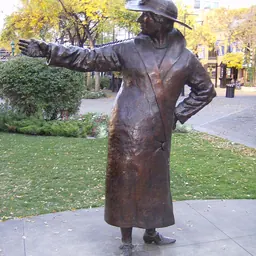
Monuments and commemorations In 2000, two identical monuments were created in Calgary, Alberta, and near the Senate of Canada Building, in Ottawa, Ontario. The monuments, called Women are Persons!, depict the members of the Famous Five reading the news about their victory in the Persons Case. The monuments were later featured on the $50 banknote of the Canadian Journey series.
Don’t just read it —
keep it.
Full-length biographies made to live with: read them, listen on the way to work, watch them tonight.
- E-book
- Audio
- Video
Instant download · yours to keep · every purchase keeps this site free
Important facts
People in Louise McKinney's life
Named in this biography and alive at the same time


Related people
Same field, nearest in time




Contemporaries
People whose lives overlapped Louise McKinney's


Frequently asked questions
Who was Louise McKinney?
Canadian politician (1868-1931)
When was Louise McKinney born?
Louise McKinney was born on 22 September 1868 in Elizabethtown-Kitley.
When did Louise McKinney die?
Louise McKinney died on 10 July 1931 in Claresholm.
What was Louise McKinney's occupation?
Louise McKinney was a politician, human rights defender, suffragette and activist.
What nationality was Louise McKinney?
Louise McKinney was Canadian.
Sources & further reading
Cite this page
APA: Biography.guide. (2026). Louise McKinney. https://biography.guide/louise-mckinney/
MLA: "Louise McKinney." Biography.guide, https://biography.guide/louise-mckinney/.
Chicago: "Louise McKinney." Biography.guide. https://biography.guide/louise-mckinney/.
Data last updated: 2026-09-23 · Spot an error? Report a correction.
Portrait: Wikimedia Commons · author & licence
Page generated 2026-09-27 05:06 UTC