About Irene Parlby
Lived 1868 – 1965 (aged 97). Irene Parlby was a Canadian politician, human rights defender and suffragette.
Political career Board of Directors of the United Farmers of Alberta in 1919. Parlby is third from the right on the bottom row. Parlby's political life began in 1914 when she, along with other women in the area, created the Alix Country Women's Club (ACWC), and Parlby was chosen as secretary. One of the first accomplishments of the ACWC was to establish a local library, one of the first in the province. When the United Farm Women of Alberta (UFWA), an auxiliary group of the United Farmers of Alberta, was formed in 1915, the ACWC became the first local branch of the UFWA. The next year, she was elected to be the first president of the UFWA. Between 1918 and 1920, the membership grew from 1,450 to 4,000 women. As president, Parlby worked to improve healthcare and helped to establish municipal hospitals. In 1920, she resigned as president, saying: "The organization has reached a stage when its own momentum will help to carry it along, the difficult days of arousing interest and establishing the position of the organization are over, and I feel I can ... leave all active work in it to those who are more capable of carrying on than myself."
In the 1921 Alberta general election, Parlby put her name forward as a candidate for the riding of Lacombe, which she won, to her surprise. She called the campaign "nasty", due to the harassment she received for being female. Herbert Greenfield was chosen to be the Premier, and Parlby was selected to be the Minister without Portfolio in the Cabinet, making her the second woman in the British Empire to hold a ministerial position, after Mary Ellen Smith of British Columbia. In 1930, she was chosen by Prime Minister R. B. Bennett to be one of three delegates of Canada to the League of Nations in Geneva, where she served until 1934. Parlby introduced and sponsored a large number of bills, including the Minimum Wage for Women Act, which made Alberta the first province to pass a minimum wage for women. She also attempted to pass the Community of Property Act, which would have allowed women to own all property they brought into a marriage, along with gifts and inheritance, but this was not passed as it was seen as too radical.
Sexual Sterilization Act Like many other prominent left wing Albertan politicians of the time, including fellow Famous Five members Murphy and McClung, Parlby was an advocate for the eugenics movement in Alberta. Parlby expressed sympathy for the mothers of mentally ill children and stated that the "great and only solution to the problem" was the sterilization of feeble-minded persons.
Famous Five and the Persons Case Parlby was one of the Famous Five, a group of five women including Henrietta Muir Edwards, Nellie McClung, Louise McKinney, and Emily Murphy, who petitioned the federal government for the right of women to serve as senators. In 1927, the case was taken to the Supreme Court of Canada, which ruled that women were not eligible for appointment to the Senate. The case was then appealed to the Judicial Committee of the Privy Council in London, the highest court of the British Empire. In 1929, the Judicial Committee overturned the Supreme Court's decision, allowing women to serve in the Senate. The first woman to serve in the Senate, Cairine Wilson, was appointed the following year.
Death and legacy
In 1935, as recognition for her achievements over the past two decades, she became the first woman to be granted an honorary doctorate from the University of Alberta.
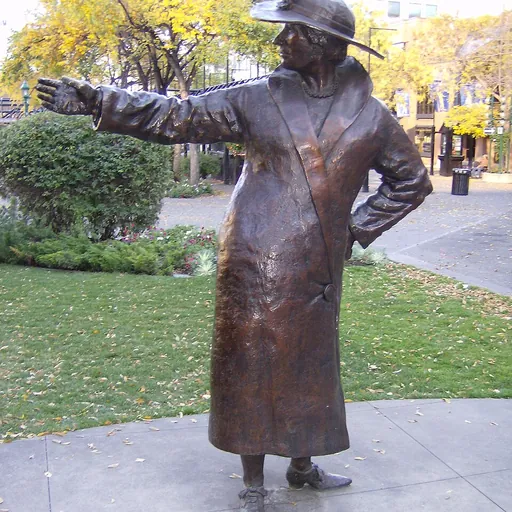
In May 1966, Parlby was recognized as a Person of National Historic Significance by the government of Canada. A plaque commemorating this is found in Alix, Alberta. In 1997, the Persons Case was recognized as a National Historic Event. In 2000, two identical monuments were created in Calgary, Alberta, and near the Senate of Canada Building, in Ottawa, Ontario. The monuments, called Women are Persons!, depict the members of the Famous Five reading the news about their victory in the Persons Case. The monuments were later featured on the $50 banknote of the Canadian Journey series. In October 2009, the Senate voted to name Parlby and the rest of the Famous Five Canada's first "honorary senators".
Don’t just read it —
keep it.
Full-length biographies made to live with: read them, listen on the way to work, watch them tonight.
- E-book
- Audio
- Video
Instant download · yours to keep · every purchase keeps this site free
Important facts
People in Irene Parlby's life
Named in this biography and alive at the same time


Related people
Same field, nearest in time





Contemporaries
People whose lives overlapped Irene Parlby's




Frequently asked questions
Who was Irene Parlby?
Canadian politician (1868-1965)
When was Irene Parlby born?
Irene Parlby was born on 9 January 1868 in London.
When did Irene Parlby die?
Irene Parlby died on 12 July 1965 in Red Deer.
What was Irene Parlby's occupation?
Irene Parlby was a politician, human rights defender and suffragette.
What nationality was Irene Parlby?
Irene Parlby was Canadian.
Sources & further reading
Cite this page
APA: Biography.guide. (2026). Irene Parlby. https://biography.guide/irene-parlby/
MLA: "Irene Parlby." Biography.guide, https://biography.guide/irene-parlby/.
Chicago: "Irene Parlby." Biography.guide. https://biography.guide/irene-parlby/.
Data last updated: 2026-09-22 · Spot an error? Report a correction.
Portrait: Wikimedia Commons · author & licence
Page generated 2026-09-27 05:03 UTC