Louise Marie Adélaïde de Bourbon
Mother of Louis Philippe I, King of the French
About Louise Marie Adélaïde de Bourbon
Lived 1753 – 1821 (aged 68). Louise Marie Adélaïde de Bourbon was a French aristocrat.
Louise Marie Adélaïde de Bourbon, Duchess of Orléans (13 March 1753 - 23 June 1821), was the daughter of Louis Jean Marie de Bourbon, Duke of Penthièvre and Princess Maria Teresa d'Este. At the death of her brother, Louis Alexandre, Prince of Lamballe, she became the wealthiest heiress in France prior to the French Revolution. She married Louis Philippe II, Duke of Orléans, the "regicide" Philippe Égalité, and was the mother of France's last king, Louis Philippe I. She was sister-in-law to Marie Thérèse Louise, Princess of Lamballe, and was the last member of the Bourbon-Penthièvre family.
Early life Marie-Adélaïde was born on 13 March 1753 at the Hôtel de Toulouse, the family residence in Paris since 1712, when her grandfather, Louis-Alexandre de Bourbon, comte de Toulouse, bought it from Louis Phélypeaux de La Vrillière. She was the youngest daughter of Louis Jean Marie de Bourbon, Duke of Penthièvre and his wife, Princess Maria Teresa d'Este. Her mother died in childbirth the following year. Styled Mademoiselle d'Ivoy initially and, as a young girl, until her marriage, Mademoiselle de Penthièvre (derived from the duchy inherited by her father). The style of Mademoiselle de Penthièvre had been previously borne by her sister Marie Louise de Bourbon (1751–1753), who died six months after Marie-Adélaïde's birth.
Education At birth, she was put in the care of Madame de Sourcy and, as was the custom for many girls of the nobility, she was later raised at the Abbaye de Montmartre convent, overlooking Paris, where she spent twelve years. As a child, she was encouraged to take an active part in the charities for which her father had become known as "Prince of the Poor". His reputation for beneficence made him popular throughout France and, subsequently, saved him during the Revolution.
Marriage Upon the death of her brother and only sibling, the Prince de Lamballe, on 8 May 1768, Marie-Adélaïde became heiress to what was to become the largest fortune of France.
Her marriage to Louis Philippe Joseph d'Orléans, Duke of Chartres, son of the Duke of Orléans, had been envisaged earlier and, while the Duke of Penthièvre saw in it the opportunity for his daughter to marry the First Prince of the Blood Royal, the Orléanses did not want another union with an illegitimate branch of the royal family. However, when the Prince de Lamballe's death left his sister sole heiress to the family fortune, the bar sinister on her inescutcheon was "overlooked". Although Marie-Adélaîde was much in love with her Orléans cousin, Louis XV warned Penthièvre against such a marriage because of the reputation of the young Duke of Chartres as a libertine. Louis XV was also fearful of the powerful leverage given the Orléans branch should it inherit the Penthièvre fortune.
Mademoiselle de Penthièvre was presented to the King on 7 December 1768, in a ceremony called de nubilité, by her maternal aunt, Maria Fortunata d'Este, Comtesse de la Marche. She was greeted by Louis XV, the Dauphin and other members of the royal family. On that day, she was baptised by Charles Antoine de La Roche-Aymon, Grand Almoner of France, and given the names Louise Marie Adélaïde.
Her marriage to the Duke of Chartres took place at the Palace of Versailles on 5 April 1769 in a ceremony which all of the princes du sang attended. The marriage contract was signed by all members of the royal family. Afterwards, Louis XV hosted a wedding supper which included the entire royal family. Mlle de Penthièvre brought to the already wealthy House of Orléans a dowry of six million livres, an annual income of 240,000 livres (later increased to 400,000), and the expectation of much more upon her father's death.
The Comtesse de Genlis La famille du Duc de Penthièvre, ou La tasse de chocolat, painting by Jean-Baptiste Charpentier le Vieux (1768). From left to right, seated: Duc de Penthièvre; prince de Lamballe; Princesse de Lamballe, Comtesse de Toulouse; standing in background: Mlle de Penthièvre. During the first few months of their marriage, the couple appeared devoted to each other, but the duke went back to the life of libertinage he had led before his marriage.
In the summer of 1772, a few months after his wife had given birth to a stillborn daughter, Philippe's secret liaison began with one of her ladies-in-waiting, Stéphanie Félicité Ducrest de St-Albin, Comtesse de Genlis, the niece of Madame de Montesson, the morganatic wife of Philippe's father. Passionate at first, the liaison cooled within a few months and, by the spring of 1773, was reported to be "dead".
Upon the death of her father-in-law Louis Philippe d'Orléans in November 1785, her husband became the new Duke of Orléans, and First Prince of the Blood, taking rank only after the immediate family of the king. As the wife of a prince du sang she was entitled to be addressed as "Your Serene Highness", though she already had such privilege by birth.
Revolution On 5 April 1791, Marie-Adélaïde left her husband, overlooking Vernon, Eure in Normandy In September 1792, having sided with the Revolution, the Duke of Orléans was elected to the National Convention under the name of Philippe Égalité. Siding with the radical group called La Montagne, he was from the very beginning suspect in the eyes of the Girondists, who wanted all the Bourbons to be banished from France. The fate of the Orléans family was sealed when Marie-Adélaïde's eldest son, the duc de Chartres, "Général Égalité" in the Army of the North commanded by Charles François Dumouriez, sought political asylum from the Austrians in March 1793. On 6 April, all the members of the Orléans family still remaining in France were arrested. After their arrest in Paris, Philippe Égalité and his son, the comte de Beaujolais, were imprisoned in the prison de l'Abbaye in Paris. where his sister Adélaïde and Mme de Genlis had been living since Philippe Égalité had made them emigrate in November 1792. The duc de Chartres accompanied them to safety in Switzerland. who had been imprisoned at the fall of the Girondins. Nearly executed before the fall of Robespierre, in July 1794 at the end of the Reign of Terror, she was transferred to the "Pension Belhomme", a former mental institution turned into a "prison for the rich" during the Revolution.
After Rouzet, who after his liberation had become a member of the Council of Five Hundred, succeeded, in 1796, to secure her liberation and that of her two sons still imprisoned in Marseille, the two always remained together and lived in Paris until 1797, when a decree banished the remaining members of the House of Bourbon from France. Marie-Adélaïde was exiled to Spain, as was her sister-in-law Bathilde d'Orléans, the last princesse de Condé. Rouzet accompanied them to the Spanish border and managed to secretly join them in Barcelona where he became her chancellor, and she obtained for him the title of comte de Folmont.
Marie-Adélaïde was never to see her two younger sons again, Montpensier and Beaujolais, who died in exile before the 1814 Bourbon Restoration. She, Rouzet and the Orléans exiled in Spain returned to France in 1814 at the time of the first Bourbon Restoration. After legal battles which lasted until her death, the bulk of her inheritance was eventually recovered. She died in her castle at Ivry-sur-Seine on 23 June 1821, after battling breast cancer. Rouzet had died nine months before, on 25 October 1820, and she had him inhumed in the new family chapel she had built in Dreux in 1816, as the final resting place for the two families, Bourbon-Penthièvre and Orléans.
The original Bourbon-Penthièvre family crypt in the Collégiale de Saint-Étienne de Dreux had been violated during the Revolution and the bodies thrown together into a grave in the Chanoines Cemetery of the Collégiale. She was buried in the new chapel which, after the accession to the throne of her son Louis Philippe, was enlarged, embellished and renamed Chapelle royale de Dreux, becoming the necropolis for the now royal Orléans family. Marie Adélaïde did not live to see her son Louis Philippe become King of the French in 1830.
Cultural references In the 2006 film, Marie Antoinette, Marie-Adélaïde appears as a minor character played by actress Aurore Clément.
Issue
The couple had six children:
A daughter (died at birth, 10 October 1771) Louis Philippe d'Orléans (future King Louis Philippe I of the French), (Palais Royal, 1773–1850, Claremont) Duke of Valois (1773–1785) **Duke of Chartres (1785–1793) Duke of Orléans (1793–1830) married Maria Amalia of Naples and had issue. Louis Antoine Philippe d'Orléans, Duke of Montpensier, (Palais Royal, 1775–1807, Salthill), Françoise Caroline Auguste d'Orléans, Mademoiselle d'Orléans (Palais Royal, 1777–1782, Palais Royal), twin sister of (below), Louise Marie Adélaïde Eugénie d'Orléans, Mademoiselle de Chartres (Palais Royal, 1777–1847, Palais de Tuileries) never married. Louis Charles Alphonse Léodgard d'Orléans, Count of Beaujolais (Palais Royal, 1779–1808, Malta) never married
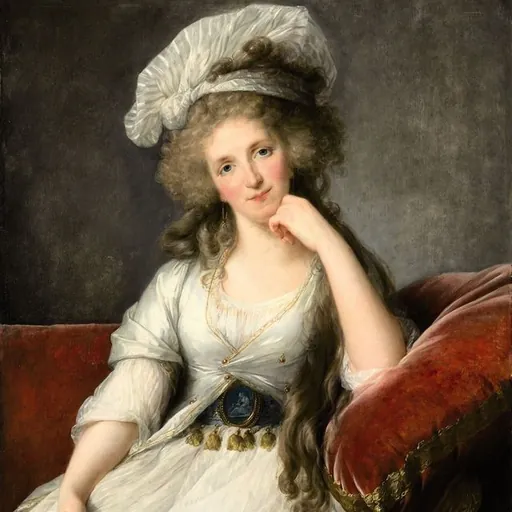
The painting On the eve of the French Revolution, in 1789, she was painted by Élisabeth-Louise Vigée-Le Brun, the favourite portrait painter of Queen Marie Antoinette. The painting was titled Madame la Duchesse d'Orléans. Vigée-Le Brun made use of the lonely duchess' melancholia in the pose. Dressed in white, a reminder of her candor, the head of the duchess is supported on her upraised arm. She is shown with a languid, sad expression. Below the breast is a Wedgwood medallion which Colin Eisler has identified as Poor Maria, possibly a reference to the life of the duchess, which was later destroyed because of the Revolution. The painting is now at the Palace of Versailles. There is another copy in the musée de Longchamp, Marseille. Versailles has a third copy which has been incorrectly described as a replica.
Ancestry
Don’t just read it —
keep it.
Full-length biographies made to live with: read them, listen on the way to work, watch them tonight.
- E-book
- Audio
- Video
Instant download · yours to keep · every purchase keeps this site free
Important facts
Family & relationships
People in Louise Marie Adélaïde de Bourbon's life
Named in this biography and alive at the same time
Related people
Same field, nearest in time

Contemporaries
People whose lives overlapped Louise Marie Adélaïde de Bourbon's






Frequently asked questions
Who was Louise Marie Adélaïde de Bourbon?
Mother of Louis Philippe I, King of the French
When was Louise Marie Adélaïde de Bourbon born?
Louise Marie Adélaïde de Bourbon was born on 13 March 1753 in Hôtel de Toulouse.
When did Louise Marie Adélaïde de Bourbon die?
Louise Marie Adélaïde de Bourbon died on 23 June 1821 in Ivry-sur-Seine.
What was Louise Marie Adélaïde de Bourbon's occupation?
Louise Marie Adélaïde de Bourbon was an aristocrat.
What nationality was Louise Marie Adélaïde de Bourbon?
Louise Marie Adélaïde de Bourbon was French.
Sources & further reading
· Wikipedia: Louise Marie Adélaïde de Bourbon
· DBpedia: Louise Marie Adélaïde de Bourbon, Duchess of Orléans
Cite this page
APA: Biography.guide. (2026). Louise Marie Adélaïde de Bourbon. https://biography.guide/louise-marie-adelaide-de-bourbon/
MLA: "Louise Marie Adélaïde de Bourbon." Biography.guide, https://biography.guide/louise-marie-adelaide-de-bourbon/.
Chicago: "Louise Marie Adélaïde de Bourbon." Biography.guide. https://biography.guide/louise-marie-adelaide-de-bourbon/.
Data last updated: 2026-09-21 · Spot an error? Report a correction.
Portrait: Wikimedia Commons · author & licence
Page generated 2026-09-27 04:59 UTC