
About Louis F. Schade
Lived 1829 – 1903 (aged 73). Louis F. Schade was a German lawyer, known for Henry Wirz.
Louis Frederick Schade (April 4, 1829 – February 25, 1903) was a German-American lawyer and newspaper editor who was prominent in political and social circles of Washington, D.C., in the United States. He is most famous for defending Confederate States of America Captain Henry Wirz in a war crimes trial in 1865. Wirz was condemned to death for his supervision of the (Camp Sumter) prisoner-of-war camp.
Early life and career Louis Schade was born on April 4, 1829, to Friedrich and Wilhelmina ( von Sydow) Schade in Berlin in what was then the Province of Brandenburg in the Kingdom of Prussia. He studied law and medicine at the Frederick William University in Berlin, graduating in 1848.
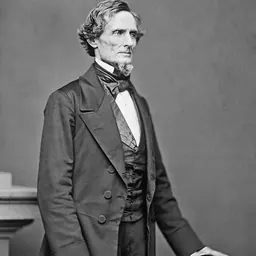
The Wirz trial In August 1865, Schade joined the legal team defending Confederate States Army Major Henry Wirz. Wirz was the former commandant of the Confederacy's Camp Sumter prisoner-of-war (POW) camp (commonly referred to as "Andersonville Prison", after a nearby town). Wirz was accused of conspiracy to injure the health of his prisoners, conspiracy to commit murder, torture, ordering guards to commit murder, allowing dogs to maul prisoners as a means of punishment, and personally committing murder on 13 separate occasions. Although the list of co-conspirators originally included former Confederate President Jefferson Davis and 12 others, by the time the trial started only Wirz was prosecuted. Wirz, a Swiss émigré of German background, was initially represented by James Hughes (former judge with the United States Court of Claims and former member of the United States House of Representatives), James W. Denver (former Territorial Governor of Kansas, former member of the House, and former Brigadier General of Volunteers in the Union Army), Charles F. Peck (an attorney from Illinois), and Schade, all of whom volunteered on or about August 20, 1865, to represent him. Hughes, Denver, and Peck withdrew from the trial on its first day, outraged at lack of fairness exhibited by the military tribunal and their lack of time to prepare the defense. Schade, however, remained as counsel. On the third day of the trial, local attorney Otis H. Baker joined him as co-counsel. After their pretrial motions and pleadings were denied by the court, Schade and Baker attempted to resign as legal counsel. Wirz pleaded with them to remain, and they agreed to do so.
The prosecution, whose presentation lasted until October 18, argued that the lack of shelter (Andersonville was of bare ground, fenced with barbed wire), food, medical care, and clothing was Wirz's responsibility as commandant of the camp. The severe punishments meted out were also due to his orders. Schade's defense was that Wirz provided the best possible care for the POWs, given the huge influx of prisoners, the complete lack of food and supplies given to his troops, and the severe shortage of both physicians and guards. Schade and Baker faced extreme difficulties during the trial. Any attempt to impugn the character of prosecution witnesses was ruled slander by the court. The defense was forced to rely on the Union Army to serve subpoenas and force witnesses to testify, which it allegedly did only in some cases (only 32 of 100 subpoenaed defense witnesses testified). Union Army soldiers were denied the opportunity to testify on Wirz's behalf. The court prevented Schade and Baker from delivering a summation, and ordered a court reporter to do so in their stead.
Wirz was found guilty on almost all charges. Schade pleaded with President Andrew Johnson for clemency. Johnson granted him an audience, although it was not a private one, and accepted a letter from Schade outlining the grounds for clemency. Aside from complaints about the military tribunal's behavior and the enumeration of hundreds of legal errors, Schade argued that Wirz was dying and would not live more than a few months. Johnson denied clemency, and Wirz was hanged on November 10, 1865.
Schade won a national reputation for his defense of Wirz, even though the defense ended in failure. When the body was disinterred, Schade was proven partially correct: Parts of the corpse were missing. U.S. Army surgeons conducted an autopsy on Wirz's body after his death. There had been claims that Wirz's neck did not snap when he was hanged, and that he'd strangled to death. Two neck vertebrae had been removed, and indeed proved that the neck had not broken. Schade and Baker had argued at trial that Wirz's right arm had been so incapacitated by a war wound that he could not have committed the murders he was accused of. After Wirz's death, surgeons also removed his right arm, which was in excellent condition and showed little of the damage witnesses claimed. Schade paid for a burial plot at Mount Olivet Cemetery in Washington, D.C., and Wirz was interred there on March 3, 1869. (The vertebrae and arm bones remain in the custody of the National Museum of Health and Medicine as of 2014.)
Post-war life Schade practiced law and remained active in politics in the nation's capital for the rest of his life. He became a professor of German language at Georgetown University, a position he held throughout the 1870s. He caused a major scandal in 1871 when he issued a public report accusing Secretary of War William W. Belknap of selling arms to France. President Ulysses S. Grant was forced to stop the sales.
Left destitute, the Petersen family sold the home. Recognizing its historic value, Scahde purchased the Petersen House on November 25, 1878, for $4,500 ($ in dollars). The room where Lincoln died had long been cleared of any historic or valuable objects, so Schade used it as a playroom for his four children. Schade also renovated the house, and added rooms in the rear of the basement and the first floor and next to the stairway. The front room on the first floor was used as the main office of the Washington Sentinel.
Don’t just read it —
keep it.
Full-length biographies made to live with: read them, listen on the way to work, watch them tonight.
- E-book
- Audio
- Video
Instant download · yours to keep · every purchase keeps this site free
Important facts
People in Louis F. Schade's life
Named in this biography and alive at the same time



Related people
Same field, nearest in time

Contemporaries
People whose lives overlapped Louis F. Schade's





Frequently asked questions
Who was Louis F. Schade?
American lawyer and newspaper editor
When was Louis F. Schade born?
Louis F. Schade was born on 4 April 1829 in Berlin.
When did Louis F. Schade die?
Louis F. Schade died on 25 February 1903.
What was Louis F. Schade's occupation?
Louis F. Schade was a lawyer.
What was Louis F. Schade known for?
Louis F. Schade was known for Henry Wirz.
What nationality was Louis F. Schade?
Louis F. Schade was German.
Sources & further reading
Cite this page
APA: Biography.guide. (2026). Louis F. Schade. https://biography.guide/louis-f-schade/
MLA: "Louis F. Schade." Biography.guide, https://biography.guide/louis-f-schade/.
Chicago: "Louis F. Schade." Biography.guide. https://biography.guide/louis-f-schade/.
Data last updated: 2026-09-22 · Spot an error? Report a correction.
Page generated 2026-09-27 05:11 UTC