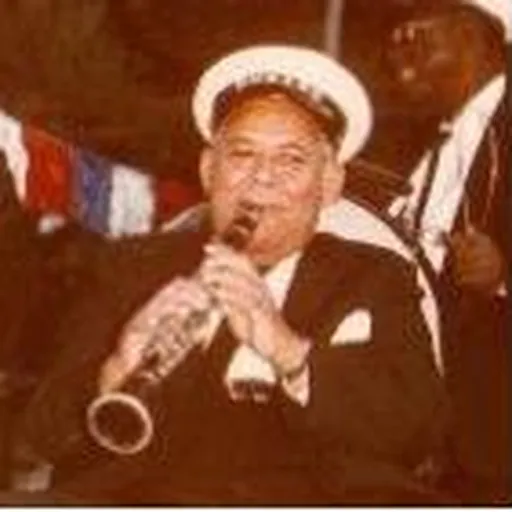
About Louis Cottrell, Jr.
Lived 1911 – 1978 (aged 67). Louis Cottrell, Jr. was an American bandleader, composer, conductor, jazz musician and saxophonist.
Louis Albert Cottrell Jr. (March 7, 1911 – March 21, 1978) was a Louisiana Creole jazz clarinetist and tenor saxophonist. He was the son of the influential drummer Louis Cottrell, Sr., and grandfather of New Orleans jazz drummer Louis Cottrell III. As leader of the Heritage Hall Jazz Band, he performed at Carnegie Hall in 1974.
Biography Cottrell was born into an upper-class Creole musical family in New Orleans. His father, Louis "Old Man" Cottrell, Sr., was a famed drummer, and cornetist Manny Perez was his godfather. The young Cottrell grew up around such great musicians as Barney Bigard, John Robichaux, and A.J. Piron.
Rhythm and blues bandleader Paul Gayten would later approach Cottrell to record "You Don't Love Me" and it became one of the first hits of the R & B New Orleans era, having made it to the number 5 spot nationally on the R & B top ten charts. Cottrell toured widely throughout North America with Albert until 1939.
After leaving Albert he returned to New Orleans, playing with Paul Barbarin in 1940. They would form an enduring collaboration. He performed with A.J. Piron in 1941, then returned to play with Desvigne from 1942 to 1947. In the 1950s he played again with Barbarin, and recorded with him in 1951 and 1955.
Cottrell first recorded as a leader in 1961, when he formed the Louis Cottrell Trio to record for Riverside's "Living Legends" series. Barbarin and Cottrell in 1960 revived the Onward Brass Band. As a sideman he recorded with Peter Bocage (1960), Jim Robinson (1961–64), Harold Dejan (1962), Thomas Jefferson (1962), Paul Barbarin at Preservation Hall (1962), Sweet Emma Barrett (1963), Avery Kid Howard (1964), Waldren Joseph (1964–1965), Barbarin's Onward Brass Band (1968, 1968) and Paul "Polo" Barnes (1969). In 1967, Cottrell, went on a U.S.O. tour to entertain troops in Vietnam and Thailand. In its day, Heritage Hall rivaled the better known Preservation Hall, both located in the French Quarter. It was during this period in 1974 that the Heritage Hall Jazz Band, under Cottrell's leadership, played Carnegie Hall in New York City. Blanche Thomas was the featured vocalist. The recording of the live concert can be found on Viko. He made several television appearances, including Perry Como's Spring in New Orleans in 1976, and The Mike Douglas Show. He recorded "Big Lip Blues" on the Academy Award-nominated soundtrack "Pretty Baby" (1978), and had a cameo appearance in the film of the same name.
Death Louis Cottrell died suddenly at his home in New Orleans, after a short illness, in 1978, at the age of 67. Fittingly, he was honored with a jazz funeral, as thousands assembled in a small Gentilly Catholic church to bid him farewell.
Cottrell's grandson, Louis Cottrell III, became a drummer and performed with the Young Tuxedo Brass Band, Dr. Michael White and numerous other traditional jazz bands.
Union activism
America throughout much of the 20th Century was a country which was racially divided. Chris Albertson, producer of the "Living Legends" series, recalls an incident in 1961 with a Black musician, McNeal Breaux, during recording of the "Living Legends" series in 1961: " owned a restaurant and invited Dave and me to have dinner there, but we had to enter through the back door, because of our color." Starting in his teens, Cottrell worked diligently to organize the Colored Musicians Union as a chapter of the American Federation of Musicians, Local 496. He would be elected president in 1956. He was as well known for seeking equitable treatment for musicians as for his music. Cottrell was able to see firsthand the fruits of his labor. Doug Ramsey wrote, "shortly before he died, told a friend how happy he was that New Orleans had finally become a city where he and other musicians like him could make a living playing as they wanted to play.
Musical style
Cottrell played traditional jazz, also referred to as Dixieland, the earliest form of jazz. It is distinguished by polymorphic improvisation by trumpet, trombone and clarinet. It has its origins in the marching bands of New Orleans which played at funerals. The main instruments of the bands, brass and woodwinds, would become the basic instruments of jazz. Cottrell's mastery of the clarinet and tenor saxophone enabled him to become a member of these bands and later lead his own. These brass bands were integral to the culture of the time. They performed at a wide variety of events, weddings, dances and most famously the jazz funeral. Rose of Sharon Witmer writes that the jazz funeral is a "living tradition carried on to this day and it owes a great debt to Louis Cottrell Jr."
New Orleans: The Living Legends
In 1960-61 Riverside Records produced an acclaimed series of albums featuring jazz and blues greats such as Jim Robinson, Sweet Emma Barrett and Alberta Hunter. The objective was to record the music of veteran musicians before their artistry was lost forever. Many of the musicians were no longer active and their union memberships had expired. Recognizing the importance of the project, the American Federation of Musicians suspended the rules. This "Living Legends" series was initially recorded in New Orleans. Later sessions were recorded in Chicago. The sessions took place at Societé des Jeunes Amis Hall, built in the 1800s. According to the producer, Chris Albertson, the hall was a "Creole fraternal headquarters and it proved to have every advantage over a studio; apart from its live sound, it gave the performers familiar surroundings... The hall's acoustical sound was exactly what I wanted to recapture: the same kind of ambience that lent such character to Bill Russell's 1940's American Music recordings from San Jacinto Hall." One of the musicians invited to participate was Louis Cottrell Jr. Cottrell's playing has also been well received:
Discography
As leader
Other appearances
Compositions
"You Don't Love Me (true)" "Blues For Dixie" "Drag's Turnaround Blues"
The song "You Don't Love Me (true)" has been recorded by artists such as Paul Gayten, Roy Milton, Camille Howard, The Spiders, Jacques Gauthe and the Preservation Hall Jazz Band.
Don’t just read it —
keep it.
Full-length biographies made to live with: read them, listen on the way to work, watch them tonight.
- E-book
- Audio
- Video
Instant download · yours to keep · every purchase keeps this site free
Important facts
People in Louis Cottrell, Jr.'s life
Named in this biography and alive at the same time





Related people
Same field, nearest in time



Contemporaries
People whose lives overlapped Louis Cottrell, Jr.'s





Frequently asked questions
Who was Louis Cottrell, Jr.?
American musician
When was Louis Cottrell, Jr. born?
Louis Cottrell, Jr. was born on 7 March 1911 in New Orleans.
When did Louis Cottrell, Jr. die?
Louis Cottrell, Jr. died on 21 March 1978 in New Orleans.
What was Louis Cottrell, Jr.'s occupation?
Louis Cottrell, Jr. was a bandleader, composer, conductor, jazz musician and saxophonist.
What nationality was Louis Cottrell, Jr.?
Louis Cottrell, Jr. was American.
Sources & further reading
· Wikipedia: Louis Cottrell, Jr.
Cite this page
APA: Biography.guide. (2026). Louis Cottrell, Jr.. https://biography.guide/louis-cottrell-jr/
MLA: "Louis Cottrell, Jr.." Biography.guide, https://biography.guide/louis-cottrell-jr/.
Chicago: "Louis Cottrell, Jr.." Biography.guide. https://biography.guide/louis-cottrell-jr/.
Data last updated: 2026-09-21 · Spot an error? Report a correction.
Portrait: Wikimedia Commons · author & licence
Page generated 2026-09-27 04:59 UTC