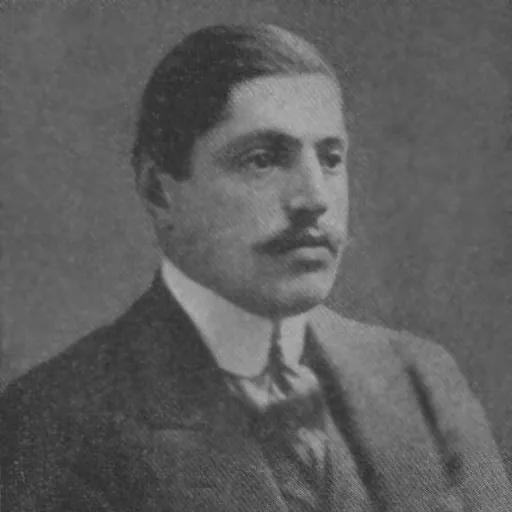
About Lord Ninian Crichton-Stuart
Lived 1883 – 1915 (aged 32). Lord Ninian Crichton-Stuart was a British politician.
Lieutenant-Colonel Lord Ninian Edward Crichton-Stuart (15 May 1883 – 2 October 1915) was a Scottish senior officer in the British Army and Member of Parliament. He was killed in action in the First World War. The second son of the Honourable Gwendolen Mary Anne Fitzalan-Howard and John Crichton-Stuart, 3rd Marquess of Bute, he entered the army in 1903 and served in the Queen's Own Cameron Highlanders and the Scots Guards as a lieutenant. After marrying he began a career in politics, serving first as a councillor on Fife County Council, Scotland. His family having close connections to the city of Cardiff in Wales, he fought and lost the January 1910 election there as a Liberal Unionist candidate. The resulting hung parliament led to a second election in December 1910, in which Crichton-Stuart won the seat.
In 1912, he took command of the 6th (Glamorgan) Battalion, The Welch Regiment. Upon the outbreak of the First World War, he volunteered his unit for service and joined the British Expeditionary Force on the Western Front. After eleven months on the front line, he was shot in the head and killed when leading his men in an attempt to repel a German counter-attack on 2 October 1915 during the Battle of Loos. He was one of 22 MPs that were killed during the conflict and the only serving MP from Wales to be killed.
The home ground of Cardiff City F.C. was named Ninian Park after Crichton-Stuart offered to be a guarantor for the football club's rental of the site. After his death, a statue of Crichton-Stuart was erected in Cathays Park in Cardiff.
Early life Crichton-Stuart was born at Dumfries House in Ayrshire, Scotland. He was the second son of John Crichton-Stuart, 3rd Marquess of Bute, and his wife, the Honourable Gwendolen Mary Anne Fitzalan Howard, daughter of Edward Fitzalan-Howard, 1st Baron Howard of Glossop. Through his father, he was an illegitimate descendant of the House of Stuart. However, he was forced to return home after contracting a severe fever and instead attended Christ Church, Oxford once he had recovered. His family's estate included numerous properties and considerable land in Cardiff, including Cardiff Castle, and Crichton-Stuart frequently visited the city, including accompanying his father on visits to Bute docks. He also learnt to speak Welsh. Crichton-Stuart later chose to enter the army and was commissioned in 1903 into the 3rd Battalion of the Queen's Own Cameron Highlanders and then served for two years in the 1st Battalion, the Scots Guards as a 2nd lieutenant. at the wedding of his brother John Crichton-Stuart and Augusta Bellingham where he was best man and Preston was a bridesmaid. The couple announced their engagement in January 1906 and married six months later,
Crichton-Stuart's family had a history of serving in parliament for the Cardiff area, his great uncle Lord Patrick Crichton-Stuart having held the post on two occasions. In August 1907, at a meeting of the Cardiff Conservative Association, Crichton-Stuart was invited by Herbert Cory and his supporting panel to be the Unionist candidate for the United Boroughs of Cardiff, Cowbridge and Llantrisant. Soon after his selection, he and his wife had their first child, named Ninian Patrick Crichton-Stuart, on 31 October 1907.
Lord Ninian's campaign for election was based on reform of the poor law and extending the age range of the old age pension. He also stated of his desire of preserving and strengthening the military forces of Britain. On the polling day, Lord Ninian's son caught a chill being driven around Cardiff and later died. He was buried near Falkland Palace in Fife. Crichton-Stuart and his family did not permanently reside in Cardiff until he and his wife moved there in April 1910, moving into Penylan Court which had previously been the residence of William Tatem, 1st Baron Glanely. In 1910, Cardiff City Football Club had secured the lease of a plot of land in order to build a new stadium. During development, one of the guarantors for the club pulled out and Crichton-Stuart instead offered his support of the project and acted as a guarantor for the £90 annual rent that the club had agreed to. In recognition of his role in the building of the ground, the club dropped the original planned name of the ground, Sloper Park, and instead named it Ninian Park. The ground was officially opened on 1 September 1910 and Crichton-Stuart performed the kick-off for a friendly match between Cardiff and Football League First Division side Aston Villa. He was also a patron of the Lord Ninian Stuart Cup, a competition for local football teams.
First World War
On 9 March 1911, Crichton-Stuart was promoted as lieutenant-colonel of the 6th (Glamorgan) Battalion, The Welch Regiment and took command of the battalion the following year. At the battalion drill hall in Swansea prior to their departure, Crichton-Stuart addressed the unit, stating "The greatest honour a man can receive is that he has been provided with a chance to give, if need be, the greatest that he has, which is his life, for his country. I do not doubt every man on this parade will give it and give it as willingly as I mean to give it myself." Crichton-Stuart had served for eleven months on the front line before his death.
On 30 April 1917 Crichton-Stuart's widow, Ismay, married Captain Archibald Henry Maule Ramsay (4 May 1894 – 11 March 1955), later a Scottish Unionist MP for Peebles and South Midlothian 1931–1945. Together they had four sons. Ismay died on 16 February 1975 aged 92, and was survived by six of her eight children.
Legacy Crichton-Stuart is commemorated on Panel 8 of the Parliamentary War Memorial in Westminster Hall, one of 22 MPs and officers of the House of Commons who died during the First World War to be named on that memorial. Crichton-Stuart is one of 19 MPs who fell in the war who are commemorated by heraldic shields in the Commons Chamber. A further act of commemoration came with the unveiling in 1932 of a manuscript-style illuminated book of remembrance for the House of Commons, which includes a short biographical account of his life and death.
A statute of Crichton-Stuart was commissioned soon after his death. Sculpted by Sir William Goscombe John, the statue was placed in Gorsedd Gardens in Cathays Park and depicts Crichton-Stuart in military uniform with binoculars in his right hand and papers in his left in a design intended to show him surveying the battlefield. Ninian Road in Roath Park, one of the Bute estate developments from the early twentieth century, continues to bear his name. Ninian Park maintained its name until it was closed and demolished in 2009 following the construction of the Cardiff City's new ground, the Cardiff City Stadium, although one side of the new ground was named the Ninian Stand. A housing estate was built on the site of the former ground and retained the name Ninian Park. The nearby Ninian Park railway station and Ninian Park primary school also bear his name.
Family Crichton-Stuart and his wife Ismay had four children:
Ninian Patrick Crichton-Stuart (31 October 1907 – 4 February 1910) They divorced in 1936. Her second marriage was to Donald Walter Munro Ross on 30 August 1937. Claudia Miriam Joanna Crichton-Stuart (24 June 1913 – 19 June 1985) Major Michael Duncan David Crichton-Stuart MC (14 March 1915 – 1981); he married Barbara Symes, daughter of Sir George Stewart Symes, on 1 March 1941. His son – Ninian Stuart – is the Hereditary Keeper of Falkland Palace, has one son and one daughter by his late wife.
Don’t just read it —
keep it.
Full-length biographies made to live with: read them, listen on the way to work, watch them tonight.
- E-book
- Audio
- Video
Instant download · yours to keep · every purchase keeps this site free
Important facts
People in Lord Ninian Crichton-Stuart's life
Named in this biography and alive at the same time



Related people
Same field, nearest in time





Contemporaries
People whose lives overlapped Lord Ninian Crichton-Stuart's


Frequently asked questions
Who was Lord Ninian Crichton-Stuart?
British politician
When was Lord Ninian Crichton-Stuart born?
Lord Ninian Crichton-Stuart was born on 15 May 1883 in Ayrshire.
When did Lord Ninian Crichton-Stuart die?
Lord Ninian Crichton-Stuart died on 2 October 1915 in Loos-en-Gohelle.
What was Lord Ninian Crichton-Stuart's occupation?
Lord Ninian Crichton-Stuart was a politician.
What nationality was Lord Ninian Crichton-Stuart?
Lord Ninian Crichton-Stuart was British.
Sources & further reading
· Wikipedia: Lord Ninian Crichton-Stuart
· DBpedia: Lord Ninian Crichton-Stuart
Cite this page
APA: Biography.guide. (2026). Lord Ninian Crichton-Stuart. https://biography.guide/lord-ninian-crichton-stuart/
MLA: "Lord Ninian Crichton-Stuart." Biography.guide, https://biography.guide/lord-ninian-crichton-stuart/.
Chicago: "Lord Ninian Crichton-Stuart." Biography.guide. https://biography.guide/lord-ninian-crichton-stuart/.
Data last updated: 2026-09-23 · Spot an error? Report a correction.
Portrait: Wikimedia Commons · author & licence
Page generated 2026-09-27 05:08 UTC