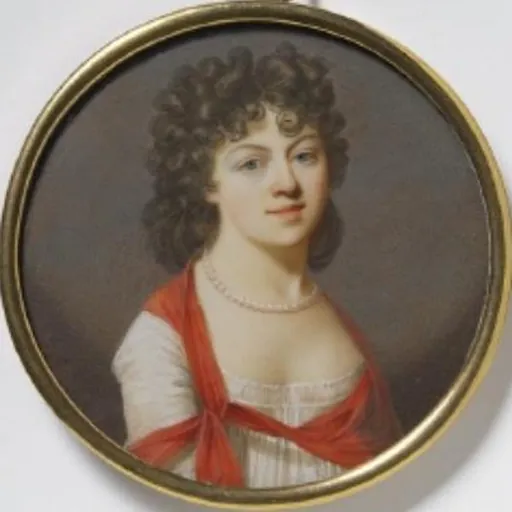
About Lolotte Forssberg
Lived 1766 – 1840 (aged 73–74). Lolotte Forssberg was a Swedish lady-in-waiting.
Fredrika Charlotte "Lolotte" Forssberg (1766–1840) was a Swedish noble and lady-in-waiting, later countess Stenbock. She was one of the most talked about people of her time as the possible child of King Adolf Frederick of Sweden. Princess Sophia Albertina of Sweden investigated her birth in the 1790s and tried to have her acknowledged as the daughter of her father. The truth is unconfirmed, though it is considered likely that she was the illegitimate daughter of the king.
Early life Officially the child of a servant at the royal court, she was widely rumored to be the child of king Adolf Fredrik and the noble lady in waiting Ulla von Liewen. The queen, Louisa Ulrika of Prussia, was said to tolerate her husband's affairs as long as he was discreet and did not take an official mistress, and the king never did have a mistress openly. Lolotte Forssberg was adopted by assistant Eric Forssberg and Hedvig Charlotta D'Orchimont. King Adolf Fredrik died in 1771.
Forssberg was eventually placed in the court of the Queen Dowager Louisa Ulrika as her foster child upon the suggestion of Louisa Ulrika's French chamber maid Michelle Elisabeth d'Ivry. According to what was later claimed, she came into this position after d'Ivry, had first suggested to her foster mother that she be placed in the care of a French official of the Queen Dowager, who was then able to see her at her court and given the opportunity to express her wish to take her as her foster child: d'Ivry was allegedly assigned this task by Louisa Ulrika. The Queen Dowager was quite found of Forssberg, and referred to her as La Petite.
When the dowager queen Louisa Ulrika died in 1782, she entrusted Forssberg to her daughter, Princess Sophia Albertina, and asked her to see to her well-being. Forssberg was described as a person with great charm, which was often given as the reason to why she became so favored by the royal family. In 1783, for example, she accompanied Princess Charlotte on a trip to the country. Sophia Albertina was very fond of Forssberg, who became her companion.
Investigation
In May or April 1795, a letter was found during a dinner at Sophia Albertina. The letter was addressed to an unnamed woman from another unnamed woman, and described the circumstances during the birth and childhood of Forssberg, at the time unofficial companion of Sophia Albertina.
The letter claimed Forssberg was born in the seventh month as the daughter of king Adolf Frederick and was left in the care of a merchant. The mother was not clearly pointed out, but could from the wording be interpreted to be either queen Louisa Ulrika or a lover of Adolf Frederik. In 1776, on the suggestion of the French chamber maid of Louisa Ulrika, madame d’Ivry, the child was moved to the custody of the spouse of the queen dowagers French hovmästare, from which she was taken care of by the queen dowager herself, after which her foster mother was sworn to an oath of silence.
Sophia Albertina admitted that she believed Liewen was the mother of Forssberg but that she would have like to have kept it a secret and that she was surprised that everyone seemed to suspect the same. Sophie Albertine continued by making Forssberg her formal and official companion in 1800, her lady-in-waiting in 1818, and her head lady-in-waiting in 1823. At the death of Sophia Albertina in 1829, Forssberg was remembered in her will.
Whatever the truth of Forssberg's true identity, the stories of her birth, both that she was the secret daughter of the king, and that she was the secret child of the princess, were among the most talked about of the era. When she married in 1799, she was referred to as ”one of the most talked about people at that time”. The truth of her parentage is unconfirmed, but it is considered likely that she was the secret illegitimate daughter of king Adolf Frederick and Ulla von Liewen.
Issue Forssberg had a child in her thirties. In 1854 her son inherited Sundby Manor at Ornö, which as entailed property remained in his line to the present day.
Don’t just read it —
keep it.
Full-length biographies made to live with: read them, listen on the way to work, watch them tonight.
- E-book
- Audio
- Video
Instant download · yours to keep · every purchase keeps this site free
Important facts
People in Lolotte Forssberg's life
Named in this biography and alive at the same time

Related people
Same field, nearest in time

Contemporaries
People whose lives overlapped Lolotte Forssberg's



Frequently asked questions
Who was Lolotte Forssberg?
Swedish countess
When was Lolotte Forssberg born?
Lolotte Forssberg was born in 1766 in Sweden.
When did Lolotte Forssberg die?
Lolotte Forssberg died in 1840.
What was Lolotte Forssberg's occupation?
Lolotte Forssberg was a lady-in-waiting.
What nationality was Lolotte Forssberg?
Lolotte Forssberg was Swedish.
Sources & further reading
· Wikipedia: Lolotte Forssberg
Cite this page
APA: Biography.guide. (2026). Lolotte Forssberg. https://biography.guide/lolotte-forssberg/
MLA: "Lolotte Forssberg." Biography.guide, https://biography.guide/lolotte-forssberg/.
Chicago: "Lolotte Forssberg." Biography.guide. https://biography.guide/lolotte-forssberg/.
Data last updated: 2026-09-24 · Spot an error? Report a correction.
Portrait: Wikimedia Commons · author & licence
Page generated 2026-10-03 09:36 UTC