
Liisu Mägi
Estonian traditional folk singer
About Liisu Mägi
Lived 1831 – 1926 (aged 94). Liisu Mägi was an Estonian traditional folk singer.
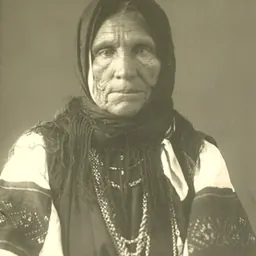
Liisu Mägi, also known as Puru Liisu and Laulu-Liisu, (16 December 1831 – 17 January 1926) was an Estonian folk singer and wedding singer in Mulgimaa and Southern Viljandi County. She was also known for creating or writing down thousands of local folk songs of life, death, war and epic events.
Biography According to some accounts, Liisu was born on 16 December 1831, in the Kutsiku tavern in Holstre parish. According to other sources, she was born on 16 December 1833 and died on 17 January 1926. Liisu Mägi lived and worked mainly in Paistu parish, Viljandi County, Mulgimaa in Estonia.
Throughout her life, Liisu challenged local prevailing customs. In church, as an unmarried woman, she was not permitted to wear a headscarf and apron, yet she insisted on doing so despite her marital status. The director of the Paistu community center commissioned the song-play "Puru Liisu’s story – Mulgi’s song play. How could it have been…" from Kauksi Ülle in 2013. As of 2023, the play remains in manuscript form and unpublished. The play was originally written in the Võru language and its content is based on Mulgi's folk songs from various folk song books, local newspaper articles and published books by local historians, events that occurred during Liisu’s lifetime, and well known people who lived and worked in Holstre rural municipality and Viljandi County at the same time. For example, in the song-play, Paistu parish school teacher Friedrich August Saebelmann invites local farm girls to sing in a mixed choir at the school. Local landlords Hain Henno, Adam Peterson, Hans Ainson and Jaan Adamson discuss the need for their own Estonian-language free school and decide to send a petition to the Russian emperor demanding the abolition of serfdom and corporal punishment.
The premiere performance of the song-play "Liisu" took place at Paistu Community Center on 1 August 2014. Director Andres Linnupuu staged it in an unconventional way: the venue's floor was covered with straw and included bales of straw. A video ran on the screen behind the actors and a musical background was added, which tied the story that has been going on for decades into a single whole and helped the spectators and actors reach the next decade. The audience sat on the stage and on chairs brought in front of the stage. In this way, the actors were on the same level as the audience, and the performance sometimes brought actors into the middle of the audience. The song-play received the main prize at the Viljandi and Pärnu County Amateur Theater Festival.
Critic Enn Siimer wrote: “As the story developed, either everyone performed in a joint song-dance-game or one or the other of the characters. Puru Liisu as a child, a young stubborn girl, a mother, and finally a blind song-mother. The production was sympathetic and nicely revived local history, which also includes a number of well-known cultural figures from the Estonian national awakening, such as Hain Henno, Ado Reinvald and Friedrich Saebelmann. While there was mostly sharp conflict between Taarka and the village community, Puru Liisu was respected and revered. Her stubbornness was evident in her relationship with the local German-speaking pastor, and this gave color and tension to the production.”
In his review, Siimer compares the folk singer Puru Liisu to the Seto song mother Hilana Taarka. He noted that the two women had similar life paths – both remained single until the end of their lives, but still became mothers and lived long lives. By creating songs and verses, both singers remained in people's minds and memories.
Don’t just read it —
keep it.
Full-length biographies made to live with: read them, listen on the way to work, watch them tonight.
- E-book
- Audio
- Video
Instant download · yours to keep · every purchase keeps this site free
Important facts
People in Liisu Mägi's life
Named in this biography and alive at the same time



Related people
Same field, nearest in time




Contemporaries
People whose lives overlapped Liisu Mägi's



Frequently asked questions
Who was Liisu Mägi?
Estonian traditional folk singer (1831-1926)
When was Liisu Mägi born?
Liisu Mägi was born on 16 December 1831 in Holstre Rural Municipality.
When did Liisu Mägi die?
Liisu Mägi died on 17 January 1926 in Holstre.
What was Liisu Mägi's occupation?
Liisu Mägi was a traditional folk singer.
What nationality was Liisu Mägi?
Liisu Mägi was Estonian.
Sources & further reading
Cite this page
APA: Biography.guide. (2026). Liisu Mägi. https://biography.guide/liisu-magi/
MLA: "Liisu Mägi." Biography.guide, https://biography.guide/liisu-magi/.
Chicago: "Liisu Mägi." Biography.guide. https://biography.guide/liisu-magi/.
Data last updated: 2026-09-20 · Spot an error? Report a correction.
Page generated 2026-09-27 05:23 UTC