
About Li Qiang
Lived 1905 – 1996 (aged 91). Li Qiang was a Chinese politician.
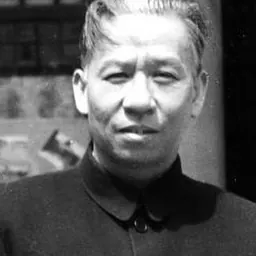
Li Qiang (; 26 September 1905 – 29 September 1996) was a Chinese Communist revolutionary, military engineer, secret agent, radio scientist, diplomat, and politician. He served as the 2nd Minister of Foreign Trade of China from November 1973 to September 1981, and was elected an academician of the Chinese Academy of Sciences in 1955.
Born into a prominent family in Changshu, as a student in Shanghai, he joined the Chinese Communist Party (CCP) during the May Thirtieth Movement in 1925, and became a key technical specialist in the early history of the CCP. After Chiang Kai-shek's Kuomintang (KMT) massacred the Communists in 1927, Li was recruited by Zhou Enlai as the communications and transportation division head of the Central Special Operations Division (Teke), the CCP's top intelligence agency, and created the CCP's first underground radio station. After his close friend and colleague Gu Shunzhang defected to the KMT in 1931, Li was forced into exile in the Soviet Union, where he studied to become a radio expert and published a book on rhombic antenna.
During the Second Sino-Japanese War, Li established an arms industry in the CCP's rural base in Yan'an and headed the Yan'an Natural Science Institute (nowadays the Beijing Institute of Technology). During the ensuing Chinese Civil War, he continued to oversee the CCP's arms industry and established a shortwave radio station for the Xinhua News Agency. After the founding of the People's Republic of China in 1949, Li served for three decades in the Ministry of Foreign Trade. As Vice-Minister, he played a major role in providing aid to North Vietnam during the Vietnam War and secretly visited the Ho Chi Minh trail. After becoming Minister of Foreign Trade in 1973, he signed hundreds of major deals to import Western technology and machinery and helped modernize China's economy.
Republican era Early life and education Li Qiang was born as on 26 September 1905 in Changshu, Jiangsu, Qing dynasty. Originally named Zeng Peihong with the courtesy name Youfan , he was a member of the prominent Zeng clan of Changsu, said to be descended from Zengzi, a major disciple of Confucius. He studied at Zongwen School in Hangzhou, but was expelled in 1923 for writing an article criticizing Confucianist traditions. He moved to Shanghai and enrolled at the High School Affiliated to Nanyang Railroad and Mining Speciality School , which used English as its language of instruction, and studied under the Kuomintang elder Ye Chucang . He joined the Chinese Communist Party (CCP) in August 1925 and made dynamite and grenades in July 1926 to prepare for the in support of Chiang Kai-shek's Northern Expedition from Guangzhou. Because of Li's experience in bomb-making and his familiarity with Shanghai's Green Gang, Zhou recruited him into Teke and made him head of the communications and transportation division (交通科), one of Teke 's four divisions. Li developed a close friendship with his colleague Gu Shunzhang, head of the Red Squad, Teke 's assassination team,
In Moscow, Li planned to study at the Communist University of the Toilers of the East, which was attended by many CCP leaders, including Liu Shaoqi, Luo Yinong, and Ren Bishi. However, Wang Ming, the CCP leader in Moscow, deeply distrusted Li because of his close relationship with Gu Shunzhang.
During the Chinese Civil War, Li oversaw arms production in Communist-controlled areas. He also held positions in the China Electronics Society and the Electronics Research Institute. In late 1970, he secretly visited the Ho Chi Minh trail to inspect the transport route of North Vietnamese troops to South Vietnam. In 1972, Li informed North Vietnam that China agreed to supply and ship critical weaponry and ammunition they requested for fighting in South Vietnam. Li's role in the Vietnam War helped shield him from attacks by the Red Guards.
Minister of Foreign Trade In October 1973, Li was promoted to Minister of Foreign Trade, replacing Bai Xiangguo, who had been dismissed. MFT was a large, important ministry with many layers of organization, which served not only commercial, but also diplomatic functions. Li was appointed partly because China became interested in importing Western technology. Yao Yilin, who later became a vice-premier and Politburo member, served as his deputy.
Li's eight-year tenure as Minister of Foreign Trade witnessed the improvement of China's foreign relations with the West. By October 1977, he had signed 197 deals to import technology and machinery from many Western countries, which greatly helped modernize China's industry, agriculture, and national defence. After the fall of the Gang of Four, he politically rehabilitated more than 2,000 people in his ministry who had been denounced and persecuted during the Cultural Revolution. Li retired in September 1981, although he continued to hold many honorary positions afterwards.
Li was a member of the 9th, 10th, and 11th Central Committee of the Chinese Communist Party, and of the 12th Central Advisory Commission. He was also a member of the 3rd, 4th, and 5th National People's Congress.
Personal life Li was married to Wei Huantu . They had two sons, Li Yanming and Li Xiaoqiang , and a daughter, Li Xiaotu .
Li was diagnosed with liver cancer in 1991. He died in Beijing on 29 September 1996, three days after his 91st birthday. He was buried in the Yushan Scenic Area in his hometown Changshu.
Don’t just read it —
keep it.
Full-length biographies made to live with: read them, listen on the way to work, watch them tonight.
- E-book
- Audio
- Video
Instant download · yours to keep · every purchase keeps this site free
Important facts
People in Li Qiang's life
Named in this biography and alive at the same time



Related people
Same field, nearest in time






Contemporaries
People whose lives overlapped Li Qiang's


Frequently asked questions
Who was Li Qiang?
Chinese revolutionary and politician (1905–1996)
When was Li Qiang born?
Li Qiang was born on 26 September 1905 in Changshu.
When did Li Qiang die?
Li Qiang died on 29 September 1996 in Beijing.
What was Li Qiang's occupation?
Li Qiang was a politician.
What nationality was Li Qiang?
Li Qiang was Chinese.
Sources & further reading
· DBpedia: Li Qiang (revolutionary)
Cite this page
APA: Biography.guide. (2026). Li Qiang. https://biography.guide/li-qiang-politician-1905/
MLA: "Li Qiang." Biography.guide, https://biography.guide/li-qiang-politician-1905/.
Chicago: "Li Qiang." Biography.guide. https://biography.guide/li-qiang-politician-1905/.
Data last updated: 2026-09-20 · Spot an error? Report a correction.
Page generated 2026-09-27 05:30 UTC