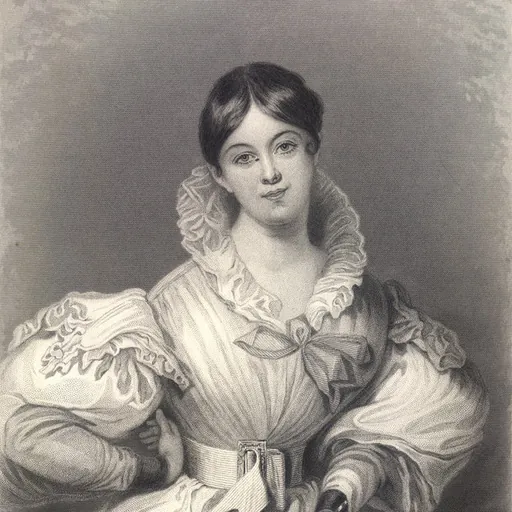
About Letitia Elizabeth Landon
Lived 1802 – 1838 (aged 36). Letitia Elizabeth Landon was a British poet, novelist, writer and editor.
Letitia Elizabeth Landon (14 August 1802 – 15 October 1838) was an English poet and novelist, better known by her initials L.E.L. Her first major breakthrough came with The Improvisatrice and she developed the metrical romance towards the Victorian ideal of the Victorian monologue, influencing fellow English writers such as Elizabeth Barrett Browning, Robert Browning, Alfred Tennyson and Christina Rossetti. Her influence can also be found in the United States, where she was very popular. Edgar Allan Poe regarded her genius as self-evident.
In spite of her wide influence, due to the perceived immorality of Landon's lifestyle, her works were largely ignored or misrepresented after her death. Other pupils of Rowden include Caroline Ponsonby, later Lady Caroline Lamb; Emma Roberts, the travel writer; Anna Maria Fielding, who published as Mrs S. C. Hall; and Rosina Doyle Wheeler, who married Edward Bulwer-Lytton and published her many novels as Rosina Bulwer Lytton. At Rowden's school, Landon became fluent in French from an early age.
The Landons moved to the countryside in 1809, so that John Landon could carry out a model farm project. Letitia Landon was educated at home by her older cousin Elizabeth from that point on. Elizabeth found her knowledge and abilities outstripped by those of her pupil: "When I asked Letitia any question relating either to history, geography, grammar – Plutarch's Lives, or to any book we had been reading, I was pretty certain her answers would be perfectly correct; still, not exactly recollecting, and unwilling she should find out just then that I was less learned than herself, I used thus to question her: 'Are you quite certain?' ... I never knew her to be wrong."
When young, Landon was close to her younger brother, Whittington Henry, born 1804. Paying for university education for him, at Worcester College, Oxford, was one of the reasons that brought Landon to publish. She also supported his preferment and later (in Fisher's Drawing Room Scrap Book, 1838) dedicated her poetical illustration Captain Cook to him, in recollection of their domestic childhood adventures together. Whittington went on to become a minister and published a book of sermons in 1835. Rather than showing appreciation for his sister's assistance, he spread false rumours about her marriage and death. Landon also had a younger sister, Elizabeth Jane (born 1806), who was a frail child and died in 1819 at the age of 13. Little is known of Elizabeth, but her death likely left a lasting impression on Letitia, and it could be Elizabeth who is referred to in the poem "The Forgotten One" ("I have no early flowers to fling").
Literary career
Early career: 1820–1834 An agricultural depression caused the Landon family to move back to London in 1815. There, John Landon met William Jerdan, editor of The Literary Gazette. According to Mrs A. T. Thomson, Jerdan took notice of the young Letitia Landon when he saw her coming down the street, "trundling a hoop with one hand, and holding in the other a book of poems, of which she was catching a glimpse between the agitating course of her evolutions". Jerdan later described her ideas as "original and extraordinary". He encouraged Landon's poetic endeavours, and her first poem was published under the single initial "L" in the Gazette in 1820, when Landon was 18. The following year, with financial support from her grandmother, Landon published a book of poetry, The Fate of Adelaide, under her full name. The book met with little critical notice, but sold well; Landon, however, received no profits, since the publisher shortly went out of business. The same month that The Fate of Adelaide appeared, Landon published two poems under the initials "L.E.L." in the Gazette; these poems, and the initials under which they were published, attracted much discussion and speculation. As contemporary critic Laman Blanchard put it, the initials L.E.L. "speedily became a signature of magical interest and curiosity". Bulwer Lytton wrote that, as a young college student, he and his classmates would
rush every Saturday afternoon for the Literary Gazette, [with] an impatient anxiety to hasten at once to that corner of the sheet which contained the three magical letters L.E.L. And all of us praised the verse, and all of us guessed at the author. We soon learned it was a female, and our admiration was doubled, and our conjectures tripled.
Landon served as the Gazettes chief reviewer as she continued to write poetry and she soon began to display an interest in art, which she projected into her poetic productions. She began, in innovative fashion, with a series on Medallion Wafers, which were commercially produced highly decorative letter seals. This was closely followed in the Literary Gazette by a Poetical Catalogue of Pictures, which was to be 'continued occasionally' and which in fact continued unremarked into 1824, the year her landmark volume, The Improvisatrice; and Other Poems was published. A further group of these poems was published in 1825 in her next volume, The Troubadour, as Poetical Sketches of Modern Pictures. In The Troubadour she included a lament for her late father, who died in 1824, thus forcing her to write to support her family; Some contemporaries saw this profit-motive as detrimental to the quality of Landon's work: a woman was not supposed to be a professional writer. Also, by 1826, Landon's reputation began to suffer as rumours circulated that she had had affairs or secretly borne children. However, her further volumes of poetry continued to be favourably reviewed, these being The Golden Violet with its Tales of Romance and Chivalry and Other Poems (1827) and The Venetian Bracelet, The Lost Pleiad, A History of the Lyre, and Other Poems (1829). During these years she became known as the 'female Byron'.
The new trend of annual gift books provided her with new opportunities for continuing her engagement with art through combinations of an engraved artwork and what she came to call 'a poetical illustration'. In the 1830s she became a highly valued artist in this field, included amongst her work, most of the poetry for Fisher's Drawing Room Scrap Books from 1832 through to 1839. Sarah Sheppard describes this work thus: 'How did pictures ever seem to speak to her soul! how would she seize on some interesting characteristic in the painting or engraving before her, and inspire it with new life, till that pictured scene spread before you in bright association with some touching history or spirit-stirring poem! L.E.L.'s appreciation of painting, like that of music, was intellectual rather than mechanical,—belonging to the combinations rather than to the details; she loved the poetical effects and suggestive influences of the Arts, although caring not for their mere technicalities.' In the words of Glenn T. Hines, 'What L.E.L.'s readers appreciated in her creations was that "new life" that she brought to her subject. Her imaginative re-castings produced intellectual pleasure for her audience. The wonderful characteristic of L.E.L.'s writings, which her readers recognized, was the author's special creative capacity to bring new meanings to her audience.'
Landon continued to publish poetry, and published her first work of prose in 1831 with her first novel, Romance and Reality. The following year, she produced her only volume of religious poetry, The Easter Gift, again as illustrations to engravings of artwork. Next she was responsible for the whole of Heath's Book of Beauty, 1833, her most self-consciously Byronic volume, which opens with The Enchantress in which she creates a 'Promethean, distinctly Luciferan, model of poetic identity and self-creation'. She returned to the long poem with The Zenana in the Drawing Room Scrap Book, 1834 and gave the 1835 Scrap Book a sting in the tale with The Fairy of the Fountains, Landon's version of the Melusine legend displaying 'the aesthetic dilemma of the woman poet who is exiled not once like the male poet, but twice'. 1834 also saw the publication of her second novel, Francesca Carrara, of which one reviewer commented 'A sterner goddess never presided over the destinies of a novel'.
In July that year Landon visited Paris with a friend, Miss Turin, who was unfortunately taken ill, restricting Landon's activities. However, amongst those she met were Heinrich Heine, Prosper Mérimée, Chateaubriand and Madame Tastu.
Engagement John Forster: 1835–1836 In 1835, Landon became engaged to John Forster. Forster became aware of rumours regarding Landon's sexual activity, and asked her to refute them. Landon responded that Forster should "make every inquiry in [his] power", which Forster did; after he pronounced himself satisfied, however, Landon broke off their engagement. To him, she wrote:
The more I think, the more I feel I ought not – I can not – allow you to unite yourself with one accused of – I can not write it. The mere suspicion is dreadful as death. Were it stated as a fact, that might be disproved. Were it a difficulty of any other kind, I might say, Look back at every action of my life, ask every friend I have. But what answer can I give ...? I feel that to give up all idea of a near and dear connection is as much my duty to myself as to you....
Privately, Landon stated that she would never marry a man who had mistrusted her. In a letter to Bulwer Lytton, she wrote that "if his future protection is to harass and humiliate me as much as his present – God keep me from it ... I cannot get over the entire want of delicacy to me which could repeat such slander to myself."
A further volume of poetry, The Vow of the Peacock, was published in 1835 and, in 1836, a volume of stories and poetry for children, Traits and Trials of Early Life. The History of a Child from this volume may draw on the surroundings of her childhood but the circumstances of the story are so unlike the known facts of her early life that it can scarcely be considered as autobiographical.
Later career
During the 1830s, Landon's poetry became more thoughtful and mature. Some of her best poems appeared in The New Monthly Magazine culminating in the series, Subjects for Pictures, with their elaborate rhyming patterns. These are in a sense a reversal of her earlier poetical illustrations of existing pictures. Also in that magazine is the set, Three Extracts from the Diary of a Week and here, she expresses her aim in opening lines, which, in Sypher's words 'could stand as a preface to much of her poetry'. A record of the inward world, whose facts Are thoughts—and feelings—fears, and hopes, and dreams. There are some days that might outmeasure years— Days that obliterate the past, and make The future of the colour which they cast. A day may be a destiny; for life Lives in but little—but that little teems With some one chance, the balance of all time: A look—a word—and we are wholly changed. We marvel at ourselves—we would deny That which is working in the hidden soul; But the heart knows and trembles at the truth: On such these records linger.
In 1837, Landon published another novel, Ethel Churchill, and began to explore new forms in which to express her literary talent. One of these was her dramatic tragedy, Castruccio Castracani, which represents a culmination of her development of the metrical romance, both in its form and content. Already, she had experimented with verses for Schloss's Bijou Almanacks, which measured 3/4 by 1/2 inch and were to be read with a magnifier. She also negotiated with Heath for the publication in the future of a series of Female Portraits of characters from literature. Her final endeavour was Lady Anne Granard (or Keeping up Appearances), a lighter novel, but her work on this at Cape Coast was cut short.
Later life
Landon began to "[talk] of marrying any one, and of wishing to get away, from England, and from those who had thus misunderstood her". In October 1836, Landon met George Maclean, governor of the Gold Coast (now Ghana), at a dinner party given by Matthew Forster, and the two began a relationship. Maclean moved to Scotland early the following year, to the surprise and distress of Landon and her friends. After much prodding, Maclean returned to England and he and Landon were married shortly thereafter, on 7 June 1838. The marriage was held privately, and Landon spent the first month of it living with friends. Her schoolfriend Emma Roberts wrote of Maclean:
No one could better appreciate than L.E.L. the high and sterling qualities of her lover's character, his philanthropic and unceasing endeavours to improve the condition of the natives of Africa; the noble manner in which he interfered to prevent the horrid waste of human life by the barbarian princes in his neighbourhood; and the chivalric energy with which he strove to put an end to the slave-trade. L.E.L. esteemed Mr Maclean the more, in consequence of his not approaching her with the adulation with which her ear had been accustomed, to satiety; she was gratified by the manly nature of his attachment. Possessing, in her estimation, merits of the highest order, the influence which he gained over her promised, in the opinion of those who were best acquainted with the docility of her temper, and her ready acquiescence with the wishes of those she loved, to ensure lasting happiness.In early July, the couple sailed for Cape Coast, where they arrived on 16 August 1838. During the short time she had in Africa, Landon continued her work on The Female Portrait Gallery, covering Walter Scott's principal heroines, and completed the first volume of a new novel, Lady Anne Granard, or Keeping Up Appearances.
In his 1883 memoir Retrospect of a Long Life, Samuel Carter Hall writes of Landon's marriage and husband in very negative terms. "Her marriage wrecked her life; but before that fatal mistake was made, slander had been busy with her fair fame" (Retrospect, p. 395). Landon had taken "refuge from [slander] . . . in union with a man utterly incapable of appreciating her or making her happy, and [she] went out with him to his government at the Gold Coast -- to die" (ibid.). Her death was "not even -- tragical as such an ending would have been . . . to wither before the pestilential influences that steam up from that wilderness of swamp and jungle" but rather "to die a violent death -- a fearful one" (ibid.). right Letitia Landon as The Minstrel of Chamouni, by Pickersgill, 1829–30Here Hall asserts his belief that Landon was murdered by her husband's common-law wife: "unhappy 'L.E.L.' was murdered I never had a doubt. . . . She landed at Cape Coast Castle in July, 1838, and on the 15th of October she was dead . . . from having accidentally taken a dose of prussic acid. But where was she to have procured that poison? . . . .It was not among the contents of the medicine-chest she took out from England" (ibid., pp. 395–396). Rather, claims Hall, after arriving in Africa, "Maclean left her on board while he went to arrange matters on shore. A negro woman was there, with four or five children -- his children; she had to be sent into the interior to make room for her legitimate successor. It is understood the negress was the daughter of a king . . . [and] from the moment 'L.E.L.' landed her life was at the mercy of her rival; that by her hand she was done to death I am all but certain" (ibid., p. 396).
In fact, Maclean's local mistress had left for Accra long before their arrival, as was confirmed by later interviews with her. His going ashore was most likely to ensure that the accommodation arranged for his new wife was in a healthy condition. The date on her prescription for dilute prussic acid was 1836, probably given when she was first diagnosed as having a critical heart condition.
Most of Hall's accounts are based on the fantastic stories invented by the press following Mrs Maclean's death and have little or no basis in fact.
Among the poets of her own time to recognise and admire Landon were Elizabeth Barrett Browning, who wrote "L.E.L.'s Last Question" in homage; and Christina Rossetti, who published a tribute poem entitled "L.E.L" in her 1866 volume The Prince's Progress and Other Poems.
Landon's reputation, while high in the 19th century, fell during most of the 20th as literary fashions changed: her poetry was perceived as overly simple and sentimental. However, such criticism had already been addressed by Sarah Sheppard in her "Characteristics of the Genius and Writings of L E L" of 1841. Her opening paragraph runs:
Because they whose decision it is, are subjects of the superficial spirit of the age, which leaves them unacquainted with all of which it appoints them judges. Because, either from a dislike of trouble, or inability to pursue the inquiry, these judges never deviate from their own beaten right line to observe how genius acts and is acted upon,—how it is influenced, and what effects it produces on society. Hence the mistaken opinions concerning literary characters one is often compelled to hear from those who, it is to be feared, know little of what they affirm; and of literary works from those who, it is also to be feared, are not competent to decide on their merits. It is indeed strange with what decision people set their seal of condemnation on volumes beyond whose title-pages they have scarcely looked.
In recent years, scholars and critics have increasingly studied her work, beginning with Germaine Greer in the 1970s. Critics such as Isobel Armstrong argue that the supposed simplicity of poetry such as Landon's is deceptive, and that women poets of the 19th century often employed a method of writing which allows for multiple, concurrent levels of meaning. McMullen argues that Landon, although she wrote about what would sell—romance, sensuality, vicariousness, etc., and plays the role of the imitator, actually uses genealogical subversion underneath her words to canonize herself. In mistranslation and retranslation of already quickly canonized Romantic male poets, Landon establishes herself among and even beyond their accomplishments.
Her ideas and the diversity of her poetry engendered a "Landon School", in England and the United States. As for style, William Howitt comments: "This is one singular peculiarity of the poetry of L. E. L.; and her poetry must be confessed to be peculiar. It is entirely her own. It had one prominent and fixed character, and that character belonged solely to itself. The rhythm, the feeling, the style and phraseology of L. E. L.'s poetry, were such, that you could immediately recognize it, though the writer's name was not mentioned."
A tribute in The Literary Gazette, following Landon's death, ran:
To express what we feel on her loss is impossible – and private sorrows of so deep a kind are not for public display: her name will descend to the most distant times, as one of the brightest in the annals of English literature; and whether after ages look at the glowing purity and nature of her first poems, or the more sustained thoughtfulness and vigour of her later works, in prose or in verse, they will cherish her memory as that of one of the most beloved of female authors, the pride and glory of our country while she lived, and the undying delight of succeeding generations. Then, as in our day, young hearts will beat responsive to the thrilling touch of her music; her song of love will find a sacred home in many a fair and ingenuous bosom; her numbers, which breathed of the finest humanities, her playfulness of spirit, and her wonderful delineation of character and society – all – all will be admired, but not lamented as now. She is gone; and, oh, what a light of mind is extinguished: what an amount of friendship and of love has gone down into the grave
Don’t just read it —
keep it.
Full-length biographies made to live with: read them, listen on the way to work, watch them tonight.
- E-book
- Audio
- Video
Instant download · yours to keep · every purchase keeps this site free
Important facts
Family & relationships
People in Letitia Elizabeth Landon's life
Named in this biography and alive at the same time



Related people
Same field, nearest in time
Contemporaries
People whose lives overlapped Letitia Elizabeth Landon's





Frequently asked questions
Who was Letitia Elizabeth Landon?
British poet and novelist (1802–1838)
When was Letitia Elizabeth Landon born?
Letitia Elizabeth Landon was born on 14 August 1802 in Chelsea, London.
When did Letitia Elizabeth Landon die?
Letitia Elizabeth Landon died on 15 October 1838 in Cape Coast.
What was Letitia Elizabeth Landon's occupation?
Letitia Elizabeth Landon was a poet, novelist, writer and editor.
What nationality was Letitia Elizabeth Landon?
Letitia Elizabeth Landon was British.
Sources & further reading
· Wikipedia: Letitia Elizabeth Landon
· DBpedia: Letitia Elizabeth Landon
Cite this page
APA: Biography.guide. (2026). Letitia Elizabeth Landon. https://biography.guide/letitia-elizabeth-landon/
MLA: "Letitia Elizabeth Landon." Biography.guide, https://biography.guide/letitia-elizabeth-landon/.
Chicago: "Letitia Elizabeth Landon." Biography.guide. https://biography.guide/letitia-elizabeth-landon/.
Data last updated: 2026-09-23 · Spot an error? Report a correction.
Portrait: Wikimedia Commons · author & licence
Page generated 2026-09-27 05:05 UTC