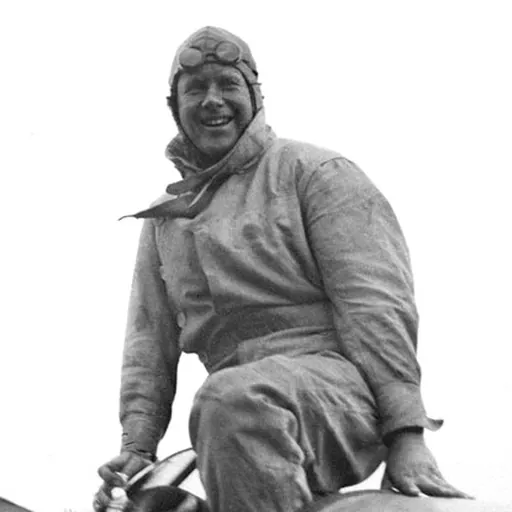
About Les Holden
Lived 1895 – 1932 (aged 37). Les Holden was an Australian aircraft pilot.
Leslie Hubert Holden, MC, AFC (6 March 1895 – 18 September 1932) was an Australian fighter ace of World War I and later a commercial aviator. A South Australian, he joined the Light Horse in May 1915, serving in Egypt and France. In December 1916, he volunteered for the Australian Flying Corps and qualified as a pilot. As a member of No. 2 Squadron on the Western Front, he gained the sobriquets "Lucky Les" and "the homing pigeon" after a series of incidents that saw him limping back to base in bullet-riddled aircraft. He was awarded the Military Cross, and went on to achieve five aerial victories flying Airco DH.5s and Royal Aircraft Factory S.E.5s.
Promoted to captain, Holden finished the war as an instructor with No. 6 (Training) Squadron in England, where his work earned him the Air Force Cross. After leaving the Australian Flying Corps in 1919, he became a manager at the family firm of Holden's Motor Body Builders and joined the part-time Citizen Air Force, before setting up as a commercial pilot and establishing his own air service. In 1929, he located Charles Kingsford Smith and Charles Ulm in the north-west Australian desert after the pair were reported missing on a flight to England in the Southern Cross. Holden began transport operations in New Guinea in 1931. He was killed the following year in a passenger plane crash in Australia.
Family and early life Leslie Hubert Holden was born on 6 March 1895 in East Adelaide, South Australia, to travelling businessman Hubert William Holden and his wife Annie Maria. Les was the nephew of H. J. Holden, who later founded the Adelaide-based firm Holden's Motor Body Builders with his son Edward. Hubert Holden landed a partnership with Nestlé in 1905, and the family moved to Turramurra, New South Wales. Les completed his education at Sydney Church of England Grammar School, and joined Nestlé in 1911 as a salesman. Serving as a driver first in the Middle East and then on the Western Front, his mechanical ability and sense of adventure led him to volunteer for the Australian Flying Corps (AFC) in December 1916. After qualifying as a pilot in England, he was commissioned a lieutenant and posted to No. 2 Squadron. Holden was involved in the AFC's first day of combat in France; just after noon on 2 October, in the vicinity of Saint-Quentin, he and his wingman engaged a German two-seater that managed to escape.
Because its Airco DH.5s were handicapped when used as fighters by engine problems and low speed, No. 2 Squadron was employed mainly in ground support duties. He returned to a forward airfield near Havrincourt Wood with his plane "a flying wreck", in the words of the official history of Australia in the war: "Every part of it was shot full of holes, including petrol-tank, tail-plane, both longerons, and part of the undercarriage, while the elevator control was shot clean away." He was recommended for the Military Cross on 3 December for his actions of 20 November. The award was promulgated in the London Gazette on 4 February 1918, and the citation appeared on 5 July:
Holden claimed his first aerial victory while No. 2 Squadron was still flying DH.5s, before it began converting to Royal Aircraft Factory S.E.5s in December 1917. On 18 February 1918, he shared in one of the unit's first two victories in the S.E.5, helping send an Albatros down in a spin. He claimed another three aircraft shot down over the following month, giving him a total of five victories.
Royal Air Force policy required pilots to be rotated to home establishment for rest and instructional duties after nine to twelve months in combat. Promoted to captain in March 1918, Holden was posted to England in May as a flying instructor with No. 6 (Training) Squadron at Minchinhampton. His unit was part of the 1st Training Wing, led by Lieutenant Colonel Watt, the former commanding officer of No. 2 Squadron. Holden briefly took command of No. 6 Squadron from 25 July to 11 August. He was awarded the Air Force Cross, promulgated on 3 June 1919, for his skill as an instructor.
Post-war career and legacy Holden in the cockpit of Canberra, his DH.61 Giant Moth, with passengers at Mascot Aerodrome, c. 1930 No. 6 Squadron was disbanded in March 1919. He was discharged from the AFC on 18 August 1919. After taking part in the Commonwealth Government's Peace Loan flights, he joined Holden's Motor Body Builders as its Sydney manager. Holden married Kathleen Packman at St Mark's Anglican Church in Darling Point on 3 June 1924; the couple had three daughters. Ranked flight lieutenant, he served as a pilot with No. 3 Squadron, which operated Airco DH.9s and S.E.5s. Formed at RAAF Point Cook, Victoria, it transferred to the newly opened RAAF Richmond, New South Wales, during 29–30 June; Holden and Malley touched down at Richmond with the first two S.E.5s on the 30th. Still hankering after a full-time career in flying, Holden enlisted the help of friends to purchase a de Havilland DH.61 Giant Moth in 1928. He named it Canberra, and used it to start a charter operation out of Mascot Aerodrome in Sydney. He continued flying commercially, and is credited with making, in September 1931, possibly the first flight from Sydney to New Guinea, where he started an air freight service.
On 18 September 1932, Holden was travelling as a passenger aboard a New England Airways DH.80 Puss Moth from Sydney to Brisbane when it crashed at Byron Bay in northern New South Wales, killing him instantly. A crowded memorial service for Holden and Hamilton took place at Sydney Church of England Grammar School on 20 September; they were cremated that afternoon at Rookwood Cemetery, where eighteen aircraft piloted by friends and associates of the pair overflew the chapel.
Holden, George Hamilton, and one of their schoolmates who had also recently died, Henry Braddon, were commemorated with a memorial stained-glass window at the Sydney Church of England Grammar School chapel in 1934. His father Hubert carried on operating Holden's Air Transport, floating it as a public corporation and serving as chairman.
Don’t just read it —
keep it.
Full-length biographies made to live with: read them, listen on the way to work, watch them tonight.
- E-book
- Audio
- Video
Instant download · yours to keep · every purchase keeps this site free
Important facts
People in Les Holden's life
Named in this biography and alive at the same time


Related people
Same field, nearest in time

Contemporaries
People whose lives overlapped Les Holden's
Frequently asked questions
Who was Les Holden?
Australian World War I flying ace and commercial aviator
When was Les Holden born?
Les Holden was born on 6 March 1895 in Adelaide.
When did Les Holden die?
Les Holden died on 18 September 1932 in Byron Bay.
What was Les Holden's occupation?
Les Holden was an aircraft pilot.
What nationality was Les Holden?
Les Holden was Australian.
Sources & further reading
Cite this page
APA: Biography.guide. (2026). Les Holden. https://biography.guide/les-holden/
MLA: "Les Holden." Biography.guide, https://biography.guide/les-holden/.
Chicago: "Les Holden." Biography.guide. https://biography.guide/les-holden/.
Data last updated: 2026-09-22 · Spot an error? Report a correction.
Portrait: Wikimedia Commons · author & licence
Page generated 2026-09-27 05:03 UTC