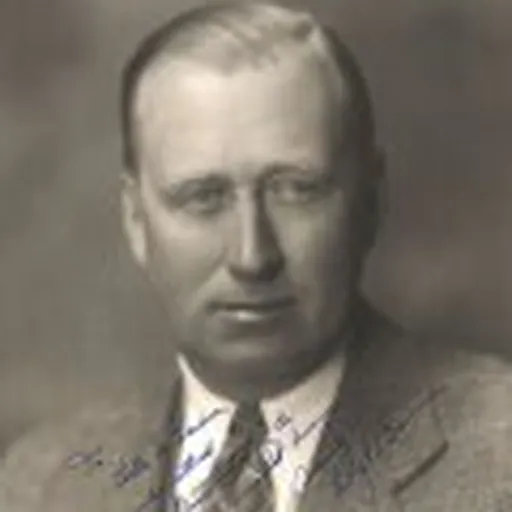
Leroy Grumman
American aerospace engineer
About Leroy Grumman
Lived 1895 – 1982 (aged 87). Leroy Grumman was an American military officer, military flight engineer, inventor, aircraft pilot, entrepreneur and grumman.
Leroy Randle "Roy" Grumman (4 January 1895 – 4 October 1982) was an American aeronautical engineer, test pilot, and industrialist. In 1929, he co-founded Grumman Aircraft Engineering Co., later renamed Grumman Aerospace Corporation, and now part of Northrop Grumman.
Early life Grumman was born in Huntington, New York. His forebears had Connecticut roots and owned a brewery. When he was a child, his father, George Tyson Grumman, owned and operated a carriage shop, and later worked for the post office. From an early age, "Red Mike" (a nickname he gained because of his red-blond hair)
Grumman earned a Bachelor of Science degree in mechanical engineering from Cornell University in 1916.
Aviation career Although Grumman applied for flight training, he failed a medical evaluation when the examining board incorrectly diagnosed flat feet. A clerical error, however, had him report to a course in aircraft inspection for pilot trainees at Massachusetts Institute of Technology. Without revealing the error in classification, he entered primary flight training at Naval Air Station Miami and successfully completed advanced flight training in Pensacola, Florida, in September 1918. After the completion of the course, Grumman's first posting, along with a promotion to lieutenant, was at the League Island Naval Yard as an acceptance test pilot for Curtiss- and Navy-built flying boats. Keystone closed their Manhattan factory and moved operations to Bristol, Pennsylvania.
Company founding
Unwilling to leave Long Island to continue working for Keystone, Grumman joined fellow Loening employees Jake Swirbul and William Schwendler in resolving that their best option was to quit and form their own company. Grumman mortgaged his house for $16,950 and Swirbul's mother borrowed $6,000 from her employers to help set up Grumman Aeronautical Engineering Co. The co-founders were soon joined by Ed Poor, Grover Loening's business manager, and E. Clinton Towl, who had recently come from Wall Street. These five men formed the company's inner circle of management for the next 50 years. Loening and his brother, Albert P. Loening, also became investors. The company was named after its largest stockholder and first president. To family and close friends, he was invariably known as "Roy". The innovative, manually operated landing gear which progressed from a heavy and unreliable design to a more sturdy version helped his company win contracts from the U.S. Navy. When the Grumman Company received its first U.S. Navy production contract for a two-seater biplane fighter, the FF-1, it featured Grumman's trademark "splayed out" landing gear. He single-handedly invented the famous "Sto-Wing" wing-panel folding system that revolutionized carrier aircraft storage and handling, pioneered on the F4F-4 Wildcat subtype. He worked out the solution by sticking paper clips into a soap eraser to find the pivot point that made the Sto-Wing possible.
Although Grumman realized the importance of his close relationship with the U.S. Navy, by the mid-1930s, he began to design aircraft for the commercial market with the development of the G-21 "Goose" amphibian and the G-22 "Gulfhawk", civil version of the Grumman F3F carrier-based fighter.
Expansion As the company expanded, it moved to bigger quarters – to Valley Stream in 1931, Farmingdale in 1932, and finally Bethpage in 1937. In 1934, a company legend grew up around the number "250" which marked the zenith for expansion in Grumman's mind. He reasoned that if there were more than 250 employees, "it's going to be too big and we're going to lose control of it. That's where we ought to stop." Company accountant Towl was eventually deputized to tell Grumman that the payroll was already at 256.
Management style Despite his innate shyness, Grumman's management style included a "hands-on" approach where he could talk comfortably with both executives and factory floor workers. His relationship with Swirbul was unusual. They resolved early in their partnership to work out of one office; both men further pledged that any problems or conflicts that arose between them would not fester, and that neither man would leave the office until they came to an understanding.
During an unusually hectic period in the summer of 1944, Grumman sought a release from tension in a unique manner. Seeking out company test pilot Selden "Connie" Converse, he asked for a check out in a "hot ship": the front line F6F Hellcat. After a 10-minute cockpit check, Grumman waved Converse away, started the engine and was soon taxiing down the runway and into the air on a half-hour joy ride. Even though he hadn't flown for years, as he had in the past, when things built up, he would "take his troubles upstairs and leave them there." The factory test pilots observed that Grumman had the flaps down as he taxied back to the flight line, and insisted that he pay the standard $1.00 fine for a flight infraction. Grumman stuffed a five-dollar bill into the party fund container, confiding that it was to make up "for things he'd done in the air that they hadn't seen." Although he was not entirely blind, his vision was greatly affected; Grumman began to "become less visible" in the company.
Postwar By March 1945, Grumman oversaw a production effort where all types reached a record 664 aircraft manufactured in one month, although Swirbul had "farmed out" production to a vast chain of subsidiary and licensed manufacturing plants. when a canvass was made of employees who wanted to "move on" at war's end, only 126 came forward.
Swirbul realized his wartime expansion would have to be abandoned, and together with Grumman made the momentous call for a complete layoff of all staff. However, Grumman personally retained as many veteran employees as possible, calling back the most proficient and experienced "hands", predominantly those who had 10 years of service. Grumman stepped down from the role of company president in 1946, but continued to play an active role in management. Although the relationship that Grumman had established with the U.S. Navy was the hallmark of the company's success, a set of new projects were initiated with the development of an engineering department, set up in much the same way that he had started out, with a small core of eight engineers given the mandate to explore new technology.
With Swirbul's death on 28 June 1960, Grumman lost not only a close friend but his "right hand" during a time when he was faced with critical decisions as to the company's future. He successfully guided the company into finding new markets for new products. In the move to diversification, he again entered the commercial civil aviation market, introducing landmark designs such as the Ag Cat aerial application and crop-dusting biplane and the Gulfstream I, Gulfstream II, Gulfstream III and Gulfstream IV series of executive turboprop and jet transport aircraft. Although his role as chairman became reduced, Grumman's counsel was paramount and when the Gulfstream project was launched, two models of a high-wing and low-wing configuration were set up outside his office. Grumman personally made the decision to go with "the low wing".
While continuing the company tradition of aircraft production for naval aviation, Grumman pushed for a shift in priorities resulting in the Space Steering Group, a space program that culminated in the design and production of the Apollo program's Lunar Excursion Module (LEM) that landed astronauts on the Moon in 1969. During that same year, the company was rebranded as Grumman Aerospace Corporation. Throughout this period, Grumman's eyesight continued to fail, and he "took to wearing dark glasses" which further limited his mobility. an honorary Doctor of Engineering degree by Brooklyn Polytechnic Institute in 1950, the Daniel Guggenheim Medal for aeronautics pioneering,
In 1972, Grumman was inducted in the National Aviation Hall of Fame, the International Air & Space Hall of Fame in 1973, and the Long Island Technology Hall of Fame in 2002.
The USNS Leroy Grumman (T-AO-195), a United States Navy fleet replenishment oiler, christened by his three daughters, was launched in 1988 and delivered to the U.S. Navy in 1989. In January 2011, a Civil Air Patrol Squadron from Northport, Long Island, New York, was renamed in his honor: the former Suffolk County Cadet Squadron VII now calls itself the Leroy R. Grumman Cadet Squadron.
In 1953, Grumman was elected to the board of trustees of his alma mater, Cornell University, and donated $110,000 for a new squash building which now bears his name, as does an office and lab space on the campus.
Don’t just read it —
keep it.
Full-length biographies made to live with: read them, listen on the way to work, watch them tonight.
- E-book
- Audio
- Video
Instant download · yours to keep · every purchase keeps this site free
Important facts
People in Leroy Grumman's life
Named in this biography and alive at the same time



Related people
Same field, nearest in time


Contemporaries
People whose lives overlapped Leroy Grumman's

Frequently asked questions
Who was Leroy Grumman?
American aerospace engineer (1895–1982)
When was Leroy Grumman born?
Leroy Grumman was born on 4 January 1895 in Huntington.
When did Leroy Grumman die?
Leroy Grumman died on 4 October 1982 in Manhasset.
What was Leroy Grumman's occupation?
Leroy Grumman was a military officer, military flight engineer, inventor, aircraft pilot, entrepreneur and grumman.
What nationality was Leroy Grumman?
Leroy Grumman was American.
Sources & further reading
Cite this page
APA: Biography.guide. (2026). Leroy Grumman. https://biography.guide/leroy-grumman/
MLA: "Leroy Grumman." Biography.guide, https://biography.guide/leroy-grumman/.
Chicago: "Leroy Grumman." Biography.guide. https://biography.guide/leroy-grumman/.
Data last updated: 2026-09-23 · Spot an error? Report a correction.
Portrait: Wikimedia Commons · author & licence
Page generated 2026-09-27 05:05 UTC