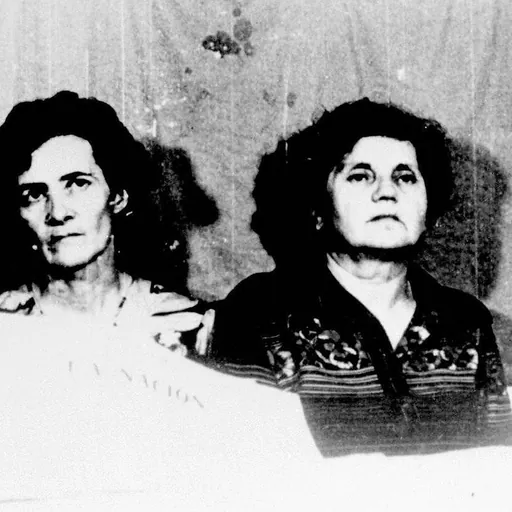
Léonie Duquet
French nun
About Léonie Duquet
Lived 1916 – 1977 (aged 61). Léonie Duquet was a French religious sister.
Memorial of two murdered French Religious Sisters in France, Place Alice Domon-et-Léonie-Duquet Street, Paris.
Marie Léonie Duquet, S.M.E. (9 April 1916 – December 1977) was one of two French Religious Sisters, members of the Sisters of the Foreign Missions based in Seysses, France, who were arrested in December 1977 in Buenos Aires, Argentina, and "disappeared". Alice Domon, the other French Sister working with Duquet, disappeared a few days later. They are believed to have been murdered by the military regime of Argentine President Jorge Rafael Videla during the Dirty War.
Duquet and Domon had been working in poor neighborhoods of Buenos Aires in the 1970s and supported the Mothers of the Plaza de Mayo, founded in 1977. Despite repeated efforts by France to trace the two Sisters, the Argentine military dictatorship was unresponsive. In 1990 a French court in Paris tried Argentine Captain Alfredo Astiz, known to have arrested Duquet and believed implicated in the "disappearance" of Domon, for kidnapping the two Sisters. He was convicted and sentenced to life imprisonment in absentia. After taking her religious vows, she traveled and worked as a missionary internationally.
In August 1949, Duquet was one of a group of four Sisters sent to Argentina by the congregation to establish their work in that country. They started their service in the city of Hurlingham. She later began to be involved in social work in the capital and its surrounding suburbs.
Another member of the congregation, Alice Domon, was assigned to Argentina during the early 1970s. At that time she was assigned to the group directed by Father Ismaele Calcagno, a first cousin of Jorge Rafael Videla, the future dictator of Argentina. Duquet and Domon were introduced to Videla because he needed assistance for his son Alejandro, a disabled child whom they taught and looked after in the Casa de la Caridad in Morón.
In Buenos Aires the two Sisters devoted their time to social work amongst the inhabitants of the city’s poorest townships. Duquet was dedicated to helping Argentina's poor and worked among them in Buenos Aires province as well as in the capital city. She lived and worked at the Church of San Pablo in Ramos Mejia, on the south side of the city.
Duquet is believed to have been killed by a military death squad under Astiz' command. As neither her nor Villaflor's bodies were found, some observers thought the women may have been among victims flown by plane and helicopter and thrown out while still alive over the ocean near Buenos Aires. In early 1978, unidentified bodies began to wash up on the beaches south of Buenos Aires.
The "disappearances" of Duquet and Domon, two French nationals, attracted international attention and outrage, with demands for a United Nations investigation of human rights abuses in the country. France demanded information of both the French nuns, but the Argentine government denied all responsibility for them.
Despite losing some of their founders, the Mothers of the Plaza continued marching and within the year hundreds of women and family friends joined them, demanding an accounting from the government. The weekly marches and annual anniversaries of resistance stood against the government's silence about the "disappeared".
Later trial and discovery In 1990, Alfredo Astiz was tried and convicted in absentia of the kidnapping of the two sisters, Duquet and Domon, by a French court in Paris and sentenced to life imprisonment. He was not charged with murder because no bodies had been found for Duquet or Domon.
Argentine trial During the ESMA trial, Luis María Mendía testified in January 2007 before the Argentine tribunal that a French intelligence agent, Bertrand de Perseval, had participated in the abduction of Duquet and Domon. Perseval, who lives today in Thailand, has denied any links with the abduction of the nuns. He has admitted to being a former member of the Organisation armée secrète (OAS) operated by the French in Algeria during the civil war and said he went to Argentina after the March 1962 Évian Accords ended the Algerian War (1954–62).
French intelligence agents have long been suspected of having trained Argentine counterparts in "counter-insurgency" techniques (including the use of torture in investigations). Marie Monique Robin's TV documentary, The Death Squads – the French School (Les escadrons de la mort – l'école française, 2003), based on her book, documented that the French intelligence services had trained Argentine counterparts in counter-insurgency techniques.
During his testimony, Luis María Mendia referred to the film as evidence, and asked that the Argentine Court require former French president Giscard d'Estaing, former French premier Messmer, former French ambassador to Buenos Aires François de la Gorce, and all officials in place in the French embassy in Buenos Aires between 1976 and 1983 to be summoned before the court for their part in the abuses. Besides this French connection, he said the former head of state Isabel Perón and former ministers Carlos Ruckauf and Antonio Cafiero, who signed the "anti-subversion decrees" before Videla's 1976 coup d'état, had set up the policy and mechanism for state terrorism.
ESMA survivor Graciela Daleo characterized Mendía's allegations as a tactic to justify his crimes as legitimate. Under the 1987 Obediencia Debida Act, passed under pressure by the military, lower-level military and security personnel could not be prosecuted for carrying out orders. Similarly, Mendía said he and others had obeyed Isabel Perón's "anti-subversion decrees" (giving them a formal appearance of legality, although torture was forbidden by the Argentine Constitution).
The 1986 and 1987 Pardon Laws had been repealed in 2003, and ruled unconstitutional by the Argentine Supreme Court in 2005. By the time of Mendía's trial, this legislation provided no protection to him and others indicted for crimes committed under the military dictatorship.
In 2012, an Argentinian prosecutor filed charges against Julio Alberto Poch (es), a Dutch-Argentinian pilot, for flying the helicopter that carried the bodies of Domon, Duquet and three other women to be dumped into the Atlantic Ocean. On November 29, 2017, an Argentinian court unanimously acquitted Mr. Poch.
Family Duquet's niece is Sister Geneviève Jeanningros, one of the Little Sisters of Jesus, who since the 1960s has had a ministry to circus performers, living, working and travelling with them in a caravan, latterly in and around Rome. In 2005, Sister Geneviève negotiated the re-burial of her aunt's body with the then Archbishop of Buenos Aires, Jorge Mario Bergoglio, later Pope Francis, and they became friends; the Pope mentioned her in his autobiography. After his death, Sister Geneviève came to public attention when, during the Pope's lying-in-state, the Vatican permitted her, against protocol, to stand for several minutes within the cordon around the open coffin to mourn and pray for him.
Don’t just read it —
keep it.
Full-length biographies made to live with: read them, listen on the way to work, watch them tonight.
- E-book
- Audio
- Video
Instant download · yours to keep · every purchase keeps this site free
Important facts
People in Léonie Duquet's life
Named in this biography and alive at the same time




Related people
Same field, nearest in time



Contemporaries
People whose lives overlapped Léonie Duquet's



Frequently asked questions
Who was Léonie Duquet?
French nun (1916-1977)
When was Léonie Duquet born?
Léonie Duquet was born on 9 April 1916 in Longemaison.
When did Léonie Duquet die?
Léonie Duquet died on 1 December 1977 in Argentina.
What was Léonie Duquet's occupation?
Léonie Duquet was a religious sister.
What nationality was Léonie Duquet?
Léonie Duquet was French.
Sources & further reading
Cite this page
APA: Biography.guide. (2026). Léonie Duquet. https://biography.guide/leonie-duquet/
MLA: "Léonie Duquet." Biography.guide, https://biography.guide/leonie-duquet/.
Chicago: "Léonie Duquet." Biography.guide. https://biography.guide/leonie-duquet/.
Data last updated: 2026-09-20 · Spot an error? Report a correction.
Portrait: Wikimedia Commons · author & licence
Page generated 2026-09-27 04:58 UTC