
Léonce Rosenberg
French art dealer and art historian
About Léonce Rosenberg
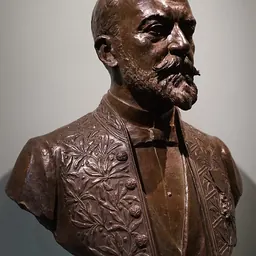
Lived 1879 – 1947 (aged 67). Léonce Rosenberg was a French art historian, art collector and art dealer.
Léonce Rosenberg (12 September 1879 in Paris – 31 July 1947 in Neuilly-sur-Seine) was an art collector, writer, publisher and art dealer. He was a supporter and promoter of the cubists, especially during World War I and in the years immediately after.
Early life The son of an antique dealer Alexandre Rosenberg and brother of the gallery owner Paul Rosenberg (21 rue de la Boétie, Paris),
After returning to Paris he worked with his brother Paul in the family business. In 1906 Léonce and his brother took over the running of the family gallery, then on Avenue de l'Opéra and which had been in existence since 1872. It specialised in 19th- and early 20th-century art, including Impressionist and Post-Impressionist paintings.
Léonce Rosenberg, however, soon began increasingly to be drawn to the avant garde experimentation of which Paris was the centre, and he began acquiring works by Cubist artists, bought mainly from the gallery of Daniel-Henry Kahnweiler, who was at the time the primary dealer and promoter of the Cubists.
World War I and its aftermath World War I proved to be the defining opportunity of Léonce Rosenberg's career.
Even before the war, growing anti-German sentiment and the role of German dealers in the rise of Cubism attracted hostility and led to Cubism being characterised as a German movement, even though most of the artists were French or Spanish. The outbreak of war also drove many of the artists who made up the avant garde circle to leave Paris. Some were called up to fight. Some left for the south of France while others, especially those with German connections or who were not French citizens, dispersed to Spain, Portugal and even America.
The same was true of many of the collectors and dealers. Galleries closed. Daniel-Henry Kahnweiler, who until the war was the primary dealer for many of the Cubists, was left stranded in Switzerland during the war. As a German citizen he couldn't return to France, and his collection was seized by the French government. It left Kahnweiler's roster of artists without their livelihood.
In stepped Léonce Rosenberg. He had begun to collect avant garde, especially Cubist, art before the war, but he now stepped up this activity with the encouragement of André Level, Pablo Picasso and Juan Gris, who were all instrumental in persuading him to fill the hole left by Kahnweiler. He also thought that the prices the Cubists could command would rise. Bidding was lacklustre, mainly because many of the potential buyers had little money and because the market became saturated through the rapid sale of so many paintings. Kahnweiler managed to pick up most of the works by Gris and Braque that were up for auction. It was a battle as much for the minds of those who influenced taste and trends in the Parisian art market as for the pockets of those with the money to spend in that market.
In mounting the first post-war Cubist exhibitions at L'Effort Moderne, Léonce Rosenberg managed to re-establish Cubism as a force within avant garde art, in the face of claims to the contrary by hostile critics.
L'Effort Moderne was not just a dealer's gallery. It was also an umbrella for a wide range of related activities aimed at raising the profile of its artists. There were regular literary and musical events designed to draw in the Parisian cultural elite. The first of these, a reading by Blaise Cendrars and performance by Erik Satie, took place in February 1919 during Fernand Léger's exhibition.
Most notably, L'Effort Moderne was also a publishing house, Éditions de L'Effort Moderne. This published a series of books featuring not only the gallery's artists, including Braque, Gris, and Léger, but also closely associated avant-garde poets such as Max Jacob, Pierre Reverdy, and Blaise Cendrars.
Although several of the leading Cubists defected from Léonce Rosenberg in the 1920s, some of them to his brother Paul, Léonce continued to represent a variety of modern artists including Giorgio de Chirico, József Csáky, Jean Metzinger, Léopold Survage, Francis Picabia and Fernand Léger. Rather than taking paintings from artists on a sale or return basis like most dealers, he insisted on buying the works outright. What he sold, he first owned. He also preferred to acquire only recent paintings, in order to maintain freshness and a greater control over prices. This grand, even megalomaniac, project reinforced Rosenberg's presentation of himself as a modern form of patron.
His optimism about the market in the face of the gathering financial storm was misplaced, however. L'Effort Moderne went bankrupt in 1931, with much of the stock auctioned off in London.
Léonce Rosenberg corresponded frequently, during certain periods, daily, with his artists. This correspondence, along with business papers, gallery inventory records and the like, are now held in various public archives, including those of the Museum of Modern Art in New York
The letters in the Léonce Rosenberg collection at the Pompidou Centre, which only relatively recently, in the 1990s and 2000s, became available in a public archive and more accessible to historians. Comprising more than 800 letters and cards to Rosenberg from various artists and copies of more than 600 sent by him, the correspondence forms a diary-like collection, journaling his dealings through some of the most problematic years in the history of modern art. They are enabling art historians to reassess their view of some of the artists and of Rosenberg, and to start to explore some subjects in greater detail, such as the pressures exerted on artists and dealers by the economic situation between the two world wars.
Selected exhibitions Auguste Herbin, 1 – 22 March 1918 Henri Laurens, 5 – 31 December 1918 Jean Metzinger, 6 – 31 January 1919 Fernand Léger, 5 – 28 February 1919 Georges Braque, 5 – 31 March 1919 Juan Gris, 5 – 30 April 1919 Gino Severini, 5 – 31 May 1919 Pablo Picasso, 5 – 25 June 1919 Drawings, Gouaches, watercolors? – 29 November 1919: Blanchard, Braque, Csaky, Gris, Hayden, Herbier, Lagut, Laurens, Léger, Lipchitz, Metzinger, Picasso, Severini Henri Hayden, 4 – 24 December 1919 Jean Metzinger, 2 – 22 January 1920 Jacques Lipchitz, 26 January – 14 February 1920 Juan Gris, 12 March – 2 April 1920 Les Maîtres du Cubisme: Georges Braque, Juan Gris, Auguste Herbin, Henri Laurens, Fernand Léger, Jean Metzinger, Pablo Picasso, Gino Severini. Exhibition 3 May – 30 October 1920 Léopold Survage, 2 – 25 November 1920 Joseph Csaky, 1 – 25 December 1920 Georges Valmier, 3 – 25 January 1921 Auguste Herbin, 5 – 31 March 1921 Maîtres du Cubisme: Piet Mondrian, Albert Gleizes, Fernand Léger, Georges Braque, Juan Gris, Auguste Herbin, Jean Metzinger, Amédée Ozenfant, Pablo Picasso, Henri Laurens, Joseph Csáky and Gino Severini. May 1921 Du cubisme à une renaissance plastique: Braque, Gleizes, Gris, Hayden, Herbin, Léger, Metzinger, Mondrian, Ozenfant, Picasso and Valmier, 1922 Dessins et aquarelles des cubistes: 3 – 25 January 1923 De Stijl, 1923, 1924 Jean Metzinger, 17 – 27 June 1925 Jean Metzinger, 16 April – 10 May 1928 Francis Picabia, Trente ans de Peinture, 9 – 31 December 1930 Francis Picabia (drawings), December 1932
Works
Notes and references
Don’t just read it —
keep it.
Full-length biographies made to live with: read them, listen on the way to work, watch them tonight.
- E-book
- Audio
- Video
Instant download · yours to keep · every purchase keeps this site free
Important facts
People in Léonce Rosenberg's life
Named in this biography and alive at the same time


Related people
Same field, nearest in time

Contemporaries
People whose lives overlapped Léonce Rosenberg's




Frequently asked questions
Who was Léonce Rosenberg?
French art dealer and art historian (1879-1947)
When was Léonce Rosenberg born?
Léonce Rosenberg was born on 12 September 1879 in 9th arrondissement of Paris.
When did Léonce Rosenberg die?
Léonce Rosenberg died on 31 July 1947 in Paris.
What was Léonce Rosenberg's occupation?
Léonce Rosenberg was an art historian, art collector and art dealer.
What nationality was Léonce Rosenberg?
Léonce Rosenberg was French.
Sources & further reading
Cite this page
APA: Biography.guide. (2026). Léonce Rosenberg. https://biography.guide/leonce-rosenberg/
MLA: "Léonce Rosenberg." Biography.guide, https://biography.guide/leonce-rosenberg/.
Chicago: "Léonce Rosenberg." Biography.guide. https://biography.guide/leonce-rosenberg/.
Data last updated: 2026-09-20 · Spot an error? Report a correction.
Page generated 2026-09-27 05:28 UTC