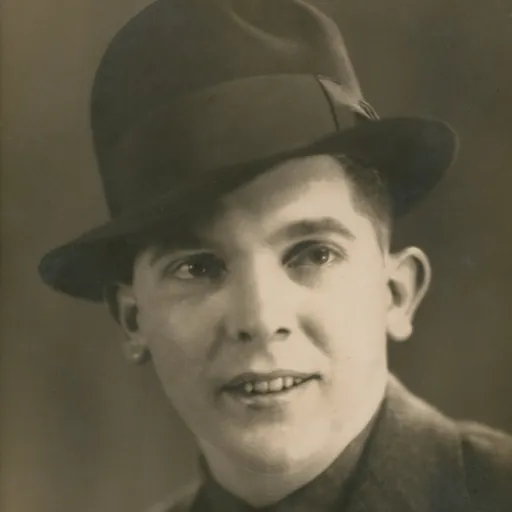
About Leonard Siffleet
Lived 1916 – 1943 (aged 27). Leonard Siffleet was an Australian military officer.
Leonard George Siffleet (14 January 1916 – 24 October 1943) was an Australian commando of World War II. Born in Gunnedah, New South Wales, he joined the Second Australian Imperial Force in 1941, and by 1943 had reached the rank of sergeant. Posted to M Special Unit of the Services Reconnaissance Department, Siffleet was on a mission in Papua New Guinea when he and two Ambonese companions were captured by partisan tribesmen and handed over to the Japanese. All three men were interrogated, tortured and later beheaded. A photograph of Siffleet's impending execution became an enduring image of the war, and his identity was often confused with that of other servicemen who suffered a similar fate, in particular Flight Lieutenant Bill Newton.
Early life
Leonard George Siffleet was born on 14 January 1916 in Gunnedah, New South Wales. The son of an itinerant worker of Dutch ancestry, his siblings included a sister and two brothers. Siffleet made his way to Sydney in the late 1930s, seeking to join the police force, but was prevented from doing so because of his eyesight. He was nevertheless called up for the militia in August 1940, and attached to a searchlight unit at RAAF Station Richmond. Allotted to a signals company based at Ingleburn, New South Wales, he was reported absent without leave on two occasions; he was by this time engaged to Clarice Lane. He joined Z Special Unit in October and was transferred to Cairns in Far North Queensland for further operational training. Assigned to the SRD's Dutch section as a radio operator, Siffleet was promoted to sergeant in May 1943. He moved across to M Special Unit the same month to take part in a mission to set up a coastwatching station in the hills behind Hollandia in Netherlands New Guinea. Siffleet joined a party led by Sergeant Thijs Staverman of the Royal Netherlands Navy, which included two Ambonese privates, H. Pattiwal and M. Reharing. Code-named Operation Whiting, their task was to work in concert with another group (Operation Locust), led by Lieutenant Jack Fryer.
Death and legacy
After Pattiwal rejoined Siffleet and Reharing, they attempted to make their way to the Dutch border. They were ambushed by a hundred native villagers near Aitape and, after a brief melée during which Siffleet shot and wounded one of their attackers, the group was captured and handed over to the Japanese. Interrogated and tortured, the team was confined for approximately two weeks before being taken down to Aitape Beach on the afternoon of 24 October 1943. Bound and blindfolded, surrounded by Japanese and native onlookers, they were forced to the ground and executed by beheading, on the orders of Vice-Admiral Michiaki Kamada of the Imperial Japanese Navy. Chikao has been variously reported as having died before the end of the war, and as having been captured and sentenced to be hanged, with his sentence subsequently commuted to 10 years' imprisonment.
The photograph of Siffleet's execution was discovered on the body of a dead Japanese major near Hollandia by American troops in April 1944. It is believed to be the only surviving depiction of a western prisoner of war being executed by a Japanese soldier. The photo was published in Australian newspapers and in Life magazine but was thought to depict Flight Lieutenant Bill Newton, who had been captured in Salamaua, Papua New Guinea, and beheaded on 29 March 1943. It later went on display at the Australian War Memorial. Despite positive identification in 1945 of Siffleet as the soldier pictured, the image continues on occasion to be misidentified as Newton by some sources. Siffleet is commemorated on the Lae Memorial in Lae, Papua New Guinea, together with all other Commonwealth war dead from actions in the region who have no known grave. A memorial park commemorating Siffleet was also dedicated at Aitape in May 2015.
Don’t just read it —
keep it.
Full-length biographies made to live with: read them, listen on the way to work, watch them tonight.
- E-book
- Audio
- Video
Instant download · yours to keep · every purchase keeps this site free
Important facts
People in Leonard Siffleet's life
Named in this biography and alive at the same time



Related people
Same field, nearest in time


Contemporaries
People whose lives overlapped Leonard Siffleet's





Frequently asked questions
Who was Leonard Siffleet?
Australian soldier, beheaded by the Japanese in 1943
When was Leonard Siffleet born?
Leonard Siffleet was born on 14 January 1916 in Gunnedah.
When did Leonard Siffleet die?
Leonard Siffleet died on 24 October 1943 in Aitape.
What was Leonard Siffleet's occupation?
Leonard Siffleet was a military officer.
What nationality was Leonard Siffleet?
Leonard Siffleet was Australian.
Sources & further reading
Cite this page
APA: Biography.guide. (2026). Leonard Siffleet. https://biography.guide/leonard-siffleet/
MLA: "Leonard Siffleet." Biography.guide, https://biography.guide/leonard-siffleet/.
Chicago: "Leonard Siffleet." Biography.guide. https://biography.guide/leonard-siffleet/.
Data last updated: 2026-09-23 · Spot an error? Report a correction.
Portrait: Wikimedia Commons · author & licence
Page generated 2026-09-27 05:05 UTC