
Leonard Arthur Bethell
Lieutenant Colonel, Gurkhas, and published author on gurkhas
About Leonard Arthur Bethell
Lived 1879 – 1950 (aged 70–71).
Lieutenant Colonel Leonard Arthur Bethell On his mother's side, he was connected to the ancient Highland Clan of Maclean.
Leonard was born in Boulogne in 1879, but the family address was 16 Royal Crescent, Walcot, Bath, Somerset. The family were in transit when the birth happened.
The Bethell household 1881 census in Garmisch, a ski resort in a mountainous area of Bavaria, mountain air being believed beneficial for TB. They took in paying guests there - Edward Elgar's family was among them, and he dedicated his work 'From the Bavarian Highlands' to them. Elgar played football with the youngsters of the house, and he and Henry remained friends throughout life.
Leonard was educated in Garmisch, then in England. His father, though Eton-educated, sent Leonard to the Catholic boys school - Ampleforth College in North Yorkshire. Henry had converted to Catholicism in 1861 - he died in Rome in 1908 when Leonard was 28. They made a trip back to England immediately afterwards - Clytie's father had died a day before the wedding. The marriage was not always a happy one, but they remained married until Clytie's death in 1940. The couple had two children — Eileen Nancy Bethell (1909 - 1988) and Leonard Norman Bethell (1914 - 1940) — Eileen went on to marry John Birney in 1937 and have children, Norman died at Dunkirk in 1940.
Leonard became a good linguist in his time - he was able to speak German, French and Italian - and Hindi, Urdu and Gurkhali, these last being a requirement of his army service. He loved trekking in the Austrian Alps - where he also bought some land in the mountains.
Bethell joined the Fairclough Lodge of Freemasons in Mandalay, Burma in 1917.
Military career
South Africa
The Second Boer War, 1899 - 1902, was fought to prevent parts of South Africa – Orange Free State and Transvaal - seceding from British control. The war was generally unsuccessful for the British, who engaged half a million troops versus the Boers 50,000 to win it. The demand for new recruits was high.
Bethell joined the York and Lancaster Regiment as a young second Lieutenant on his 20th birthday, Bethell was a keen photographer and took about 200 on the expedition, now held by the Birney family.
Though militarily successful the treaties it led to were later revoked, and it fell into disfavour with government and the British public, who saw it as a massacre of unarmed peasants. Bethell gives a different view, based on his own experience, in 'A Footnote' into the jungles of Assam, 1911–12, to avenge the murder by the Abors of the explorers Dr. Gregorson and Assistant Political Officer Mr. N. Williamson, and most of their fifty servants and porters. F. M. Bailey was also a member of this expedition.
Burma and Pakistan Recovering from his wound he returned to Burma, rejoined the Gurkhas, and took command of the 1st/10th Gurkha Rifles Depot at Mandalay until January 1916, after which he was appointed Company Officer at the Cadet College in Quetta, Baluchistan. He returned to the 1st/10th Depot soon afterwards, and commanded it at Mandalay Fort and Maymyo. The History of the 10th Gurkha Rifles says of him: “Bethell was a strange and in some ways eccentric character and many stories were told about him and his unorthodox disciplinary methods, but there was never any criticism of his work as Depot Commander throughout the war, and the 1st Battalion owe him a deep debt of gratitude for the five drafts sent them... he also showed unusual breadth of vision in the great care he took to safe-guard the health and happiness of the families of the men on service.”. with the 7th Gurkha Rifles. He was appointed OBE, On 14 September 1926 he was placed on the Unemployed List on completion of his command.
His army pension left him short of funds, but his mother-in-law cleared his debts, and bought New Clan in Dorking for the family. By 1926 both he and his wife are on the electoral register for New Clan.
New Clan land: the old orchard, 2015. House is in the far distance
A detailed list of his service record is held by the Gurkha Museum, Winchester, in the biography by Denis Wood, February 2023.
Medals Bethell received the following military awards and decorations. Index to 'Tales from the Outposts'.
The books fell out of favour during the mid-twentieth century as interest in the empire declined. However some of the volumes have now been re-issued in paperback, and are available on Kindle. Amazon's 'Goodreads' website rates the series at three stars.
Published works Bethell also published works of his own, including some of the stories in 'Tales from the Outposts'.
Outpost duties as learnt in South Africa, William Clowes & Sons, London 1903. (43 pp)
Bethell's first published work, published under his own name. The short book, or pamphlet, written as an army manual, is based on his experiences in South Africa during the Boer War. The Boer soldiers, better adapted to the landscape and country, presented a real challenge to sentries. The book's general attitude might be summarised as 'shoot first, ask questions later; bayonet if possible to avoid noise!'.
Blackwood's Tales from the Outposts; general editor, under his own name. 12 volume, Edinburgh and London, 1932-1933 (with reprints from articles in Blackwoods Magazine).
Bethell's stories within this series - all written under the pseudonym 'Pousse Cailloux' - are -
Volume 1 : Frontiers of Empire: "A Footnote" - Bethell's personal account of the Younghusband expedition. Bethell's regiment was responsible for keeping open the passes, and supply lines from India. When these were eventually over-stretched, the expedition risked an unsupported journey to Lhasa, raiding monasteries for food. 'A Footnote' is repeatedly cited in Charles Allen's 'Duel in the Snows'.
'A Footnote' gained gratitude from Younghusband's wife, Lady Helen Augusta Younghusband, who wrote "I shall never forget my delight in this blessed Blackwood, sent to me anonymously in 1935. We never saw the author, but I wrote to him through the publishers to tell him what this charming appreciation has meant to me. H. A. Y."
"A Border Affair" describes an expedition across the Assam jungles to investigate reports of Chinese activity on the Northern border. They find an isolated garrison, and a notice in Chinese - this is the limit of the Celestial Empire. The garrison is starving and demoralised - they are taken back to British headquarters, and given a passage by ship back to China.
"The Silver Hand of Alexander" - a remarkable, though speculative, account of factors in the Conolly and Stoddart affair, based on archives of The Great Game that Bethell had been given access to. The title refers to a silver replica of the hand of Alexander - almost the only successful conqueror of Afghanistan and other Islamist Khanates of the area, where his name still carries respect.
Volume 3 : Tales of the Border: "Retaliation" - a story of revenge in the Pathan community, as narrated to Bethell.
Volume 8 : Jungle Tales: "Lost Sepoys" - told against the background of the Lakhimpur Military Police restoring order in the jungle after the Abor Expedition withdrew. Two soldiers go hunting and fail to return at nightfall. As the search parties go to sleep on the last night of their search, they hear the extraordinary, almost human wailing of a chorus of jackals. A sound they have never heard before in that part of the jungle. The remains of the two Gurkhas are found some months later, only yards from where the searchers were looking for them.
"Highbrows and Lowbrows" - a fictionalised version of the Abor expedition which Bethell was part of. Names and details are altered, but it seems probable that Dr Gregorson ("Grant" in the story) – is from life. Bethell blames his ethnographical inquiries for the incomprehension and hostility arising between explorers and tribesmen, and the consequent volatile situation. The most singular incident - of the colours on the envelopes being the cause of the massacre, and hence the resulting punitive expedition - accords with the historical accounts of the time. The conclusion of the story - which is not historical - gives Bethell's imagined view of how the Abor expedition should have been run.
Bethell says in his opening paragraph that his story brings cause and effect into closer relationship than occurred in real life, and that he does not use real names - "so it is useless, after all these years, to try to identify the people who walk through these pages"
"Movable Columns" - Strategy in jungle warfare, in particular the work by the Assam Military Police – of which Bethell was Assistant Commandant – to normalise relations with the tribes following the withdrawal of the Abor expedition. Bethell himself was on the Abor expedition, whose methods he criticises – thus his preference for writing under a pseudonym.
Volume 11 : From Strange Places: "Eldorado Unlimited" - An economic history of India from the first opening of the sea route to Bombay onwards. A mixture of official facts and figures blended with Bethell's own experiences and anecdotes of India.
Volume 12 : In Lighter Vein: "Weights and Scales" - A fishing holiday in happy mood, somewhere in the Punjab, on a river where the foothills of the Himalayas are visible in the distance. Bethell catches a huge mahseer with much-needed help from two Indian boys – the sons of his shikari.
"A Rapid Survey" - An adventure down an unexplored jungle river in a Berthon boat. The boat holds up well given its construction, but is broken as they cross their third rapids. Bethell mentions this story in his letters, and makes it clear that real events have been extended and amplified for the purpose of the story. He says that F. M. Bailey was one of the people with him – named 'Baird' in the story.
"Fiat Experimentum" - After a rabies cure at the Pasteur Institute, Bethell uses the rest of his leave to stay on and look over the various experiments and researches in progress at the institute.
"Experiments in the Primitive" - Among Blackwoods articles not published in 'Tales from the Outposts', this attracted critical interest. Zarif, in his book, 'Two Months Leave', says 'This was an excellent article, covering entirely new ground, in which the author showed, for the first time, probably, in the history of shikar, that there is a definite peculiar influence which man exerts over animals. There is some form of mental "telepathy" which, if a man sits waiting patiently, murder in his heart, to shoot an animal, seems to warn that animal, who probably never appears". F. W. Champion in 'The Jungle in Sunlight and Shadow' summarises - 'He (Bethell) had been watching some of these magnificent wild sheep at rather long range for hours on end waiting for a chance to shoot. At long last he decided to risk the shot, and, simultaneously with his decision, the three Ammon, which had paid no attention to him all day, jumped to their feet, fully alert, even though he had not made the slightest sound or movement'.
'Anyhow, whatever theories people may have about this, we do all of us owe a debt of gratitude to "Forepoint Severn" for his courage in being the first to bring to light what must, after all, have seemed at first sight to be a crazy theory.'
His Majesty's Shirt Sleeves, (as Pousse Cailloux). Blackwood, Edinburgh and London, 1930.
A collection of short stories, many of them later republished in 'Tales from the Outposts'.
The Garden of the Hesperides, (as Forepoint Severn). Blackwood, Edinburgh and London, 1936.
A collection of short stories, including
Adedoids, which refers to Frederick Marshman Bailey's under cover activities in what was to become Soviet Central Asia. Bailey was a master of disguise. He joined the Soviet Secret Police and was assigned to a mission to find an undercover British secret agent - who was himself! Luckily, the mission was not a success. In this story, Bailey is referred to under the pseudonym 'Barclay' as Bethell makes clear in his letter to Bailey, 8 November 1934 Bethell knows him from the Tibet Mission. He names him 'Drummond' - in fact a pseudonym for Frederick Marshman Bailey. As he states in his letter to Bailey "there are bound to be a number of people who will be able to identify 'Drummond' with F. M. Bailey".
("Drummond" is taken from Bailey's home street in Edinburgh.)
The party, led by Bethell, struggle against multiple obstacles – eaten alive by leeches, throwing rope bridges across river gorges, scrambling along sheer rocks by the side of a river as their only means of progress, and cutting a weary way through dense belts of bamboo forest. Reaching the northern limit of their journey, they assess that any invasion through that route would be as doomed as they have been but they rescue 'Drummond' whom they find destitute and half-starved in a cave.
The story is based on Bethell's diary of the year, and includes many evocative and atmospheric diversions into the life of the jungle, the tribes, the little understood tribal rituals of birth and death.
Travelling back, when crucial parts of the food ration are stolen by the jungle tribes, one of the guards on the food store is suspected of complicity. Summary execution is considered, but commuted until they get back to HQ - 'Hodiya' in the story, Sadiya in fact. Half-starved and in rags they do get back home - the death sentence is reprieved.
'The Blind Road' received favourable critical reviews - the Observer of 1939, for example, writing "Until this book of Forepoint Severn's the North East Frontier has lacked its Herodotus and Xenophon, its Stevenson and Verne. Now we have a man's tale which for vivid incident and descriptive power is likely to be long without a rival. On to his personal knowledge of the grim borderland north of Assam the author has grafted a thrilling and fascinating tale."
Friendship with Frederick Marshman Bailey
Sample letter from Leonard Arthur Bethell to Frederick M. Bailey
Bethell and Bailey were on the Younghusband Expedition together, shared a tent and shared the privations of that expedition. "In that first winter - indeed, throughout the expedition except during the two months of summer - personal cleanliness went by default. Had there been fuel enough to spare for hot water, the bath would have suffered the same fate as the teacup." (frozen instantly). "There was no shaving, and a most atrocious beard disguised everybody. A change of underwear became a risky adventure, rarely to be indulged in; and since going to bed involved only the addition of more clothing to that of the day, the matter was steadily overlooked"
Bailey was a secret agent in China and Central Asia during the same era as Bethell was working in Assam - effectively playing his part in 'The Great Game', countering Russian influence on India's northern border. A friendship developed between the two, and later included their families as well, sharing holidays and visits together. They remained friends for years, and a long correspondence from 1915 to 1938 is held in the National Archive. (The letters from Bethell were archived by Bailey, but not his own replies to them.)
Bethell used the adventures and travels of Bailey in several of his stories, most notably 'The Blind Road'. The correspondence between the two came to an end after publication of 'The Blind Road'. The last two letters from Bethell both ask for comments on 'The Blind Road', but he evidently did not receive any. There was a conflict of interest, as Bailey was planning his own memoirs at the time.
On the night of Sunday December 29, 1940, Blackwoods head office in Paternoster Row was completely destroyed in World War II bombing raids. His wife died on the same day, (Doris's husband Frederick had left her, and gone to America in 1924).
Doris and Leonard remained together until Leonard died in December 1950. He left his estate to Doris Leonard Bethell's resting place, between the two headstones, Clunbury church yard.
Aliases of people and place names Bethell often covers true stories with aliases and altered names some of which are listed below: "Drummond" = Frederick Marshman Bailey "Barclay" = Frederick Marshman Bailey "Dr Grant" = Dr Gregorson (of the Abor expedition) "Pardon-Howe" = Mr. W. C. M. Dundas, Political Officer at Sadiya "Hodiya" = Sadiya . "Push" = Leonard Bethell
Don’t just read it —
keep it.
Full-length biographies made to live with: read them, listen on the way to work, watch them tonight.
- E-book
- Audio
- Video
Instant download · yours to keep · every purchase keeps this site free
Important facts
People in Leonard Arthur Bethell's life
Named in this biography and alive at the same time
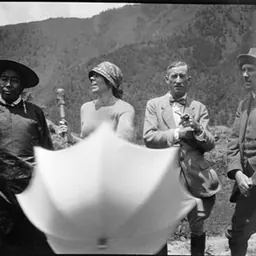







Contemporaries
People whose lives overlapped Leonard Arthur Bethell's


Frequently asked questions
Who was Leonard Arthur Bethell?
lieutenant Colonel, Gurkhas, and published author on gurkhas
When was Leonard Arthur Bethell born?
Leonard Arthur Bethell was born on 6 December 1879.
When did Leonard Arthur Bethell die?
Leonard Arthur Bethell died in 1950.
Sources & further reading
· Wikipedia: Leonard Arthur Bethell
· DBpedia: Leonard Arthur Bethell
Cite this page
APA: Biography.guide. (2026). Leonard Arthur Bethell. https://biography.guide/leonard-arthur-bethell/
MLA: "Leonard Arthur Bethell." Biography.guide, https://biography.guide/leonard-arthur-bethell/.
Chicago: "Leonard Arthur Bethell." Biography.guide. https://biography.guide/leonard-arthur-bethell/.
Data last updated: 2026-09-20 · Spot an error? Report a correction.
Page generated 2026-09-27 05:23 UTC