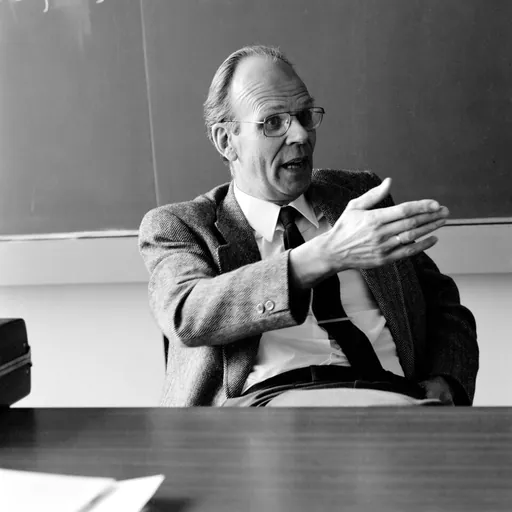
Léon van Hove
Belgian physicist, Director General of CERN
About Léon van Hove
Lived 1924 – 1990 (aged 66). Léon van Hove was a Belgian physicist, university teacher and nuclear physicist, known for Dynamic structure factor, Quantization (physics) and Van Hove singularity.
Léon Charles Prudent Van Hove (10 February 1924 – 2 September 1990) was a Belgian physicist and a Director General of CERN. He developed a scientific career spanning mathematics, solid state physics, elementary particle and nuclear physics to cosmology.
Biography Van Hove studied mathematics and physics at the Université libre de Bruxelles (ULB). In 1946 he received his PhD in mathematics at the ULB. From 1949 to 1954 he worked at the Institute for Advanced Study in Princeton, New Jersey by virtue of his meeting with Robert Oppenheimer. Later he worked at the Brookhaven National Laboratory and was a professor and Director of the Theoretical Physics Institute at the University of Utrecht in the Netherlands. In the 1950s he laid the theoretical foundations for the analysis of inelastic neutron scattering in terms of the dynamic structure factor. In 1958, he was awarded the Francqui Prize in Exact Sciences. In 1959, he received an invitation to become the head of the Theory Division at CERN in Geneva. In 1975 Prof. Van Hove was appointed CERN Director-General, with John Adams, responsible for the research activities of the Organization. The LEP project was proposed during Van Hove's tenure as Director General.
Controversies In 1963–64, George Zweig developed a particle physics model in which hadrons comprise fundamental constituents called "aces," independently of Murray Gell-Mann's quark model. As head of CERN's Theory Division, Van Hove opposed the work, reportedly refusing permission for journal submission, instructing staff not to type the manuscript, and cancelling a seminar where Zweig planned to present it. Zweig instead circulated the work as CERN preprints, which became influential despite not being formally published. Van Hove's actions substantially reduced the visibility of Zweig's work at a critical moment and are widely regarded as having contributed to Zweig's failure to receive the recognition that ultimately culminated in Gell-Mann alone receiving the 1969 Nobel Prize. Van Hove cited publication policy, though scientific skepticism toward fractionally charged constituents likely also played a role. Today, both Zweig and Gell-Mann are recognized as independent originators of the quark model.
Awards Francqui Prize, 1958 Dannie Heineman Prize for Mathematical Physics, 1962 Member, American Academy of Arts and Sciences, 1964 Max Planck Medal, 1974 Member, United States National Academy of Sciences, 1980 Member, American Philosophical Society, 1980 There is a square, Square Van Hove, named after Van Hove at CERN, Geneva, Switzerland.
Don’t just read it —
keep it.
Full-length biographies made to live with: read them, listen on the way to work, watch them tonight.
- E-book
- Audio
- Video
Instant download · yours to keep · every purchase keeps this site free
Important facts
People in Léon van Hove's life
Named in this biography and alive at the same time




Related people
Same field, nearest in time


Contemporaries
People whose lives overlapped Léon van Hove's



Frequently asked questions
Who was Léon van Hove?
Belgian physicist, Director General of CERN (1924–1990)
When was Léon van Hove born?
Léon van Hove was born on 10 February 1924 in Brussels metropolitan area.
When did Léon van Hove die?
Léon van Hove died on 2 September 1990 in Geneva.
What was Léon van Hove's occupation?
Léon van Hove was a physicist, university teacher and nuclear physicist.
What was Léon van Hove known for?
Léon van Hove was known for Dynamic structure factor, Quantization (physics) and Van Hove singularity.
What nationality was Léon van Hove?
Léon van Hove was Belgian.
Sources & further reading
Cite this page
APA: Biography.guide. (2026). Léon van Hove. https://biography.guide/leon-van-hove/
MLA: "Léon van Hove." Biography.guide, https://biography.guide/leon-van-hove/.
Chicago: "Léon van Hove." Biography.guide. https://biography.guide/leon-van-hove/.
Data last updated: 2026-09-22 · Spot an error? Report a correction.
Portrait: Wikimedia Commons · author & licence
Page generated 2026-09-27 05:03 UTC