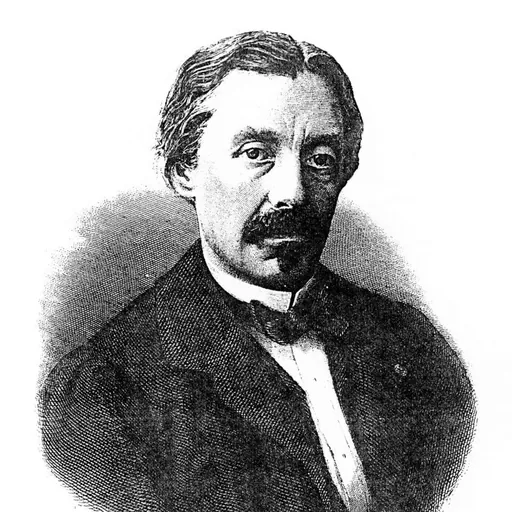
About Léon Foucault
Lived 1819 – 1868 (aged 48). Léon Foucault was a French physicist and astronomer, known for Catadioptric system, Diurnal motion and Eddy currents.
Jean Bernard Léon Foucault (, ; ; 18 September 1819 – 11 February 1868) was a French physicist who invented the Foucault pendulum, a device demonstrating the effect of Earth's rotation. He also made an early measurement of the speed of light, discovered eddy currents, and is credited with naming the gyroscope.
Life
Early years and education The son of a publisher, Foucault was born in Paris on 18 September 1819. After an education received chiefly at home, he studied medicine, which he abandoned in favour of physics due to a blood phobia.
Career He first directed his attention to the improvement of Louis Daguerre's photographic processes. For three years he was experimental assistant to Alfred Donné (1801–1878) in his course of lectures on microscopic anatomy.
With Hippolyte Fizeau he carried out a series of investigations on the intensity of the light of the sun, as compared with that of carbon in the arc lamp, and of lime in the flame of the oxyhydrogen blowpipe; on the interference of infrared radiation, and of light rays differing greatly in lengths of path; and on the chromatic polarization of light. thumb In 1850, he did an experiment using a rotating mirror to measure the speed of light; it was viewed as "driving the last nail in the coffin" of Newton's corpuscular theory of light when it showed that light travels more slowly through water than through air. In 1851, he provided an experimental demonstration of the rotation of the Earth on its axis (diurnal motion). This experimental setup had been used by Vincenzo Viviani but became well known to the public by Foucault's work. Foucault achieved the demonstration by showing the rotation of the plane of oscillation of a long and heavy pendulum suspended from the roof of the Panthéon, Paris. The experiment caused a sensation in both the learned and popular worlds, and "Foucault pendulums" were suspended in major cities across Europe and America and attracted crowds. In the following year he used (and named ) the gyroscope as a conceptually simpler experimental proof (see Foucault's gyroscope experiment). In 1855, he received the Copley Medal of the Royal Society for his 'very remarkable experimental researches'. Earlier in the same year he was made physicien (physicist) at the imperial observatory at Paris.
In September 1855 he discovered that the force required for the rotation of a copper disc becomes greater when it is made to rotate with its rim between the poles of a magnet, the disc at the same time becoming heated by the eddy current or "Foucault currents" induced in the metal.
In 1857 Foucault invented the polarizer which bears his name, and in the succeeding year devised a method of testing the mirror of a reflecting telescope to determine its shape. The so-called "Foucault knife-edge test" allows the worker to tell if the mirror is perfectly spherical or has non-spherical deviation in its figure. Prior to Foucault's publication of his findings, the testing of reflecting telescope mirrors was a "hit or miss" proposition.
Foucault's knife edge test determines the shape of a mirror by finding the focal lengths of its areas, commonly called zones and measured from the mirror center. In the test, light from a point source is focused onto the center of curvature of the mirror and reflected back to a knife edge. The test enables the tester to quantify the conic section of the mirror, thereby allowing the tester to validate the actual shape of the mirror, which is necessary to obtain optimal performance of the optical system. The Foucault test is in use to this date, most notably by amateur and smaller commercial telescope makers as it is inexpensive and uses simple, easily made equipment.
Foucault died of what was probably a rapidly developing case of multiple sclerosis on 11 February 1868 in Paris and was buried in the Montmartre Cemetery.
Honours The asteroid 5668 Foucault was named for him. His is one of the 72 names inscribed on the Eiffel Tower.
Don’t just read it —
keep it.
Full-length biographies made to live with: read them, listen on the way to work, watch them tonight.
- E-book
- Audio
- Video
Instant download · yours to keep · every purchase keeps this site free
Important facts
more
Glan–Foucault prism, Gyroscope, SilveringPeople in Léon Foucault's life
Named in this biography and alive at the same time


Related people
Same field, nearest in time





Contemporaries
People whose lives overlapped Léon Foucault's



Frequently asked questions
Who was Léon Foucault?
French physicist (1819–1868)
When was Léon Foucault born?
Léon Foucault was born on 18 September 1819 in Paris.
When did Léon Foucault die?
Léon Foucault died on 11 February 1868 in Paris.
What was Léon Foucault's occupation?
Léon Foucault was a physicist and astronomer.
What was Léon Foucault known for?
Léon Foucault was known for Catadioptric system, Diurnal motion, Eddy currents, Fizeau–Foucault apparatus, Foucault knife-edge test and Foucault pendulum.
What nationality was Léon Foucault?
Léon Foucault was French.
Sources & further reading
Cite this page
APA: Biography.guide. (2026). Léon Foucault. https://biography.guide/leon-foucault/
MLA: "Léon Foucault." Biography.guide, https://biography.guide/leon-foucault/.
Chicago: "Léon Foucault." Biography.guide. https://biography.guide/leon-foucault/.
Data last updated: 2026-09-23 · Spot an error? Report a correction.
Portrait: Wikimedia Commons · author & licence
Page generated 2026-09-27 05:04 UTC