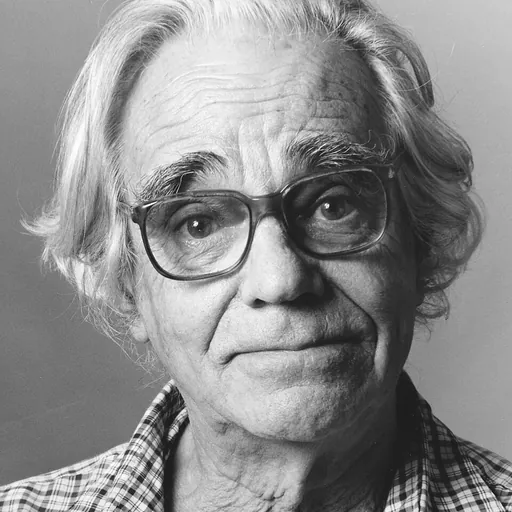
About León Ferrari
Lived 1920 – 2013 (aged 92). León Ferrari was an Argentine sculptor, painter, actor, draftsperson, conceptual artist and artist.
León Ferrari (September 3, 1920 – July 25, 2013) was an Argentine contemporary conceptual artist. During his extended art career (1954-2013), his artworks often protested the Argentine government, the imperialist west, and the Church.
Ferrari's protest piece "Western and Christian Civilization", which depicted a near life-size Christ hanging crucified on an American fighter jet, attracted controversy when he created it in 1965, and it has been exhibited many times since. Ferrari caused protests against his work throughout his career, including from Pope Francis when he was still Cardinal Jorge Bergoglio.
Biography
Ferrari was born September 3, 1920, in Buenos Aires to Susana Celia del Pardo and Augusto César Ferrari; his father was a well-known painter from San Possidonio, Italy. As a young man, Ferrari studied electrical engineering at the University of Buenos Aires. Ferrari worked as an engineer into his thirties. In 1946, Ferrari married Alicia Barros Castro and the three went on to have three children: Marialí, Pablo, and Ariel. He began casually making art during that same year. In 1952, Ferrari moved to Italy with his family because his daughter, Marialí, was fighting tuberculosis and he wanted her to have access to high quality medical care.
Almost by chance, he began working with clay and started dedicating substantial time to ceramic artwork in 1954. During his time in exile, Ferrari explored new forms of art, including mail art, photocopying, lithography, and he even wrote some books. In 2008, he created the Augusto (his father) and León Ferrari Foundation which keeps the memory of the artist alive.
Career
Overview Ferrari began his career by making small drawings, but primarily did sculptures until 1962, when he began to employ his life-long motif of language and scratchy, calligraphic writing. Ferrari created protest art using collage, photocopying and sculpture in wood, plaster, wire and ceramics. He often used text, especially newspaper clippings or poetry, particularly in his pieces protesting the Church and the Argentine government. His art often dealt with the subject of political power and religion. Some of his most controversial images depicted saints, the Virgin Mary, and Jesus found in toasters or microwaves, on nude figures, or being defecated on by live birds. He deals with issues of United States foreign policy with the Vietnam War in his best-known work, La civilización occidental y cristiana (Western-Christian Civilization, 1965). In this work, Christ appears crucified on a fighter plane, as a symbolic protest against the Vietnam War and Western Imperialism .
Early works (1955–1964) Ferrari took up painting in 1946, then began seriously making art in 1954. Much of his early work is sculpting, often ceramic or made of cement. He began to draw in March 1962, opening a period of language and word-based art that would continue for the rest of his career. He began collage and object work in 1964.
Language and writing (1962 and on) Starting in 1962, Ferrari began to use language and letters as a common theme in many artworks. Scholars point to multiple influences as explanations for Ferrari's interest in words. One reason is that his young daughter lost her ability to hear due to meningitis and had to be taught language differently by her parents.
Ferrari did not always use language in intelligible ways. For instance, he would sometimes just use lines and letters to create the image of text, as in his piece Reflections from 1963-64. Another famous example of his unintelligible writing is Ferrari's famous piece Carta a un general (Letter to a General). This piece is written in a very loose, calligraphic style that does not allow the viewer to clearly read the message. This piece represented Ferrari's thoughts that effective communication with a political power (such as a dictatorial general) is impossible. The controversy surrounding Western and Christian Civilization manifested Ferrari's central role in Argentina's political protest art.
Tucumán Arde One of Ferrari's most prolific protests within the Argentine art world was his participation in Tucumán Arde. Tucumán Arde was a series of art shows put on by a collection of Argentine artists whose aim was to expose the Argentine government's wrongdoings in Tucumán, Argentina. The exhibitions displayed photographs, articles, and short videos collected by the group of artists which showed the hardships and economic distress of the people living in Tucumán. As these exhibits were an exposure of the corrupt government, attacking the powerful and dangerous Argentine dictatorship of the time, many of the artists who helped with Tucumán Arde remained in the background, not wanting to place a target on their back by proclaiming participation in the events. In addition to this, Ferrari had been heavily involved in the political protest scene of Argentina in the 1960s. He may have made the decision to lie low for a while following highly dynamic period of protest, which included his participation in Tucumán Arde. In 1976, Ferrari departed the country and entered a period of exile in São Paulo, Brazil.
Works of the 1980s
Wire sculpture (late 1970s and 1980s) Ferrari made his first wire sculpture in 1961. Art scholars suggest that Ferrari's sculptures represent the way many small pieces (individual wires, for instance) can come together to create a stronger function as a whole (the full sculpture). Along with this concept of absurdity, scholars suggest Ferrari desired to point out the dangers of blindly following a pattern or movement. He created prints where small figures were trapped inside a closed loop, moving forward in the loop but never moving out. With this idea of blindly choosing uniformity, Ferrari hoped to draw ties to the way many Argentines simply ambivalently allowed injustice to continue with their blind adherence to the status quo.
Mannequins (1994) In 1994, Ferrari held an exhibition Buenos Aires titled, "Cristos y Maniquíes" or "Christs and Mannequins". This gallery included some nude prints and paintings embossed with braille (as discussed above), but also included another form of bodily art. Ferrari took mannequins and with some, pasted Christian images over the top, while with others, he wrote in his classic scratchy, calligraphic style. The mannequins he used did not have full arms, legs, or heads, but did have accentuated curves and a clear sexualized posture. For one of these image-covered mannequins, titled Devoción, he used many different Christian images, including Jesus' miracles, martyrdoms of saints, and the birth of Christ, with a central figure was the Virgin Mary. The goal for these mannequins was to "dress" the nude body with these Christian images, while also juxtapose the virginity of Mary with the sexuality and nudity of the female body. Another mannequin figure titled Dueteronomio was a similarly sexualized, limbless mannequin, this time covered with sections from the Book of Deuteronomy, written in Ferrari's calligraphic style. The idea Ferrari is playing with here is that of the "clothing of grace" that covered Adam and Eve in the Garden of Eden, withholding the shame that their nudity would later bring. However, instead of these words and images representing that "clothing of grace", Ferrari invites the reader to think of nudity in positive terms, rather than the typically negative, shameful way that he posits to Christian thought on nudity. If nudity is positive here, then the scriptures and images withhold the natural sexuality of the body. Christianity becomes an impediment to the natural sexuality which exudes from the body.
Intervention of the Church and Pope (2004) His work was again the subject of controversy when in 2004, a retrospective of his works at the Palais de Glace exhibition hall in Recoleta, Buenos Aires, was forced to close. 70,000 people came to the exhibition, including a few attendees who attacked and destroyed some of the artworks. Soon after, a team of Catholic lawyers demanded that the exhibit be closed. Ferrari rebutted the critiques questioning how Christians could spend 2,000 years condemning the suffering of Jesus at the crucifixion, while simultaneously ignoring and justifying millions of the world's poor and marginalized. A judge finally shut down the exhibit when Cardinal Jorge Bergoglio (later Pope Francis), then the Archbishop of Buenos Aires, declared the works of art blasphemous, and an announcement was made in every church in the Diocese of Buenos Aires. The city government appealed the decision and the gallery was reopened. Ferrari made his final move by publicly thanking the cardinal for the free advertisement of his exhibition whose numbers of visitors continued to increase. The work is one of Ferrari's earliest political protest piece. It carries a simple idea: by using language and letters that are all but unintelligible, Ferrari is representing the inability to communicate. In the work's title, Ferrari only specifies a "General," which, given the time frame, could be understood to be a leader in one of Argentina's oppressive regimes of the 1950s and 60s. So, Ferrari is showing that communication with leaders like this is impossible.
La Planeta (1979) La Planeta (Planet) comes from Ferrari's return to wire sculpture in the 1970-80s. This artwork is enormous, stretching 51 inches in diameter, and made of stainless steel. The steel wires seem to protrude in every direction, creating a sphere of smaller, straight wires. The sculpture is so large that when it was first displayed, the door to the gallery had to be broken in order to fit the piece inside. When the wind blew through this sculpture, moving it even a little, the rubbing of the steel wires caused a low, humming tone which many find musical. This piece was part of a series Ferrari made which had a goal of "inverting the pendulum". Although Ferrari spent his life fighting critics with sharp and caustic responses, images, and ideas, Ferrari never lost his good humor. He was admired and loved by many around him.
Exhibitions
National Prize of Torcuato di Tella Institute in Buenos Aires (1965) "Tangled Alphabets" with artist Mira Schendel at the Museum of Modern Art in New York City (2009) "León Ferrari" at Rencontres d'Arles Festival, in Arles, France (2019)
Don’t just read it —
keep it.
Full-length biographies made to live with: read them, listen on the way to work, watch them tonight.
- E-book
- Audio
- Video
Instant download · yours to keep · every purchase keeps this site free
Important facts
People in León Ferrari's life
Named in this biography and alive at the same time






Related people
Same field, nearest in time

Contemporaries
People whose lives overlapped León Ferrari's




Frequently asked questions
Who was León Ferrari?
Argentine artist (1920-2013)
When was León Ferrari born?
León Ferrari was born on 3 September 1920 in Buenos Aires.
When did León Ferrari die?
León Ferrari died on 25 July 2013 in Buenos Aires.
What was León Ferrari's occupation?
León Ferrari was a sculptor, painter, actor, draftsperson, conceptual artist and artist.
What nationality was León Ferrari?
León Ferrari was Argentine.
Sources & further reading
Cite this page
APA: Biography.guide. (2026). León Ferrari. https://biography.guide/leon-ferrari/
MLA: "León Ferrari." Biography.guide, https://biography.guide/leon-ferrari/.
Chicago: "León Ferrari." Biography.guide. https://biography.guide/leon-ferrari/.
Data last updated: 2026-09-24 · Spot an error? Report a correction.
Portrait: Wikimedia Commons · author & licence
Page generated 2026-09-27 05:08 UTC