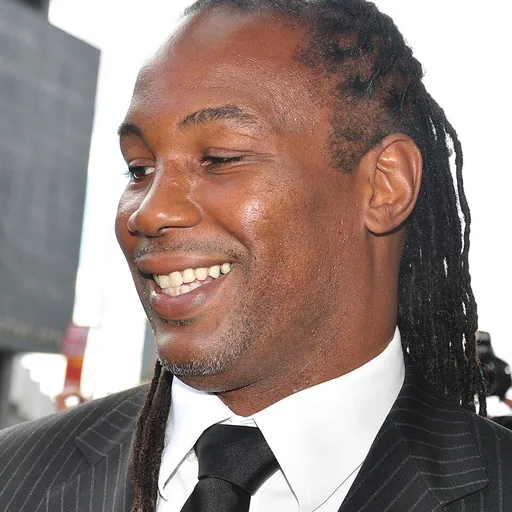
About Lennox Lewis
Born 1965. Lennox Lewis is a Canadian and British boxer, actor and athlete.
Early life Lewis was born on 2 September 1965 in West Ham, London, to Jamaican immigrant parents and according to his mother, he would often fight with other children growing up. At birth he weighed 4.8 kg (10 lb 10 oz), and was given the name Lennox by the doctor, who said "he looked like a Lennox."
Lewis moved to Kitchener, Ontario, Canada with his mother in 1977 at the age of 12. He attended Cameron Heights Collegiate Institute for high school, where he excelled in Canadian football, soccer, and basketball. In the 1982–83 school year, he helped the school's AAA basketball team win the Ontario provincial championship.
Amateur career Lewis eventually decided that his favourite sport was boxing. He took up boxing circa 1978. He became a dominant amateur boxer and won the gold medal at the Junior World Championships in 1983. At age 18, Lewis represented Canada in the super-heavyweight division at the 1984 Summer Olympics in Los Angeles. By that time he was ranked #6 in the world by the AIBA. He advanced to the quarter-finals, where he lost by decision to Tyrell Biggs of the US, who went on to win the gold medal. Despite being 6'5" tall, and having a very strong punch, his coaches admitted they had to pressure him to convert size and raw talent into aggression. His amateur boxing coaches were Arnie Boehm and Adrian Teodorescu, who guided Lewis to the Olympic title in 1988.
Lewis chose not to turn professional after the Olympics, and instead fought four more years as an amateur, hoping for a second chance to win a gold medal. At the 1986 World Championships, he lost in the preliminary round to Petar Stoimenov of Bulgaria. Later that year, Lewis won gold at the Commonwealth Games. He had a close fight against Cuban Jorge Luis González at the 1987 Pan American Games super-heavyweight finals: the American judge scored the bout in favour of Lewis 60–57, while the judges from the Dominican Republic, Venezuela and Uruguay scored the bout 59–58 for González. He avenged the loss shortly thereafter, boxing for the North American amateur title eight days later. Lewis became the first Canadian to win boxing gold in 56 years.
Lewis, upon turning professional, had registered an amateur record of 85–9. HBO Boxing credited him with a shorter amateur record of 75 wins (58 by knockout) and 7 losses. Of all losses on the record, Valeriy Abadzhyan of the Soviet Union was the only opponent to stop Lewis in amateurs, in October 1986.
After winning the Olympic gold, Lewis was approached immediately by big-time American boxing promoters, including Bob Arum. However, he was not overly impressed by their contract offers and thought about signing a professional contract with a Toronto-based promotion group. "I feel like a basketball player being scouted by scouts down in the States. I don't want anyone controlling me. These (offers) coming to me after the Olympics are mainly because I won the gold."
Professional career
Early career Having achieved his goal, Lewis declared himself a professional and moved back to his native England. He claimed he had always considered himself British, but one article reported that many British fans regarded him as "a Canadian at heart and a Briton for convenience." In 2015 Lewis explained "When I turned pro, I had to go to the United Kingdom in order to pursue my career. The infrastructure to develop boxers wasn't in Canada then."
Lewis signed with boxing promoter Frank Maloney and his early professional career was filled with knockouts of journeymen, as well as fighters such as Osvaldo Ocasio.
British, Commonwealth and European champion
After he signed with American promoter Main Events, he won the European heavyweight title in 1990 against Frenchman Jean Maurice Chanet. In his next fight in March 1991, Lewis won the British title against undefeated, world-ranked Gary Mason, and in April 1992 won the Commonwealth title against Derek Williams. Lewis was a top-five world heavyweight, and during this period he also defeated former WBA heavyweight champion Mike Weaver, 1984 Olympic Gold medalist Tyrell Biggs, former world cruiserweight title holders Glenn McCrory and trial horses Levi Billups and Mike Dixon.
On 31 October 1992, Lewis knocked out Canadian Donovan "Razor" Ruddock in two rounds for the number one contender's position in the WBC rankings. It was Lewis's most impressive win to date and established him as one of the world's best heavyweights. Sportscaster Larry Merchant declared, "We have a great new heavyweight."
First reign as WBC heavyweight champion
The win over Ruddock made Lewis the mandatory challenger for Riddick Bowe's heavyweight championship. Bowe held a press conference during which he threw his WBC title belt in a rubbish bin, relinquishing it to avoid a mandatory defence against Lewis. On 14 December 1992, the WBC declared Lewis its champion, making him the first world heavyweight titleholder from Britain in the 20th century.
Lewis defended the belt three times, defeating Tony Tucker, whom he knocked down for the first time in Tucker's career, and Frank Bruno and Phil Jackson by knockout. The Lennox Lewis vs. Frank Bruno fight was the first time two British-born boxers fought for a version of the world heavyweight title in the modern era.
Lewis vs. McCall
Lewis lost his WBC title to Oliver McCall on 24 September 1994 in a huge upset at the Wembley Arena in London. In the second round, McCall landed a powerful right cross, putting Lewis on his back. Lewis returned to his feet at the count of six, but stumbled forward into the referee in a daze. Referee Jose Guadalupe Garcia felt Lewis was unable to continue and ended the fight, giving McCall the title by technical knockout. Lewis and others argued the stoppage was premature and that a champion should be given the benefit of the doubt. In spite of the Lewis camp protests, Boxing Monthly editor Glynn Leach pointed out that Lewis "only seemed to recover his senses once the fight was waved off", and that "in the opinions of everyone I spoke to at ringside, the decision was correct."
After the fight, Lewis decided he needed a new trainer to replace Pepe Correa, who had become increasingly difficult to work with. Correa denounced Lewis in public after being fired. Renowned trainer Emanuel Steward, who had been McCall's trainer during their fight, was Lewis's choice. Even before the fight with McCall, Steward had seen much potential in Lewis and immediately expressed a desire to work with him. He corrected several of Lewis's technical flaws, which included maintaining a more balanced stance, less reliance on his cross, and a focus on using a strong, authoritative jab; the latter of which would become a hallmark of Lewis's style throughout the rest of his career. Their partnership lasted until Lewis's retirement.
Second reign as WBC heavyweight champion
In his first comeback fight, Lewis was given a chance to fight for the mandatory challenger position within the WBC and won it by knocking out American contender Lionel Butler. However, at the behest of promoter Don King, the WBC bypassed him and gave Mike Tyson the first chance at the title recently won by Briton Frank Bruno from Oliver McCall. Bruno had previously lost to both Lewis and Tyson.
Lewis had the number 1 contender's slot in the WBC rankings when he knocked out Australian Justin Fortune, then defeated former WBO Champion Tommy Morrison in October 1995, winning the minor IBC title. This was followed by a close majority decision win over Olympic gold medallist and former WBO champion Ray Mercer in May 1996. Lewis successfully sued to force Tyson to make a mandatory defence of the WBC title against him. Lewis was offered a $13.5 million guarantee to fight Tyson to settle the lawsuit, but turned it down. This would have been Lewis's highest fight purse to date. Lewis accepted $4 million from Don King to step aside and allow Tyson to fight Bruce Seldon instead, with a guarantee that if Tyson defeated Seldon, he would fight Lewis next. After winning the WBA title from Seldon, Tyson relinquished the WBC title to fight Evander Holyfield instead. The WBC title was declared vacant. This set up a rematch between Lewis and McCall, who met on 7 February 1997 in Las Vegas for the WBC title.
In one of the strangest fights in boxing history, McCall, who had lost the first three rounds, refused to box in the fourth and fifth rounds. He then began crying in the ring, forcing the referee to stop the fight and award Lewis the victory and the title. As newly recrowned WBC champion, Lewis successfully defended the title in 1997 against fellow Briton and former WBO world champion Henry Akinwande, who was disqualified after five rounds for excessive clinching. Lewis then met Poland's Andrew Golota, whom he knocked out in the first round. Lewis retained the WBC world title in 1998 when he knocked out lineal champion Shannon Briggs, who had recently outpointed George Foreman in a controversial fight to win the lineal title in five rounds, and beat formerly undefeated European champion Željko Mavrović from Croatia in a 12-round unanimous decision. Lewis stated in 2006 that his fight with Mavrovic was the most awkward win of his career.
Undisputed heavyweight champion Lewis vs. Holyfield
On 13 March 1999, Lewis faced WBA and IBF title holder Evander Holyfield in New York City in what was supposed to be a heavyweight unification bout. Lewis fought a tactical fight, keeping Holyfield off balance with a long jab and peppering him with powerful combinations throughout the bout. Although most observers in the media believed Lewis had clearly won the fight, the bout was declared a draw, to much controversy.
The raw statistics of the fight suggested the bout belonged to Lewis, who landed 348 punches compared to Holyfield's 130. Lewis also out-jabbed Holyfield 137 to 52. Judge Eugenia Williams, who scored the fight in Holyfield's favour, said she saw Lewis land fewer punches than Holyfield. The camps of both fighters agreed to an immediate rematch with both fighters receiving equal purses of $15 million.
Lewis vs. Holyfield II
The sanctioning bodies ordered a rematch. Eight months later in Las Vegas (13 November 1999), the two men fought again in a more competitive contest than the original fight, with the two boxers having some heavy exchanges from rounds six to nine. The punch stats however still clearly favoured Lewis, who landed 195 punches to Holyfield's 137, although Lewis landed 119 power shots and 76 jabs, showing a definite shift in his tactics from the first fight, when he focused more on the jab. This time the three judges scored the fight unanimously (115–113, 116–112 and 117–111) in favour of Lewis, who became undisputed heavyweight champion of the World. The British public voted Lewis the 1999 BBC Sports Personality of the Year.
Though not as contentiously disputed as in their first bout, the result of the rematch was also challenged as numerous media sources and observers felt Holyfield should have won a decision or kept his unified championship with a draw. Some writers and reporters speculated that the verdict for Lewis had been a form of retribution for the controversial results of the prior bout.
Lewis did not view either bout with Evander Holyfield as among his most difficult, but conceded Holyfield tested his limits more than any other boxer.
First reign as unified heavyweight champion
After Lewis defeated Holyfield the WBA ordered Lewis to defend the title against John Ruiz of Chelsea, Massachusetts, who was then an obscure Don King fighter who had been made the WBA's number one-ranked contender. The WBA gave permission for Lewis to fight his WBC mandatory Michael Grant first if he would fight Ruiz next, to which Lewis agreed. Opposed to this, King challenged this decision in court on the basis of a clause in the Lewis-Holyfield rematch contract that said Lewis's first bout as undisputed champion would be against the WBA's number one contender. Lewis was therefore to be stripped of his WBA belt if he fought Grant first. It was because of this that the WBA instated its "Super Champion" title, giving unified titleholders who also hold a WBA belt more time to defend against mandatory challengers.
Lewis proceeded to fight the 203 cm (6 foot 7 inch) American Michael Grant, whom he considered the best contender available. He successfully defended his WBC, IBO and IBF titles against Grant with a second-round knockout victory in Madison Square Garden in April 2000.
Later that same year, Lewis knocked out South African Francois Botha in two rounds in London, before winning a 12-round decision against New Zealander and IBF mandatory opponent, David Tua in Las Vegas.
Lewis vs. Rahman
On 21 April 2001, Lewis was knocked out by 20-to-1 underdog Hasim Rahman in a bout at Carnival City Casino in South Africa. The main event actually took place on Sunday 22 April 2001 at 05:00 local time in order to accommodate HBOs significant United States–based audience at a reasonable hour on the Saturday night. Before the bout, Lewis had a role in the film Ocean's Eleven in which he "boxed" against Wladimir Klitschko.
Second reign as unified heavyweight champion Lewis vs. Rahman II
Lewis immediately sought a rematch with the new champion; Rahman, however, now being promoted by Don King, tried to secure another opponent for his inaugural title defence. Lewis took Rahman to court to honour the rematch clause in their contract. Rahman was ordered to honour the clause and give Lewis a rematch in his first title defence. While promoting the rematch with Rahman on ESPN's Up Close, the fighters got into a brawl similar to the one between Muhammad Ali and Joe Frazier in front of Howard Cosell on Wide World of Sports. Lewis regained the title on 17 November by outclassing and then knocking out Hasim Rahman in the fourth round of their rematch.
Lewis vs. Tyson
On 8 June 2002, Lewis defended his title against Mike Tyson. Ticket sales were slow because they were priced as high as US$2,400, but a crowd of 15,327 turned up to see boxing's then biggest event at the Pyramid Arena in Memphis, Tennessee. Tyson also had to pay Lewis $335,000 out of his purse for biting him at the news conference announcing the fight, which was originally scheduled for 6 April 2002 in Las Vegas. Las Vegas, however, rejected the fight because of Tyson's licensing problems and several other states refused Tyson a licence before Memphis finally bid US$12 million to land it.
By the end of the seventh round Tyson was tired and sluggish, his face swollen and his eyes cut. He was knocked out in the eighth by a right cross. After the fight, George Foreman declared, "He [Lewis] is, no doubt, the best heavyweight of all time. What he's done clearly puts him on top of the heap." This was the highest-grossing event in pay-per-view history, generating US$106.9 million from 1.95 million buys in the US, until it was surpassed by De La Hoya-Mayweather in 2007. Both fighters were guaranteed US$17.5 million.
Lewis vs. Klitschko
Lewis was forced to vacate the IBF title in 2002 after refusing to face mandatory challenger Chris Byrd. In May 2003, Lewis sued boxing promoter Don King for US$385 million, claiming that King used threats and bribery to have Tyson pull out of a rematch with Lewis and a fight on the card of a Lewis title defence.
Lewis scheduled a fight with Kirk Johnson for June, but when Johnson suffered an injury in training, Lewis fought Vitali Klitschko, the WBC's No. 1 contender and former WBO champion. Lewis had planned to fight him in December, but since Klitschko had been on the undercard of the Johnson fight anyway, they agreed to square off on 21 June. Lewis entered the ring at a career high 116 kg (256 pounds). Lewis was dominated in the early rounds and was wobbled in round two by solid Klitschko punches. Lewis opened a cut above Klitschko's eye with a right cross in the third round and gave a better showing from the fourth round onwards. With both fighters looking tired before the start of round seven, the doctor advised that the fight should be stopped because of a severe cut above Klitschko's left eye, awarding Lewis victory by TKO. Klitschko was leading 58–56 on all three judges' scorecards when the fight was stopped. Lewis was guaranteed US$7 million and Klitschko US$1.4 million. The gate was US$2,523,384 from an attendance of 15,939 at the Staples Center in California. The fight aired live on HBO's World Championship Boxing with approximately 7 million viewers.
Interviewed about the fight by HBO, Dr. Paul Wallace explained his decision to stop the fight: When he raised his head up, his upper eyelid covered his field of vision. At that point I had no other option but to stop the fight. If he had to move his head to see me, there was no way he could defend his way against a punch. Klitschko's face required sixty stitches.
Because Klitschko had fought so bravely against Lewis, boxing fans soon began calling for a rematch. The WBC agreed, and kept the Ukrainian as its No. 1 contender. Lewis initially was in favour of a rematch: I want the rematch, I enjoyed that fight. It was just a fight. We went at it. You have to play dollars and cents but I'm opting more for the rematch. Negotiations for the rematch followed but Lewis changed his mind. Instead, Klitschko fought and defeated Kirk Johnson on 6 December in WBC Eliminator, setting up a mandatory rematch with Lewis. Lewis announced his retirement shortly thereafter in February 2004, to pursue other interests, including sports management and music promotion, and vacated the title. Lewis said he would not return to the ring. At his retirement, Lewis's record was 41 wins, two losses and one draw, with 32 wins by knockout.
Retirement In 2008 when asked about a potential bout after being antagonised by Riddick Bowe, Lewis quipped
In 2011, Bowe again confronted Lewis, this time over Twitter, demanding he "put [his] gold medal on and let's fight for that!!", where Lewis remarked "I thought we already did."
Lewis worked as a boxing analyst for HBO on Boxing After Dark from 2006 until 2010.
Fighting style Lewis was a classic upright boxer, who beat opponents from the outside with his dominant 213 cm (84 inch) reach. His jab, which was often a pawing shot early in his career, became a formidable weapon under the tutelage of Emmanuel Steward, which Lewis used to set up his signature punch, the straight right hand. Under Steward, Lewis became less reliant on his right hand and displayed a more complete skill-set. Criticised at times for being too patient and for his lack of infighting skills, Lewis was at his most effective when boxing from range. Known for his physical strength, Lewis was able to maneuver opponents into punching range and was especially effective against taller opponents. Lewis eventually developed into one of the more complete heavyweights, able to box at range or fight aggressively when necessary, as well as being a hard puncher.
Legacy
Lewis was the seventh Olympic gold medallist to become world heavyweight champion after Floyd Patterson, Muhammad Ali, Joe Frazier, George Foreman, Leon Spinks, and Michael Spinks. He holds the distinction of being the first professional heavyweight champion to win a gold medal in the super-heavyweight category, which was not created until the 1984 Summer Olympics. He is also the only boxer to represent Canada at the Summer Olympics and subsequently win a professional world title. Lewis was the first boxer to hold the British heavyweight title and subsequently win a world title. Although three fighters have since repeated this feat (Herbie Hide, Tyson Fury, and Anthony Joshua), only Lewis also won the Lonsdale belt outright.
While struggling to achieve popularity and respect earlier in his professional career, Lewis's standing has increased since his retirement in 2003, and he is now considered one of the greatest heavyweights of all time. Struggling to win the affection of the British public and facing indifference from an American audience, Lewis's body of work eventually established him as the dominant heavyweight of his time. He was the last undisputed heavyweight champion, until May 2024, when Oleksandr Usyk defeated Tyson Fury.
Lewis became one of only two boxers in history, and the first since Ken Norton in 1978, to have been awarded the heavyweight championship without actually winning a championship bout when the WBC awarded him their title in 1992. This was due to Riddick Bowe relinquishing the title after failing to agree to defend the title against Lewis, who had become the mandatory challenger by defeating Donovan Ruddock a few weeks earlier. In 2001, Lewis became the fourth boxer (after Muhammad Ali, Evander Holyfield and Michael Moorer) to have held the world heavyweight championship on three occasions.
Lewis defeated 15 boxers for the world heavyweight title, the fifth-most in history. His combined three reigns tally 3,086 days (8 years, 5 months and 13 days), which ranks as the fourth-longest cumulative time spent as world heavyweight champion. His total of fourteen successful defences ranks as the fifth-highest in heavyweight history. At four years, two months and fifteen days, Lewis has the twelfth-longest reign in heavyweight championship history. As of December 2024, BoxRec ranks Lennox as the 55th greatest fighter of all time, pound for pound.
In 2018, Boxing News ranked Lewis as the third-greatest heavyweight of all time, behind Muhammad Ali and Joe Louis. While acknowledging that he could occasionally be vulnerable, the magazine stated that at his best, Lewis was as unbeatable as any heavyweight in history. In 2017, Boxing News also ranked Lewis as the second best British fighter of all time, after Jimmy Wilde. In the same year, The Ring magazine ranked Lewis as both the greatest heavyweight of the last thirty years and the joint-eleventh greatest heavyweight of all time (alongside Evander Holyfield), describing him as "a giant who fought with finesse" who beat every available contender. Thomas Hauser stated that the idea of Lewis having no chin was a myth, citing his rising from the powerful punch from Oliver McCall which floored Lewis for the first knockdown of his career, and suggesting that he was perhaps stopped prematurely. He also contended that the knockout punch from Hasim Rahman in their first fight would have knocked out anyone. In 2003, The Ring ranked Lewis 33rd in their list of greatest punchers of all time.
Along with Ingemar Johansson and Rocky Marciano, Lewis is one of three world heavyweight champions to have retired with victories over every opponent he faced as a professional. Unlike Johansson, who lost twice to Floyd Patterson after winning their first bout, Lewis is the only heavyweight to have avenged all his in-ring defeats. He is also, along with Gene Tunney, Marciano and Vitali Klitschko, one of four heavyweight champions to have ended his career as world champion, and with a world title fight victory in his final fight.
In 1999, he was named Fighter of the Year by the Boxing Writers Association of America, as well as BBC Sports Personality of the Year. In 2008, Lewis was inducted into Canada's Sports Hall of Fame. In 2009, in his first year of eligibility, Lewis was inducted into the International Boxing Hall of Fame. He was inducted into the Ontario Sports Hall of Fame in 2012.
Life outside boxing
In 2000, Lewis appeared on Reflection Eternal's debut album Train of Thought, giving a shout out on the track "Down for the Count."
In 2001, Lewis had a role in the film Ocean's Eleven in which he "boxed" against Wladimir Klitschko.
In 2002, Lewis was reportedly offered £5m by World Wrestling Entertainment (WWE) chairman Vince McMahon to take up professional wrestling in his industry. His camp held discussions over a possible match with Brock Lesnar in February 2003, at the No Way Out pay-per-view event. Prior to the offer Lewis was familiar with wrestling; he was part of the famous match held in the old Wembley Stadium between The British Bulldog and Bret "The Hitman" Hart for the Intercontinental Championship at SummerSlam in 1992, representing the Bulldog during his entrance while bearing a Union Flag.
In 2002, Lewis played himself on an episode of The Jersey called "It's a Mad Mad Mad Mad Jersey".
In 2003, Lewis made a brief cameo appearance in the Jennifer Lopez and LL Cool J video "All I Have".
In 2006, he appeared in the movie Johnny Was with Vinnie Jones.
Lewis played in the World Series of Poker in both 2006 and 2007, and was knocked out without winning any money.
Lewis appeared on NBC's Celebrity Apprentice in 2008. He came in fourth place (out of 14).
Lewis made a public service announcement against domestic violence for Do Something.
In 2011, he was awarded an honorary Doctorate from Wilfrid Laurier University in Waterloo, Ontario. He also has his own charitable foundation called the Lennox Lewis foundation which helps disadvantaged children in Canada, Jamaica, the United Kingdom, and the United States.
Lewis is a supporter of his home town football club, West Ham United.
On 24 May 2018, Lewis was part of an Oval Office ceremony to announce the pardon of boxer Jack Johnson.
In 2024, Lewis joined fellow London boxers – Frank Bruno, Nigel Benn, and Chris Eubank – for a mini documentary, Four Kings.
Personal life Lewis is a Christian. He is an avid amateur chess player, and funded an after-school chess programme for disadvantaged youths, one of whom earned a university chess scholarship at Tennessee Tech. He holds both British and Canadian citizenship. 6 (12), 21 Jun 2003
43 Win 40–2–1
KO 8 (12), 8 Jun 2002
42 Win 39–2–1
KO 4 (12), 17 Nov 2001
41 Loss 38–2–1
KO 5 (12), 22 Apr 2001
40 Win 38–1–1
UD 12 11 Nov 2000
39 Win 37–1–1
TKO 2 (12), 15 Jul 2000
38 Win 36–1–1
KO 2 (12), 29 Apr 2000
37 Win 35–1–1
UD 12 13 Nov 1999
36 Draw 34–1–1
12 13 Mar 1999
35 Win 34–1
UD 12 26 Sep 1998
34 Win 33–1
TKO 5 (12), 28 Mar 1998
33 Win 32–1
KO 1 (12), 4 Oct 1997
32 Win 31–1
DQ 5 (12), 12 Jul 1997
31 Win 30–1
TKO 5 (12), 7 Feb 1997
30 Win 29–1
10 10 May 1996
29 Win 28–1
TKO 6 (12), 7 Oct 1995
28 Win 27–1
TKO 4 (10), 2 Jul 1995
27 Win 26–1
TKO 5 (12), 13 May 1995
26 Loss 25–1
TKO 2 (12), 24 Sep 1994
25 Win 25–0
TKO 8 (12), 6 May 1994
24 Win 24–0
TKO 7 (12), 1 Oct 1993
23 Win 23–0
UD 12 8 May 1993
22 Win 22–0
TKO 2 (12), 31 Oct 1992
21 Win 21–0
TKO 4 (10), 11 Aug 1992
20 Win 20–0
TKO 3 (12), 30 Apr 1992
19 Win 19–0
UD 10 1 Feb 1992
18 Win 18–0
TKO 3 (10), 23 Nov 1991
17 Win 17–0
KO 2 (12), 30 Sep 1991
16 Win 16–0
KO 6 (10), 12 Jul 1991
15 Win 15–0
TKO 7 (12), 6 Mar 1991
14 Win 14–0
TKO 6 (12), 31 Oct 1990
13 Win 13–0
KO 2 (10), 11 Jul 1990
12 Win 12–0
8 27 Jun 1990
11 Win 11–0
TKO 6 (8), 20 May 1990
10 Win 10–0
KO 1 (8), 9 May 1990
9 Win 9–0
TKO 1 (8), 14 Apr 1990
8 Win 8–0
KO 1 (8), 22 Mar 1990
7 Win 7–0
TKO 2 (6), 31 Jan 1990
6 Win 6–0
TKO 5 (8), 18 Dec 1989
5 Win 5–0
2 (6), 5 Nov 1989
4 Win 4–0
KO 1 (6) 10 Oct 1989
3 Win 3–0
TKO 4 (6), 25 Sep 1989
2 Win 2–0
2 (6) 21 Jul 1989
1 Win 1–0
2 (6), 27 Jun 1989
Titles in boxing Major world titles WBA heavyweight champion (200+ lbs) WBC heavyweight champion (200+ lbs) (3×) IBF heavyweight champion (200+ lbs) (2×)
The Ring magazine titles The Ring heavyweight champion (200+ lbs)
Minor world titles IBC heavyweight champion (200+ lbs) IBO heavyweight champion (200+ lbs) (2×)
Regional/International titles Lonsdale Belt heavyweight champion (200+ lbs) European heavyweight champion (200+ lbs) British heavyweight champion (200+ lbs) Commonwealth heavyweight champion (200+ lbs)
Lineal title Lineal heavyweight champion (200+ lbs) (2×)
Undisputed titles Undisputed heavyweight champion (200+ lbs)
Honorary titles WBC Emeritus Champion
Pay-per-view bouts United States
United Kingdom Date Fight Network Buys Source(s) Evander Holyfield vs. Lennox Lewis Sky Box Office 400,000 Lennox Lewis vs. Mike Tyson Sky Box Office 750,000 Total UK sales Sky Box Office 1,150,000
Amateur bouts and tournaments
Ontario Junior Championships (75 kg), Toronto, Ontario, March 1980: Lost to Donovan Ruddock (Canada) by split decision, 2–3 Canadian Junior Championships (91 kg), Montreal, Quebec, May 1982: Lost to H. Thompson (Canada) by split decision, 2–3 British Columbia Golden Gloves (91 kg), Toronto, Ontario, May 1982: Defeated K. Hataway (Canada) by unanimous decision, 3–0 Invitation tournament (91 kg), Kitchener, Ontario, June 1982: Defeated D. Walls (Canada) by unanimous decision, 3–0 Invitation tournament (+91 kg), Brantford, Ontario, July 1982: Defeated J. Mathiasen (Canada) RSC 1 Invitation tournament (+91 kg), Sarnia, Ontario, July 1982: Defeated G. Lamblon (Canada) RSC 1 Invitation tournament (+91 kg), Sudbury, Ontario, July 1982: Defeated I. Lewis (Canada) RSC 1 Commonwealth Games Eliminator (+91 kg), Winnipeg, Manitoba, July 1982: Defeated Barry Forbes (Canada) by majority decision, 4–1 Invitation tournament (+91 kg), Toronto, Ontario, August 1982: Defeated I. Lewis (Canada) by unanimous decision, 3–0 Invitation tournament (+91 kg), Toronto, Ontario, September 1982: Defeated M. Rome (Canada) by unanimous decision, 3–0 Defeated B. Allan (Canada) RSC 2 Invitation tournament (+91 kg), Toronto, Ontario, October 1982: Defeated J. Corrigan (Canada) RSCH 3 USA–Canada Duals (+91 kg), Chicago, Illinois, January 1983: Defeated J. Valleyfield (United States) by unanimous decision, 3–0 Canada Winter Games (+81 kg), Chicoutimi, Quebec, February 1983: Finals: Defeated Claude Courchesne (Canada) RSCH 1 Invitation tournament (+91 kg), Waterloo, Ontario, March 1983: Defeated B. Drift (Canada) by decision Invitation tournament (+91 kg), Hamilton, Ontario, June 1983: Defeated Larry Evans (Canada) by decision II Junior World Championships (+91 kg), Santo Domingo, Dominican Republic, June 1983: 1/4: Defeated Vincent Jones (United States) by unanimous decision, 5–0 1/2: Defeated Durin Răcaru (Romania) by unanimous decision, 5–0 Finals: Defeated Pedro Quesada (Cuba) by walkover Canada–Finland Junior Duals (+91 kg), Oulu, Finland, September 1983: Defeated Jouni Kopola (Finland) by walkover Canada–Sweden Junior Duals (+91 kg), Uppsala, Sweden, September 1983: Defeated Tommy Börzsei (Sweden) RSC 3 Invitation tournament (+91 kg), Waterloo, Ontario, October 1983: Defeated Larry Evans (Canada) RSC 2 Stockholm Open Tournament (+91 kg), Stockholm, Sweden, January 1984: Defeated Bengt Cederquist (Sweden) by unanimous decision, 5–0 Invitation tournament (+91 kg), Waterloo, Ontario, January 1984: Defeated D. Mills (Canada) by unanimous decision, 3–0
USA–Canada Duals (+91 kg), Edmonton, Alberta, February 1984: Defeated Craig Payne (United States) by split decision, 2–1 Invitation tournament (+91 kg), Toronto, Ontario, February 1984: Defeated J. Singletary (Canada) RSC 2 Canadian Senior Championships (+91 kg), Trois Rivieres, Quebec, April 1984: 1/4: Defeated Don Stevenson (Canada) RSCH 1 1/2: Defeated Barry Forbes (Canada) by unanimous decision, 5–0 Finals: Defeated Vernon Linklater (Canada) by unanimous decision, 5–0 Olympic Box-offs (+91 kg), Halifax, Nova Scotia, May 1984: Defeated Vernon Linklater (Canada) by walkover XXIII Summer Olympics (+91 kg), Los Angeles, California, August 1984: 1/8: Defeated Mohammad Yousuf (Pakistan) RSCH 3 1/4: Lost to Tyrell Biggs (United States) by unanimous decision, 0–5 Britain–Canada Duals (+91 kg), Milton Keynes, England, October 1984: Defeated Robert Wells (England) KO 3 USA–Canada Duals (+91 kg), Orlando, Florida, December 1984: Defeated Nathaniel Fitch (United States) by unanimous decision, 3–0 Canadian Senior Championships (+91 kg), Medicine Hat, Alberta, March 1985: 1/4: Defeated Joe Stack (Canada) RET 1 1/2: Defeated J. Horton (Canada) RET 2 Finals: Defeated Brian Lansing (Canada) RSCH 1 Invitation tournament (+91 kg), Kitchener, Ontario, April 1985: Defeated M. Jarvin (United States) RET 2 Invitation tournament (+91 kg), London, Ontario, May 1985: Defeated R. Garrison (United States) RSC 2 XI Albena Open Tournament (+91 kg), Albena, Bulgaria, June 1985: Finals: Defeated Milan Turek (Czech Republic) RET 1 North American Championships (+91 kg), Beaumont, Texas, August 1985: 1/2: Defeated Kimmuel Odum (United States) by decision Finals: Defeated Isaac Barrientos (Puerto Rico) by majority decision, 4–1 III World Cup (+91 kg), Seoul, South Korea, November 1985: 1/2: Defeated Juan Antonio Díaz Nieves (Argentina) RET 1 Finals: Lost to Vyacheslav Yakovlev (Soviet Union) by unanimous decision, 0–5 Invitation tournament (+91 kg), Toronto, Ontario, January 1986: Defeated A. White (United States) by unanimous decision, 5–0 Canadian Senior Championships (+91 kg), Cornwall, Ontario, March 1986: 1/2: Defeated Sandy Hervieux (Canada) RET 2 Finals: Defeated Wade Parsons (Canada) DQ 2 World Champ Box-Offs (+91 kg), Glace Bay, Nova Scotia, April 1986: Defeated Wade Parsons (Canada) by walkover World Championships (+91 kg), Reno, Nevada, May 1986: 1/8: Lost to Petar Stoimenov (Bulgaria) by split decision, 2–3 Invitation tournament (+91 kg), Bay City, USA, July 1986: Lost to Jonathan Littles (United States) by split decision, 1–2 Defeated J. Davidson (United States) RSC 2
XIII Commonwealth Games (+91 kg), Edinburgh, Scotland, July 1986: 1/2: Defeated James Oyebola (England) RSCH 2 Finals: Defeated Aneurin Evans (Wales) RSC 2 TSC Tournament (+91 kg), East Berlin, East Germany, September 1986: 1/4: Lost to Valeriy Abadzhyan (Soviet Union) RSC 3 3rd place bouts: Lost to Ladislav Husarik (Czechoslovakia) by walkover Quebec Cup (+91 kg), Montreal, Quebec, December 1986: Finals: Defeated Sandy Hervieux (Canada) RSC 2 Stockholm Open (+91 kg), Stockholm, Sweden, January 1987: 1/2: Defeated Håkan Brock (Sweden) by unanimous decision, 5–0 Finals: Defeated Aleksander Burmistrov (Bulgaria) KO 3 Canadian Senior Championships (+91 kg), Oromocto, New Brunswick, April 1987: 1/2: Defeated Sandy Hervieux (Canada) by unanimous decision, 5–0 Finals: Defeated K. Russell (Canada) RET 2 French Open (+91 kg), Saint-Nazaire, France, April 1987: Finals: Defeated István Szikora (Hungary) by unanimous decision, 5–0 Pan Am Box-Offs (+91 kg), Ottawa, Ontario, May 1987: Defeated Sandy Hervieux (Canada) RSC 1 Pan American Games (+91 kg), Indianapolis, Indiana, August 1987: 1/2: Defeated Carlos Barcelete (Brazil) KO 2 Finals: Lost to Jorge Luis González (Cuba) by majority decision, 1–4 North American Championships (+91 kg), Toronto, Ontario, August 1987: Finals: Defeated Jorge Luis González (Cuba) by split decision, 2–1 IV World Cup (+91 kg), Belgrade, Yugoslavia, October 1987: 1/4: Lost to Ulli Kaden (East Germany) by split decision, 2–3 Feliks Stamm Memorial (+91 kg), Warsaw, Poland, November 1987: 1/2: Defeated Nathaniel Fitch (United States) KO 2 Finals: Defeated Marian Klepka (Poland) RET 2 Canadian Senior Championships (101 kg), Edmonton, Alberta, March 1988: Finals: Defeated Richard Ayotte (Canada) RET 1 Intercup (+91 kg), Karlsruhe, West Germany, April 1988: 1/4: Defeated Crispine Odera (Kenya) by unanimous decision, 5–0 1/2: Defeated Petar Stoimenov (Bulgaria) by split decision, 3–2 Finals: Lost to Aleksandr Miroshnichenko (Soviet Union) by unanimous decision, 0–5 Canada Cup (+91 kg), Ottawa, Ontario, June 1988: Finals: Defeated Elton Wright (United States) RET 1 XXIV Summer Olympics (+91 kg), Seoul, South Korea, September–October 1988: 1/8: Defeated Crispine Odera (Kenya) RSCH 2 1/4: Defeated Ulli Kaden (East Germany) RSCH 1 1/2: Defeated Janusz Zarenkiewicz (Poland) by walkover Finals: Defeated Riddick Bowe (United States) RSC 2
Honours Lennox Lewis, CM (1988–1998) Lennox Lewis, CM, MBE (1998–2002) Lennox Lewis, CBE, CM (2002–present)
Don’t just read it —
keep it.
Full-length biographies made to live with: read them, listen on the way to work, watch them tonight.
- E-book
- Audio
- Video
Instant download · yours to keep · every purchase keeps this site free
Important facts
more
Lenox louisPeople in Lennox Lewis's life
Named in this biography and alive at the same time



Related people
Same field, nearest in time



Contemporaries
People whose lives overlapped Lennox Lewis's


Frequently asked questions
Who is Lennox Lewis?
British-Canadian boxer Vc
When was Lennox Lewis born?
Lennox Lewis was born on 2 September 1965 in West Ham.
What is Lennox Lewis's occupation?
Lennox Lewis is a boxer, actor and athlete.
What nationality is Lennox Lewis?
Lennox Lewis is Canadian and British.
Sources & further reading
Cite this page
APA: Biography.guide. (2026). Lennox Lewis. https://biography.guide/lennox-lewis/
MLA: "Lennox Lewis." Biography.guide, https://biography.guide/lennox-lewis/.
Chicago: "Lennox Lewis." Biography.guide. https://biography.guide/lennox-lewis/.
Data last updated: 2026-09-22 · Spot an error? Report a correction.
Portrait: Wikimedia Commons · author & licence
Page generated 2026-09-27 05:03 UTC