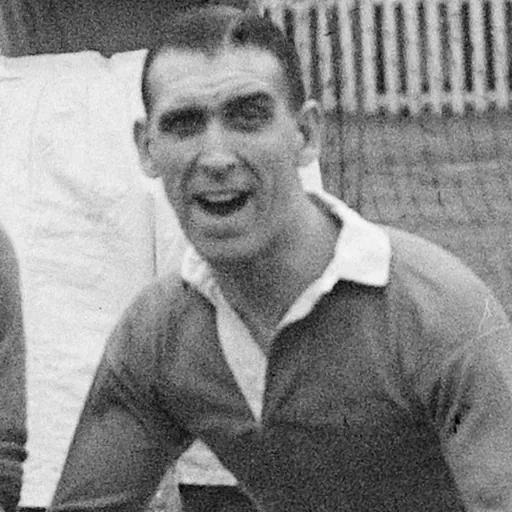
About Len Goulden
Lived 1912 – 1995 (aged 82). Len Goulden was a British association football player and association football coach.
Leonard Arthur Goulden (16 July 1912 – 14 February 1995) was an English footballer who played as an inside-left. His son Roy was also a footballer.
Club career Goulden was born at Homerton, in Hackney, London, and raised in nearby Plaistow. He signed for West Ham United as an amateur in 1931, but was sent out to Chelmsford City and Leyton to gain experience. During this time he supported himself by working at the Tate & Lyle sugar refinery in Silvertown. He signed professional forms with West Ham in 1933 and remained with the Hammers for six years, making over 250 appearances and scoring 55 goals from the inside-left position. He was an ever-present, along with Joe Cockroft, during the 1936–37 season.
His West Ham career was interrupted when World War II started and he never played another competitive match for the club, though he did win the Football League War Cup with them in 1940.
Following the conflict, he signed with west Londoners Chelsea for £4,500 and linked up well with fellow new signings Tommy Lawton and Tommy Walker – the trio scored 47 goals between them in 1946–47 – though the side failed to make to challenge for honours, coming closest in the FA Cup, when they lost to Arsenal in the semi-finals, despite having led 2–0. Goulden retired as a player in 1950, having made 111 Chelsea appearances and scored 17 goals.
International career Appearances and goals Goulden won 14 England caps while a West Ham player, scoring four goals. He made his debut on 14 May 1937, against Norway in Oslo. England won 6–0 with Goulden scoring in the 85th minute; barging through the defence he scored with a left foot shot.
He also appeared in several wartime internationals, but these are not considered official full international matches.
Berlin 1938 The match against Germany in Berlin in 1938 is notorious because the England team were pressured by the Foreign Office into giving the Nazi salute while the German national anthem was played. The team were furious:
However, the British ambassador, Nevile Henderson, insisted, believing that doing so would help defuse dangerously high international tensions.
There were 110,000 Germans watching the game, including Hermann Goering and Josef Goebbels, and Hitler had hoped to use the game for propaganda, in part because the German side included a player from the newly annexed Austria. Hitler was expected at the game, but it is believed that he did not attend.
Goulden, who was Jewish, and normally known for his creativity rather than his shooting ability; scored the final goal in England's 6–3 victory, a goal has been described as the East End's Jesse Owens moment and which teammate Stanley Matthews described as probably the greatest goal I ever saw.
Other notable matches A week after the Berlin game, England played Switzerland at Sportplatz Hardturm in Zurich. The match was started by a drop ball released from an aircraft - after circling the stadium, the aeroplane swooped over the pitch releasing the ball which landed almost exactly on the centre circle. The match finished 1–1.
On 26 October 1938, England played a Rest of Europe side managed by Vittorio Pozzo at Highbury in London, to celebrate the 75th anniversary of the Football Association. The match was the second ever to be shown on live on TV, though only the first half was shown. Goulden scored the final goal in a 3–0 victory. Sixty three years later, in 2001, FIFA retrospectively downgraded the match to unofficial, though the FA disputes this decision and continues to treat the match as official.
Coaching and managerial career Goulden remained at Chelsea until 1952, before moving to Hertfordshire in November 1952 for a management opportunity at Watford. His first match in charge was a 1–1 draw at home to Coventry, and by the end of 1952–53 Goulden had guided his team to a top-10 finish in the Third Division South. That summer he signed Dave Bewley, Roy Brown and Maurice Cook, all of whom went on to play key roles during his reign. After guiding Watford to 4th and 7th in the next two campaigns, Goulden stepped down to become a coach midway through the 1955–56 season. However, his successor and former player Johnny Paton's spell yielded just 2 wins from 15 games, including defeat at the hands of non-league clubs Aldershot and Bedford Town. Goulden took over for the remainder of the season, but was only able to salvage a 21st-placed finish.
Don’t just read it —
keep it.
Full-length biographies made to live with: read them, listen on the way to work, watch them tonight.
- E-book
- Audio
- Video
Instant download · yours to keep · every purchase keeps this site free
Important facts
People in Len Goulden's life
Named in this biography and alive at the same time





Related people
Same field, nearest in time



Contemporaries
People whose lives overlapped Len Goulden's





Frequently asked questions
Who was Len Goulden?
English footballer (1912–1995)
When was Len Goulden born?
Len Goulden was born on 16 July 1912 in London.
When did Len Goulden die?
Len Goulden died on 14 February 1995.
What was Len Goulden's occupation?
Len Goulden was an association football player and association football coach.
What nationality was Len Goulden?
Len Goulden was British.
Sources & further reading
Cite this page
APA: Biography.guide. (2026). Len Goulden. https://biography.guide/len-goulden/
MLA: "Len Goulden." Biography.guide, https://biography.guide/len-goulden/.
Chicago: "Len Goulden." Biography.guide. https://biography.guide/len-goulden/.
Data last updated: 2026-09-22 · Spot an error? Report a correction.
Portrait: Wikimedia Commons · author & licence
Page generated 2026-09-27 05:04 UTC