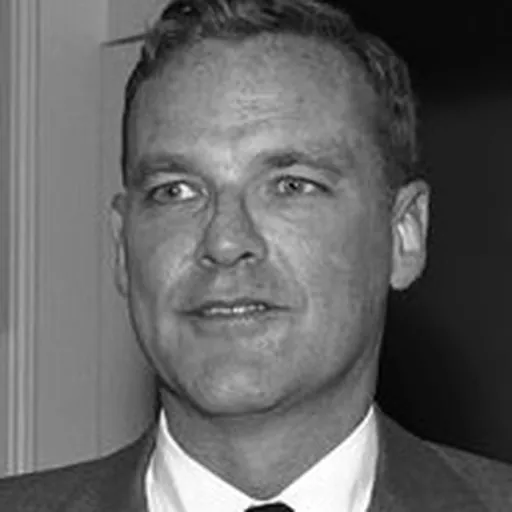
About Lem Billings
Lived 1916 – 1981 (aged 65). Lem Billings was an American businessperson and advertising person.
Kirk LeMoyne "Lem" Billings (April 15, 1916 – May 28, 1981) was an American businessman known for his close, long-standing friendship with John F. Kennedy and the Kennedy family. A graduate of Choate, Billings earned a bachelor's degree from Princeton University and a master's degree in business administration from Harvard University. He served in the AFS ambulance service and the U.S. Naval Reserve during World War II and later had a long career in advertising. Billings was a preparatory school roommate of Kennedy's, an usher at his wedding, and a campaigner for his successful 1960 presidential bid. During Kennedy's presidency, Billings acted as an unofficial aide to Kennedy and was a frequent visitor to the White House. Later, Billings assisted Sargent Shriver as a trustee of the Kennedy family trusts.
Early life, education, and military service Billings was born in Pittsburgh on April 15, 1916, the third child of Frederic Tremaine Billings (1873–1933) and Romaine LeMoyne (1882–1970). His father was a prominent physician and a graduate of the U.S. Naval Academy. His mother was a Mayflower descendant and his great-grandfather, Francis Julius LeMoyne, was a prominent abolitionist who helped establish LeMoyne–Owen College. The Billings family were Episcopalians and Republicans.
Billings attended Choate, arriving at the school shortly after the death of his father. His father's death had left his family impoverished, and he attended Choate on scholarship. He was a member of the Choate crew team.
In 1939, Billings graduated from Princeton University, majoring in art and architecture. He wrote his senior thesis on Tintoretto. He was a member of the Ivy eating club. In 1942, supported by a recommendation from Joseph P. Kennedy Sr., he was accepted by the AFS ambulance service, where his poor eyesight was not a disqualification. He was deployed to North Africa from 1942 to 1943. In 1944, he received a commission in the U.S. Naval Reserve and served in the South Pacific until being discharged in 1946.
From 1946 to 1948, Billings attended Harvard Business School. He earned an MBA there.
Career Billings sold Coca-Cola dispensers to drugstores and worked at a General Shoe store. As Vice President at the Emerson Drug Company in Baltimore, he invented the 1950s fad drink Fizzies by adding a fruit flavor to disguise the sodium citrate taste. In 1958, Billings moved to the prominent Manhattan advertising firm Lennen & Newell as an advertising executive. He had a lengthy career in advertising. At Choate, they formed a club and called themselves "The Muckers". The Muckers would pull pranks around the school. They planned to dump horse manure in the school gym, but that plan fell through after the headmaster found out about it.
Some historians believe that Billings expressed sexual interest in Kennedy in writing in 1934 and that Kennedy politely rebuffed his advances. Kennedy was aware that a fellow Choate student had revealed Billings' homosexual behavior during their time there.
Billings' first visit with the Kennedy family was for Christmas in Palm Beach in 1933. He went on to become a close friend of the Kennedys who participated in Kennedy family events. Joseph Kennedy described Billings as his "second son". Billings repeated his senior year so that he and Kennedy could graduate from Choate together. In the summer of 1937, Billings and Kennedy took a nine-week summer trip through Europe which solidified their friendship.
After working on Kennedy's successful campaign for Congress in 1946, Billings toured seven Latin American countries with Robert F. Kennedy.
On September 12, 1953, Billings was an usher at the wedding of Jacqueline Lee Bouvier and Kennedy. In 1956, he was an usher at the wedding of Kennedy's sister Jean to Stephen Edward Smith.
In 1960, Billings worked on Kennedy's presidential campaign. He managed the campaign in the Third Congressional District in the Wisconsin primary and then served as a general troubleshooter and coordinator of television in the West Virginia primary. Billings (second from left) at the White House as Kennedy signs legislation creating the U.S. Travel Service In 1961, Billings declined Kennedy's offers to appoint him the first head of the Peace Corps, director of a new agency to promote tourism, the U.S. Travel Service, or ambassador to Denmark. He later said: "I realized that I did not want to work for the president—because I felt it would change our relationship." In September 1961, he accepted an appointment to the board of trustees of the planned National Cultural Center, which later became the Kennedy Center. The next year, Kennedy named Billings to the board planning America's participation in the New York World's Fair of 1964–1965. He represented Kennedy when the Choate alumni association unveiled Kennedy's portrait in May 1963.
Billings visited the White House on most weekends during the Kennedy Administration. When a butler commented on the fact that Billings was leaving his belongings in one of the third-floor guest rooms, Jacqueline Kennedy replied: "He's been my house guest since I was married." Sometimes he stayed for longer periods. When Jacqueline Kennedy was away, Billings organized White House dinner parties for Kennedy and old friends. When Kennedy traveled, he kept Jacqueline Kennedy company. One presidential aide later said that "some people saw him so much they thought he was the Secret Service." Historian Sally Bedell Smith compared him to Leonard Zelig, a nondescript character in Woody Allen's 1983 film Zelig who is always present in the back row at major events. He accompanied Kennedy to church, launched a kite for Kennedy's daughter Caroline, and delivered pet hamsters to the Kennedy children. He joined Kennedy's entourage for his tours of Europe in both 1961 and 1963. In 1962, he escorted two of Kennedy's sisters, Eunice Shriver and Jean Kennedy Smith, around Europe for two weeks. When the Kennedys spent the weekend at Glen Ora, their Virginia estate, Jacqueline Kennedy invited Billings to join them more often than Kennedy did. She needed Billings to keep Kennedy company while she went horseback riding.
Billings' role as "first friend" was assessed by many observers at the time and since. Ted Sorensen called him "an admirer — almost a fawning admirer — of his friend."
Most recognized that Billings and Kennedy had been friends from youth and did not question their relationship or Billings' presence. Ben Bradlee, a Kennedy friend who worked at Newsweek during the Kennedy Administration (and later, as editor of The Washington Post), was no friend of Billings, yet observed "they were childhood friends and stayed loyal to each other forever." Billings, he said, "had a natural jealousy. He didn't want to share his friendship with Jack." Gore Vidal, who was banned from the White House after a run-in with Billings, was critical of Billings; however, he acknowledged that Billings played an important role as an aide to Kennedy, who was often ill or in pain. According to Vidal, Kennedy "needed Lem Billings to get around" because being accompanied by a nurse would have made his political career impossible. Vidal believed Billings loved Kennedy.
Many testify to Billings' wit and ability to help Kennedy relax. He once described the Kennedy family's lack of business awareness: "Listening to the Kennedy brothers talk about business was like hearing nuns talk about sex." Billings also served Kennedy as an artistic adviser, selecting scrimshaw for display in the Oval Office and, on one European tour, quickly assembling a selection of artworks to be presented as gifts.
Charles L. Bartlett, the journalist who introduced Kennedy to Jacqueline Bouvier and was a friend of both Billings and Kennedy, described their relationship this way: "Lem was a stable presence for Jack. Lem's raison d'être was Jack Kennedy. I don't think it's true that he did not have views of his own, as some have said. He had a very independent mind. He had interests of his own that Jack didn't necessarily share. He certainly didn't have the same interest in politics and women that Jack had."
Kennedy "made a big difference in my life," Billings said. "Because of him, I was never lonely."
Billings spent the last weekend of October 1963 with the Kennedys. This was the last time he saw them together. Billings saw Kennedy for the last time when they dined at the White House with Greta Garbo on November 13, 1963, nine days before Kennedy was assassinated in Dallas.
After the JFK assassination Billings was devastated by Kennedy's death. He participated in the funeral procession with the Kennedy family.
In 1964, Billings was named to select a memorial to Kennedy to be placed in the Kennedy Center. In 1965, Jacqueline Kennedy invited Billings to accompany her and her children to England for the unveiling of a memorial to Kennedy at Runnymede. and Ethel Kennedy, Robert F. Kennedy's widow, to the 1971 opening of the Kennedy Center.
Billings frequently socialized with Bobby Kennedy Jr. (to whom he became almost a surrogate father) and Christopher Lawford. However, the elder Kennedys began to discourage the boys from associating with Billings because of his excessive recreational drug use (including alcohol). working from an office in the Pan Am Building.
Personal life Billings was gay, but was not open to discussing his sexuality.
Billings once said that his friendship with Kennedy may have been the reason that he never married. His behavior changed drastically in the late 1960s.
Death On May 28, 1981, Billings died in his sleep following a heart attack in his Manhattan apartment.
Billings's dying wish was for the young Kennedy men to carry his casket to its final resting place. When they arrived at the cemetery, it was already in place to be lowered. The young Kennedys took the casket and carried it around the gravesite before returning it to the burial plot.
Billings is buried in Allegheny Cemetery in Pittsburgh.
Literature John F. Kennedy; Kirk LeMoyne Billings, Das geheime Tagebuch: Europa 1937, Oliver Lubrich (Hrsg.), Wien, DVB Verlag, 2021, Jack and Lem - John F. Kennedy and Lem Billings - The Untold Story of an Extraordinary Friendship, David Pitts, New York, Da Capo Press, 2007, Jackie and Me: a Novel, Louis Bayard, Workman Publishing, New York, 2022,
Don’t just read it —
keep it.
Full-length biographies made to live with: read them, listen on the way to work, watch them tonight.
- E-book
- Audio
- Video
Instant download · yours to keep · every purchase keeps this site free
Important facts
People in Lem Billings's life
Named in this biography and alive at the same time



Related people
Same field, nearest in time


Contemporaries
People whose lives overlapped Lem Billings's




Frequently asked questions
Who was Lem Billings?
American businessman (1916-1981)
When was Lem Billings born?
Lem Billings was born on 15 April 1916 in Pittsburgh.
When did Lem Billings die?
Lem Billings died on 28 May 1981 in Manhattan.
What was Lem Billings's occupation?
Lem Billings was a businessperson and advertising person.
What nationality was Lem Billings?
Lem Billings was American.
Sources & further reading
Cite this page
APA: Biography.guide. (2026). Lem Billings. https://biography.guide/lem-billings/
MLA: "Lem Billings." Biography.guide, https://biography.guide/lem-billings/.
Chicago: "Lem Billings." Biography.guide. https://biography.guide/lem-billings/.
Data last updated: 2026-09-22 · Spot an error? Report a correction.
Portrait: Wikimedia Commons · author & licence
Page generated 2026-09-27 05:03 UTC