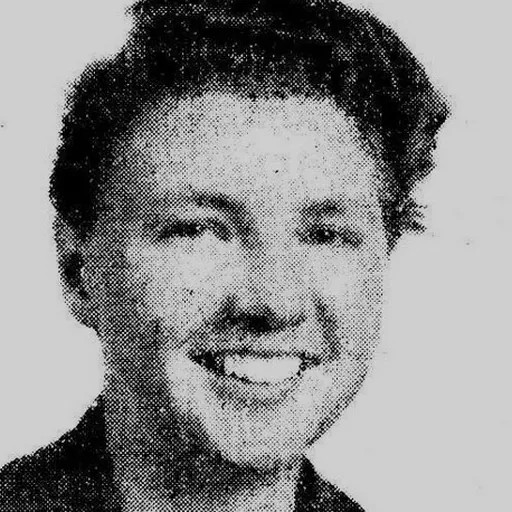
About Leigh Brackett
Lived 1915 – 1978 (aged 62). Leigh Brackett was an American screenwriter, novelist, writer, science fiction writer and comics writer.
Leigh Douglass Brackett (December 7, 1915 – March 18, 1978) was an American author and screenwriter. Nicknamed "the Queen of Space Opera", she was one of the most prominent female writers during the Golden Age of Science Fiction. As a screenwriter, she was best known for her collaborations with director Howard Hawks, mainly writing Westerns and crime films. She also worked on an early draft of The Empire Strikes Back, elements of which remained in the film; she died before it went into production.
In 1956, her book The Long Tomorrow made her the first woman ever shortlisted for the Hugo Award for Best Novel, and, along with C. L. Moore, one of the first two women ever nominated for a Hugo Award. In 2020, she posthumously won a Retro Hugo for her novel The Nemesis From Terra, originally published as Shadow Over Mars (Startling Stories, Fall 1944).
Early life and education Leigh Brackett was born and raised in Los Angeles, California. Her father died when she was very young; her mother did not remarry. She was a tomboy, "tall" and "athletic". Her earliest years as a writer (1940–1942) were her most productive. Some of her stories have social themes, such as "The Citadel of Lost Ships" (1943), which considers the effects on alien cultures of Earth's expanding trade empire. At the time, she was an active member of the Los Angeles Science Fantasy Society (LASFS), and participated in local science fiction fandom by contributing to the second issue of Pogo's STF-ETTE, an all-female science fiction fanzine (probably the first such).
The Brackett-Bradbury collaboration "Lorelei of the Red Mist" took the cover of Planet Stories in 1946. Brackett's first detective story, "Murder in the Family", was published in Mammoth Detective in 1943. Brackett's first novel, No Good from a Corpse (1944), It won a Retro Hugo for best novel in 2020.
Planet Stories published the novella "Lorelei of the Red Mist", in which the protagonist is a thief named Hugh Starke. Brackett finished the first half before turning it over to her close friend Ray Bradbury, so that she could leave to work on the screenplay of The Big Sleep.
Brackett returned to science fiction writing in 1948 after her movie work. Between 1948 and 1951, she produced a series of science fiction adventure stories that were longer than her previous work, including classic representations of her planetary settings as "The Moon that Vanished" and the novel Sea-Kings of Mars (1949). The latter was later published as The Sword of Rhiannon.
In "Queen of the Martian Catacombs" (1949), Brackett created the character of Eric John Stark.
After another decade-long hiatus, Brackett returned to science fiction in the 1970s with the publication of The Ginger Star (1974), The Hounds of Skaith (1974), and The Reavers of Skaith (1976), collected as The Book of Skaith in 1976. This trilogy brought Eric John Stark back for adventures on the extra-solar planet of Skaith (rather than his old haunts, Mars and Venus).
Brackett's Solar System Often called the "Queen of Space Opera", Brackett also wrote planetary romance. Almost all her planetary romances take place in the Solar System, which contains richly detailed fictional versions of the consensus Mars and Venus of science fiction from the 1930s to the 1950s. Mars appears as a marginally habitable desert world, populated by ancient, decadent and mostly humanoid races, and Venus as a primitive, wet jungle planet, occupied by vigorous, primitive tribes and reptilian monsters. Brackett's Skaith combines elements of her other worlds with fantasy elements.
Though Edgar Rice Burroughs' influence is apparent in Brackett's Mars stories, her Mars is set firmly in a world of interplanetary commerce and competition. A prominent theme of her stories is the clash of planetary civilizations; they illustrate and criticize the effects of colonialism on civilizations that are either older or younger than those of the colonizers. Burroughs' heroes set out to remake entire worlds according to their own codes; Brackett's heroes (often antiheroes) are at the mercy of trends and movements far bigger than they are.
After the Mariner missions indicated there was no life on Mars, Brackett never returned to her Solar System. When she started to write planetary romance again in the 1970s, she invented a new Solar System outside our own. The film was written by Brackett, Faulkner, and Jules Furthman, and starred Humphrey Bogart.
After getting married, Brackett took a break from screenwriting. When she returned to screenwriting in the mid-1950s, she wrote for TV and movies. Howard Hawks hired her to write or co-write several John Wayne pictures, including Rio Bravo (1959), Hatari! (1962), El Dorado (1966), and Rio Lobo (1970). Because of her background with The Big Sleep, she later adapted Raymond Chandler's novel The Long Goodbye for the screen. Brackett and Kasdan (but not Lucas) were credited for the final screenplay. Brackett was credited in tribute despite not being involved in the final film.
Laurent Bouzereau, in Star Wars: The Annotated Screenplays, said that Lucas disliked the direction of Brackett's screenplay, discarded it, and produced two more screenplays before turning the results over to Kasdan. io9's co-founder Charlie Jane Anders has written that while "It's fashionable to disparage Brackett's contributions to Empire", "it's not true that none of Brackett's storyline winds up in the final movie—the basic story beats are the same."
For over 30 years, Brackett's screenplay could be read only at the Jack Williamson Special Collections library at Eastern New Mexico University in Portales, New Mexico, and at Lucasfilm's archives in California. It was officially published in February 2016. In this draft, there is a love triangle between Luke, Leia and Han Solo. Yoda is named Minch, Luke has a hidden sister named Nellith, Lando Calrissian is Lando Kaddar, Luke's father is still a distinct character from Darth Vader and appears as a Force ghost on Dagobah, and Han Solo, at the end of the script, leaves to search for his uncle Ovan Marek, the most powerful man in the universe after the Emperor Palpatine.
John Saavedra of Den of Geek website wrote:
Personal life and death On December 31, 1946, at age 31, Brackett married another science fiction writer, Edmond Hamilton,
Don’t just read it —
keep it.
Full-length biographies made to live with: read them, listen on the way to work, watch them tonight.
- E-book
- Audio
- Video
Instant download · yours to keep · every purchase keeps this site free
Important facts
Family & relationships
People in Leigh Brackett's life
Named in this biography and alive at the same time




Related people
Same field, nearest in time


Contemporaries
People whose lives overlapped Leigh Brackett's




Frequently asked questions
Who was Leigh Brackett?
American novelist and screenwriter (1915–1978)
When was Leigh Brackett born?
Leigh Brackett was born on 7 December 1915 in Los Angeles.
When did Leigh Brackett die?
Leigh Brackett died on 18 March 1978 in Lancaster.
What was Leigh Brackett's occupation?
Leigh Brackett was a screenwriter, novelist, writer, science fiction writer and comics writer.
What nationality was Leigh Brackett?
Leigh Brackett was American.
Sources & further reading
Cite this page
APA: Biography.guide. (2026). Leigh Brackett. https://biography.guide/leigh-brackett/
MLA: "Leigh Brackett." Biography.guide, https://biography.guide/leigh-brackett/.
Chicago: "Leigh Brackett." Biography.guide. https://biography.guide/leigh-brackett/.
Data last updated: 2026-09-20 · Spot an error? Report a correction.
Portrait: Wikimedia Commons · author & licence
Page generated 2026-09-27 04:58 UTC