
About Lee Man Fong
Lived 1913 – 1988 (aged 74). Lee Man Fong was an Indonesian artist and painter.
Lee Man Fong (; November 14, 1913 – April 3, 1988) was a painter born in Guangzhou, China. His father, a merchant with ten children, brought him to Singapore. When his father died in 1930, Lee had to work hard to earn a living for his mother and siblings using his skill in painting ads and artwork. However, that was not enough for him. In 1932, he moved to Jakarta, Indonesia. The tension between nationalist groups such as the Indonesian Painters Association (Persatuan Ahli-ahli Gambar Indonesia) and Indische-Holland kunstkring community stimulated him. In 1942, Lee was jailed because of his opposition to Japanese colonialism in Indonesia. After six months in jail, Takahashi Masao helped him gain freedom. This Japanese officer was interested in his artistic potential.
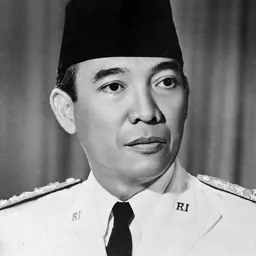
In 1946, President Sukarno heard about him when he had his solo exhibition in Jakarta. Sukarno then knew that Lee was given a Malino scholarship from Van Mook, the Netherlands lieutenant-governor general. In Europe, many of his exhibitions were successful. He briefly returned to Indonesia, and went back to hold exhibitions from The Hague to Paris. In 1952 he returned to Jakarta. The visit from Sukarno and Basuki Abdullah, the official palace painter at that time, encouraged him to establish Yin Hua in 1955. Yin Hua was an organization of Chinese painters that had its office on Lokasari Street, Jakarta. Many art exhibitions were organised by Yin Hua. In 1956, Yin Hua was invited to hold exhibitions in China.
The relationship between Sukarno and Lee improved. His beautiful and perfect works matched with Sukarno's taste. For him, Lee's art was an escape from revolutionary spirit. Sukarno didn't have any particular theme preference in art. Only ten percent of all his collections had a nationalist theme. "A thing of beauty is a joy forever," was his remark about his taste on art. Therefore, when Basuki Abdullah suggested to him to appoint Lee as the next presidential painter, Sukarno agreed to it without hesitance.
Source: Kompas, June 1, 2001, an article by Agus Dermawan T.
"Style should not be casually borrowed from others. Even worse is the deliberate imitation of the style created by another artist. Those who pretend that another artist's style is his own have no shame. For any style to hold up, the artist - its true creator - has had to toil ceaselessly for years with repeated experimentation and reflection out of which the results in turn are subjected to successive reevaluations and corrections. "
- Lee Man Fong, The Oil Paintings of Lee Man Fong: The Pioneer Artist of Indonesia and Singapore, Art Book Co., Ltd, p. 11
Don’t just read it —
keep it.
Full-length biographies made to live with: read them, listen on the way to work, watch them tonight.
- E-book
- Audio
- Video
Instant download · yours to keep · every purchase keeps this site free
Important facts
People in Lee Man Fong's life
Named in this biography and alive at the same time

Related people
Same field, nearest in time




Contemporaries
People whose lives overlapped Lee Man Fong's




Frequently asked questions
Who was Lee Man Fong?
Chinese artist (1913-1988)
When was Lee Man Fong born?
Lee Man Fong was born on 14 November 1913 in Jakarta.
When did Lee Man Fong die?
Lee Man Fong died on 3 April 1988.
What was Lee Man Fong's occupation?
Lee Man Fong was an artist and painter.
What nationality was Lee Man Fong?
Lee Man Fong was Indonesian.
Sources & further reading
Cite this page
APA: Biography.guide. (2026). Lee Man Fong. https://biography.guide/lee-man-fong/
MLA: "Lee Man Fong." Biography.guide, https://biography.guide/lee-man-fong/.
Chicago: "Lee Man Fong." Biography.guide. https://biography.guide/lee-man-fong/.
Data last updated: 2026-09-20 · Spot an error? Report a correction.
Page generated 2026-09-27 05:20 UTC