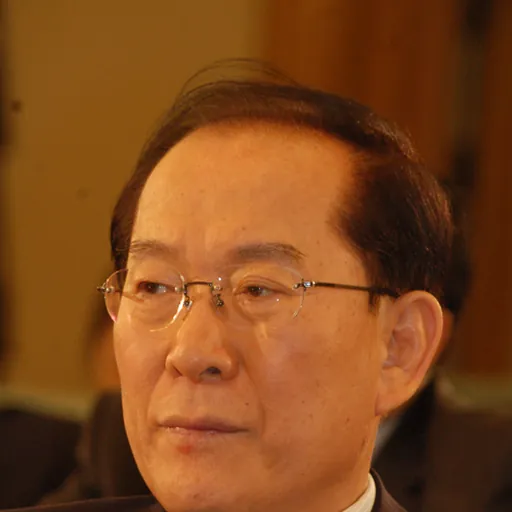
About Lee Hoi-chang
Born 1935. Lee Hoi-chang is a South Korean judge, lawyer, politician and member of the Constitutional Court of Austria.
Lee Hoi-chang (; born 2 June 1935) is a South Korean politician and lawyer who served as the prime minister of South Korea from 1993 to 1994. A political independent, he was a candidate in the 1997, 2002, and 2007 South Korean presidential elections. Prior to his presidential campaigns, Lee served as an associate justice of the Supreme Court of Korea.
Early life and education Lee was born to an elite family in Seoheung, Hwanghae Province (part of what is now North Korea), Korea, Empire of Japan. His father, Lee Hong-gyu, a public prosecutor, was appointed to a new post in the southern part of the peninsula and they moved there. Lee studied law at Seoul National University. Lee served as a judge from 1960 to 1980, when he became the country's youngest-ever Supreme Court Justice at the age of 46. Lee was elected as his party's presidential candidate for the presidential election scheduled for that same year. Lee was initially considered the frontrunner in the race, although his performance in public polling took a hit amid revelations in September that two of his sons had been excused from mandatory military service for reporting for duty underweight, having each lost 22 pounds since their initial physical examinations. Lee ultimately lost to Kim Dae-Jung in the midst of the Asian economic crisis.
Lee again campaigned to win the presidency in 2002, running against Roh Moo-hyun of the incumbent Millennium Democratic Party. Although corruption scandals marred the incumbent government, Lee's campaign suffered from the wave of Anti-American sentiment in Korea generated by the Yangju highway incident. Public opinion of Lee, who was widely seen as being both pro-U.S. and the preferred candidate of the George W. Bush Administration in Washington, D.C., suffered. After losing to Roh by 2% in the December 2002 elections, Lee subsequently announced his retirement from politics.
On November 7, 2007, Lee officially announced his third campaign for the South Korean presidency as an unaligned candidate after quitting the GNP. Launching his campaign late in the race, some two months prior to the election, Lee joined GNP candidate Lee Myung-bak, UNDP contender Chung Dong-young, and Moon Kook-hyun. Running to the right of his opponents, Lee criticized foreign aid to North Korea, arguing that such programs were fiscally burdensome and inappropriate while North Korea continued to pursue the development of nuclear weapons. His presidential bid posed a concern to the conservatives who were eager to regain the presidency after a decade of leftist rule, as it was feared Lee's candidacy would divide the conservative vote; however, Lee Myung-Bak won the December elections with 48.7% of the vote, while Lee Hoi-chang came in third, with approximately 15%. After his 2007 election bid, Lee founded the Liberty Forward Party.
Political positions Lee has been described as a staunch conservative in the context of South Korean politics. His positions include anti-communism, support for free market capitalism, and a hard-line stance against North Korea. Lee repeatedly criticized Kim Dae-jung's "Sunshine Policy" of engagement and détente with North Korea, and argued for the cessation of foreign aid until the North should dismantle its nuclear weapon program. Lee has called for a crackdown on illegal strikes, and for the appointment of more women to government offices.
Election results Year Elections Constituency Political party Votes (%) Results 1996 15th National Assembly General Election National (1st) NKP 6,783,730 (34.52%) Elected 1997 1997 Presidential Election South Korea GNP 9,935,718 (38.74%) Defeated 1999 June 1999 By-election Songpa A (Seoul) GNP 42,901 (61.47%) Won 2000 16th National Assembly General Election Proportional representation (1st) GNP 7,365,359 (38.96%) Elected 2002 2002 Presidential Election South Korea GNP 11,443,297 (46.58%) Defeated 2007 2007 Presidential Election South Korea Independent 3,559,963 (15.07%) Defeated 2008 18th National Assembly General Election Hongseong-Yesan (South Chungcheong) LFP 49,908 (60.99%) Won
Don’t just read it —
keep it.
Full-length biographies made to live with: read them, listen on the way to work, watch them tonight.
- E-book
- Audio
- Video
Instant download · yours to keep · every purchase keeps this site free
Important facts
People in Lee Hoi-chang's life
Named in this biography and alive at the same time


Related people
Same field, nearest in time

Contemporaries
People whose lives overlapped Lee Hoi-chang's




Frequently asked questions
Who is Lee Hoi-chang?
South Korean politician (born 1935)
When was Lee Hoi-chang born?
Lee Hoi-chang was born on 2 June 1935 in Sohung County.
What is Lee Hoi-chang's occupation?
Lee Hoi-chang is a judge, lawyer, politician and member of the Constitutional Court of Austria.
What nationality is Lee Hoi-chang?
Lee Hoi-chang is South Korean.
Sources & further reading
Cite this page
APA: Biography.guide. (2026). Lee Hoi-chang. https://biography.guide/lee-hoi-chang/
MLA: "Lee Hoi-chang." Biography.guide, https://biography.guide/lee-hoi-chang/.
Chicago: "Lee Hoi-chang." Biography.guide. https://biography.guide/lee-hoi-chang/.
Data last updated: 2026-09-22 · Spot an error? Report a correction.
Portrait: Wikimedia Commons · author & licence
Page generated 2026-09-27 05:02 UTC