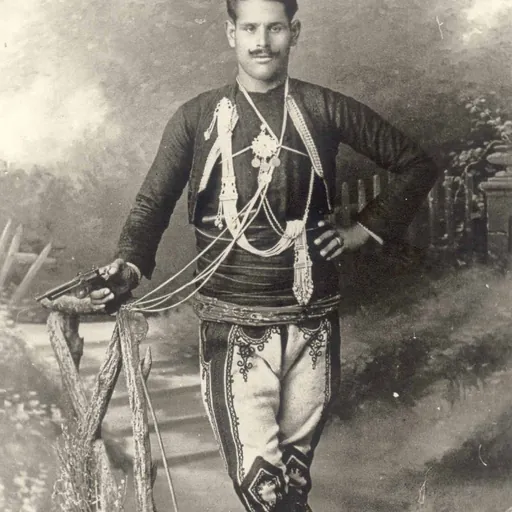
About Lazo Doiamas
Lived 1878 – 1912 (aged 33–34). Lazo Doiamas was a Turkish military personnel.
Lazaros or Lazos Dogiamas was a Greek chieftain of the Macedonian Struggle. He went by the nom de guerre Kapetan Barovitsalis .
Early life Lazos Dogiamas was born in the village of Barovitsa (now Kastaneri, Greece) in 1878 to Christos and Angeliki Dogiama. He could speak both Greek and Bulgarian. He came from the old and well known family of Dogiamas which was involved in agriculture and animal breeding. He had three brothers, Traianos, Demetrios, and Georgios, and a sister Maria. He and his three brothers would all become Makedonomachoi.
IMRO and the Ilinden Uprising Lazos Dogiamas joined the IMRO in the latter half of 1903, entering the armed band of his elder brother Traianos, who had joined sometime prior for security purposes. He joined with the desire to fight the Ottomans and served in the band of Apostol Petkov. Lazos and his brothers formed their own band in 1902 and in 1903 participated in the Ilinden Uprising. In early 1904, he and his brother learned the true intentions of the IMRO towards to the Greek population and in an act of reprisal, killed three Komitadjis and two IMRO Agents. Their band began to act autonomously and in an attempt at blackmail, the Bulgarians began commit the murders of their relatives.
Lazos and his brothers Demetrios and Georgios after the Young Turk Revolution.
HMC and the Macedonian Struggle Lazos Dogiamas and his brothers collectively entered the service of the Hellenic Macedonian Committee in 1905. They were placed under command of M. Moraitis (Kapetan Kodrou)
In 1906, Lazos Dogiamas and his band, in collaboration with his brothers, operated in the areas around Yenice, Karadjova, and Gevgeli and successfully rivalled the efforts of the Komitadjis. In July of that year, he worked with the band of Christos Dellios of Gevgeli in order to locate and kill Apostol Petkov which resulted in failure. However, they were able to assassinate the Turkish Aga Kiose Emin, Lazos and Gonos went from village to village to raise the morale of the Greek Patriarchists. At times, they had to disguise themselves as ragged villagers to evade Ottoman authorities.
In 1908, Lazos Dogiamas continued his operations and engaged in many skirmishes against the Ottomans, Bulgarians, and Romanians. After the Young Turk Revolution Lazos Dogiamas went to Athens following the Young Turk Revolution. However, after some time, it became obvious that the new administration of the Young Turks was not keeping many of its promises and persecution against the Greeks of Macedonia resumed. Additionally, the IMRO returned and terrorized the Greek population. Many of the Chieftains, Lazos included, worried for their families that remained in Macedonia. In the summer of 1910, Lazos organized a group of men and re-entered Macedonia to resume his operations. He once again cooperated with Gonos Yiotas as well as Georgios Karaiskakis. thumb Lazos Dogiamas with others (centre on horse).Following a betrayal in February 1911, a fierce battle commenced against the Ottoman Army by the lake of Giannitsa which resulted in the death of Gonos Yiotas. Lazos Dogiamas was left to assume leadership of their band. Days later he was once again forced to take refuge in Athens to avoid Ottoman persecution. He returned a few months later with a new band following reports of renewed violence against Greeks. He became wanted by Ottoman authorities, declaring him as dangerous.
During the summer of 1912, Lazos Dogiamas kidnapped the son of a rich Bulgarian from Igumencho by the name of Gotsos. He demanded a ransom, but a Komitadji from Lazos' village convinced him to release the son without ransom. Death Lazos Dogiamas was invited by the IMRO to discuss potential cooperation against the Ottomans. Various members from each side attended the meeting. Once the meeting concluded, a signal was given and the Bulgarians axed Lazos and two other Greeks to death.
His body was retrieved by his mother and was transported to the church of Agia Paraskevi in his village, where he was later buried in its cemetery.
Legacy A bust of Lazos was erected in Goumenissa in 1967 and was unveiled by his widow, Aikaterini. Gallery
Don’t just read it —
keep it.
Full-length biographies made to live with: read them, listen on the way to work, watch them tonight.
- E-book
- Audio
- Video
Instant download · yours to keep · every purchase keeps this site free
Important facts
People in Lazo Doiamas's life
Named in this biography and alive at the same time

Related people
Same field, nearest in time





Contemporaries
People whose lives overlapped Lazo Doiamas's



Frequently asked questions
Who was Lazo Doiamas?
Greek soldier
When was Lazo Doiamas born?
Lazo Doiamas was born in 1878 in Kastaneri.
When did Lazo Doiamas die?
Lazo Doiamas died on 24 August 1912 in Kastaneri.
What was Lazo Doiamas's occupation?
Lazo Doiamas was a military personnel.
What nationality was Lazo Doiamas?
Lazo Doiamas was Turkish.
Sources & further reading
Cite this page
APA: Biography.guide. (2026). Lazo Doiamas. https://biography.guide/lazo-doiamas/
MLA: "Lazo Doiamas." Biography.guide, https://biography.guide/lazo-doiamas/.
Chicago: "Lazo Doiamas." Biography.guide. https://biography.guide/lazo-doiamas/.
Data last updated: 2026-09-20 · Spot an error? Report a correction.
Portrait: Wikimedia Commons · author & licence
Page generated 2026-09-27 04:57 UTC