
About Lawrence H. Cooke
Lived 1914 – 2000 (aged 85). Lawrence H. Cooke was a lawyer and judge.
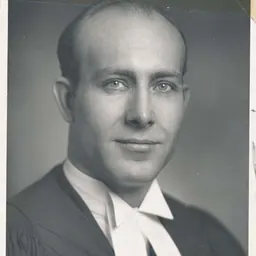
Lawrence Henry Cooke (October 15, 1914, Monticello, Sullivan County, New York – August 17, 2000, Monticello, Sullivan Co., NY) was an American lawyer and politician from New York. He was Chief Judge of the New York Court of Appeals from 1979 to 1984.
Life He was the son of George L. Cooke and Mary E. (Pond) Cooke. He graduated from Monticello High School (New York), from Georgetown University in 1935, and from the Albany Law School in 1938. After opening a law office in Monticello in 1939, he was elected Supervisor of the Town of Thompson for two terms. He married Alice McCormack, and they had three children.
His judicial career began in 1953 when he was elected county judge, surrogate and Children's Court judge of Sullivan County. In November 1961, he was elected unopposed a justice of the New York Supreme Court, and was appointed to the Appellate Division in 1968.
In 1972, he ran for the Court of Appeals on the Democratic and Conservative tickets but was defeated. In 1974, he and Jacob D. Fuchsberg were the last two judges elected to the New York Court of Appeals. In 1977, a constitutional amendment made the judgeships appointive. He was the first Chief Judge appointed by the Governor. He was nominated by Governor Hugh L. Carey on January 2, 1979, and confirmed by the New York State Senate on January 23, 1979. He retired from the bench at the end of 1984 when he reached the constitutional age limit of 70 years.
He died at his home in Monticello, and was buried at the Rock Ridge Cemetery there.
His opinions In In re Rothko, he wrote the court's opinion finding that the executors of the estate of abstract expressionist painter Mark Rothko violated their fiduciary duties to the beneficiaries of Rothko's estate. In People v. Rogers, he wrote in the majority opinion that once a lawyer has entered a proceeding in what may develop into a criminal case, the police must cease questioning the suspect, and that a waiver of the right to counsel may be made only in the presence of counsel. In Beach v. Shanley, he wrote the court's opinion that the Shield law permits a reporter who has been called before a grand jury to withhold the name of confidential sources without being subject to any sanction for criminal contempt. In Sharrock v. Dell Buick-Cadillac, he wrote the majority opinion that a state lien law permitting garage operators to satisfy an overdue bill by auctioning off the delinquent customer's car constituted a state deprivation of property without due process of law under the State Constitution.
Legacy A number of events and places have been named in his honor, including the Annual Chief Judge Lawrence H. Cooke State Constitutional Commentary Symposium and the . His name is also attached to several awards given to law students and lawyers.
Don’t just read it —
keep it.
Full-length biographies made to live with: read them, listen on the way to work, watch them tonight.
- E-book
- Audio
- Video
Instant download · yours to keep · every purchase keeps this site free
Important facts
Related people
Same field, nearest in time



Contemporaries
People whose lives overlapped Lawrence H. Cooke's




Frequently asked questions
Who was Lawrence H. Cooke?
American judge
When was Lawrence H. Cooke born?
Lawrence H. Cooke was born on 15 October 1914.
When did Lawrence H. Cooke die?
Lawrence H. Cooke died on 17 August 2000.
What was Lawrence H. Cooke's occupation?
Lawrence H. Cooke was a lawyer and judge.
Sources & further reading
· Wikipedia: Lawrence H. Cooke
Cite this page
APA: Biography.guide. (2026). Lawrence H. Cooke. https://biography.guide/lawrence-h-cooke/
MLA: "Lawrence H. Cooke." Biography.guide, https://biography.guide/lawrence-h-cooke/.
Chicago: "Lawrence H. Cooke." Biography.guide. https://biography.guide/lawrence-h-cooke/.
Data last updated: 2026-09-20 · Spot an error? Report a correction.
Page generated 2026-09-27 05:15 UTC