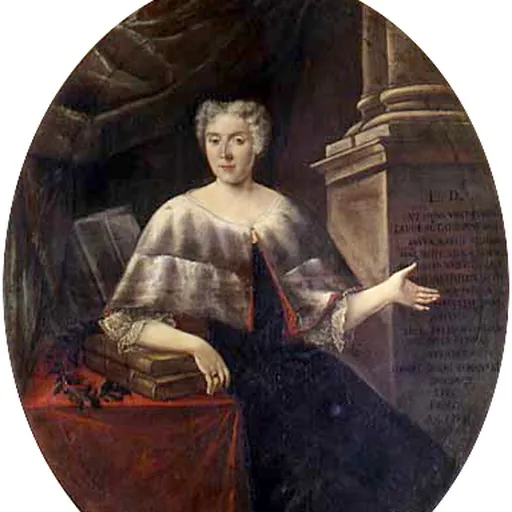
About Laura Bassi
Lived 1711 – 1778 (aged 66). Laura Bassi was an Italian physicist, university teacher, mathematician, anatomist, professor of philosophy and philosopher.
Laura Maria Caterina Bassi Veratti (29 October 1711 – 20 February 1778) was an Italian physicist and academic. Recognized and depicted as "Minerva" (goddess of wisdom), she was the first woman to have a doctorate in science, and the second woman in the world to earn the Doctor of Philosophy degree. Working at the University of Bologna, she was the first salaried female teacher in a university. At one time the highest paid employee of the university, by the end of her life Bassi held two other professorships. She was also the first female member of any scientific establishment, when she was elected to the Academy of Sciences of the Institute of Bologna in 1732 at 21.
Bassi did not receive formal education; instead, she was privately tutored from the age of five until she was twenty. By then, she was well-versed in major disciplines, including sciences and mathematics. Noticing her ability, Prospero Lambertini, the Archbishop of Bologna (later Pope Benedict XIV), became her patron. With Lambertini's arrangement, she publicly defended forty-nine theses before professors of the University of Bologna on 17 April 1732, for which she was awarded a doctoral degree on 12 May. A month later, she was appointed by the university as its first female teacher, albeit with the restriction that she was not allowed to teach all-male classes. Lambertini, by then the Pope, helped her to receive permissions for private classes and experiments, which were granted by the university in 1740.
Bassi became the most important populariser of Newtonian mechanics in Italy. Bassi's parents belonged to the city's lower middle class.
Education
Bassi was educated at home rather than attending a school. From the age of five to thirteen, she studied Latin, French, and arithmetic with her cousin, Father Lorenzo Stegani.
From age thirteen to twenty, Bassi studied with Gaetano Tacconi, her family's physician and a professor of medicine at the University of Bologna. Her studies included philosophy, logic, metaphysics, mathematics, mechanics, chemistry, languages, and natural history. Tacconi also trained Bassi in academic debate.
As Bassi's reputation grew, Tacconi introduced her to Bologna's academic circles, where she demonstrated her knowledge in philosophical debates. Among the scholars who became interested in her work was Prospero Lambertini, the archbishop of Bologna and later Pope Benedict XIV. Lambertini became one of Bassi's principal supporters and helped her gain formal recognition from the city and university. Less than a month later, on 17 April, she publicly defended forty-nine philosophical theses in the Sala degli Anziani of Bologna's Palazzo Pubblico. The event drew a large audience that included university scholars and leading political and religious figures. She became the second woman known to earn a doctorate in philosophy, fifty-four years after Venetian scholar Elena Cornaro Piscopia received one in 1678, and the first woman to receive a doctorate in science. She also became an honorary member of the university's College of Philosophers. Baptismal records held only eight. Caterina (born 1739), Caterina (born 1742), and Flaminio (born 1751) died in infancy. But five survived infancy: Giovanni (1738–1800), who became a canon of San Petronio and professor of theology in the Collegio Montalto; Ciro (1744–1827); Caterina (1745–1768), who became a nun; Giacomo (1749–1818), who became a canon; and Paolo (1753–1831), who became a doctor and professor of experimental physics at the Institute of Science and the only one to produce heirs. The defence formed part of her petition for a university teaching position. Her theses covered chemistry, physics, hydraulics, mathematics, mechanics and technical subjects.
Bassi's first university lecture was titled De aqua corpore naturali elemento aliorum corporum parte universi ("Water as a natural element of all other bodies"). Despite her appointment, the university restricted her public teaching because she was a woman and was not permitted to lecture to all-male classes. In 1766, aged 54, Bassi received another formal appointment to teach experimental physics at the Collegio Montalto, a residential college in Bologna.
In 1772, Paolo Balbi, professor of experimental physics at the Institute of Sciences, died, leaving his chair vacant. Bassi sought the position repeatedly during the following years while the institute debated how to reorganize its experimental physics course.
Bassi was not among the 24 scholars initially selected. After learning of her exclusion, she wrote to Flaminio Scarselli, Bologna's representative at the papal court, asking him to approach Benedict XIV on her behalf. Rather than displace one of the existing members, Bassi proposed that she be admitted as an additional member. Despite opposition from some members of the academy, Benedict XIV created a twenty-fifth position for her, making Bassi the only woman among the Benedettini. Correspondence One of her most important patrons was Cardinal Prospero Lambertini, who encouraged her scientific work. He continually supported the University of Bologna and intervened when other members of the institute tried to segregate Bassi from the rest of the professors.
Academy of Sciences of the Institute of Bologna: first woman member, in 1732. Accademia degli Ipocondriaci in Reggio Emilia, Accademia degli Ardenti in Bologna, Accademia degli Agiati in Rovereto, Accademia dell'Emonia in Busseto, Accademia degli Erranti in Fermo, Accademia degli Amanti della Botanica in Cortona, Accademia Fulginia in Foligno, and Accademia dei Teopneusti in Correggio, between 1750 and 1763. A marble statue of Bassi was made after her death and placed above the entrance to the Nautical Room of the Institute of Sciences in Bologna.
Places, institutions and objects bearing her name
Bassi is a impact crater on Venus. The International Astronomical Union approved the name in 1991. Via Laura Bassi Veratti is a street in Bologna. Liceo Laura Bassi is a secondary school in Bologna. The Laura Bassi Scholarship provides editorial assistance to postgraduate students and early-career academics researching subjects that have received relatively little attention in their disciplines. It was established in 2018. The University of Bologna awards a Laura Bassi Medal as one of its Alumni Awards. Laura Bassi is an Italian icebreaking research vessel used for scientific and logistical work in Antarctica by the Italian National Antarctic Research Program since 2019. It is the only Italian research vessel certified to operate in polar waters.
Other commemorations
Google marked the anniversary of Bassi's public defence of 49 theses with a Google Doodle, on 17 April 2021. American poet Jessy Randall included a poem about Bassi in her collection Mathematics for Ladies: Poems on Women in Science, published in 2022. Published works Owing to her administrative duties, family problems and frequent diseases during childbirth, Bassi published only a few works, which reflect a small fraction of her contributions to the University of Bologna. Her scientific works were best summed up in Domenico Piani's treatise Catalogo dei Lavori dell'Antica Accademia, raccolti sotto i singoli autori, published in 1852.
De aeris compressione (Concerning air pressure, 1745) De problemate quodam hydrometrico (Concerning certain problems in hydrometrics, 1757) De problemate quodam mechanico (Concerning certain problems in mechanics, 1757) De immixto fluidis aere (Concerning intermixed gaseous fluid, posthumously published in 1792)
Don’t just read it —
keep it.
Full-length biographies made to live with: read them, listen on the way to work, watch them tonight.
- E-book
- Audio
- Video
Instant download · yours to keep · every purchase keeps this site free
Important facts
Related people
Same field, nearest in time




Contemporaries
People whose lives overlapped Laura Bassi's





Frequently asked questions
Who was Laura Bassi?
Italian physicist (1711-1778)
When was Laura Bassi born?
Laura Bassi was born on 31 October 1711 in Bologna.
When did Laura Bassi die?
Laura Bassi died on 20 February 1778 in Bologna.
What was Laura Bassi's occupation?
Laura Bassi was a physicist, university teacher, mathematician, anatomist, professor of philosophy and philosopher.
What nationality was Laura Bassi?
Laura Bassi was Italian.
Sources & further reading
Cite this page
APA: Biography.guide. (2026). Laura Bassi. https://biography.guide/laura-bassi/
MLA: "Laura Bassi." Biography.guide, https://biography.guide/laura-bassi/.
Chicago: "Laura Bassi." Biography.guide. https://biography.guide/laura-bassi/.
Data last updated: 2026-09-20 · Spot an error? Report a correction.
Portrait: Wikimedia Commons · author & licence
Page generated 2026-09-27 04:57 UTC