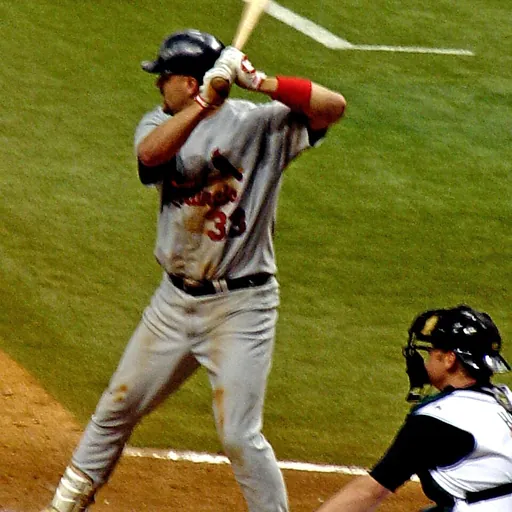
About Larry Walker
Born 1966. Larry Walker is a Canadian baseball player.
Larry Kenneth Robert Walker (born December 1, 1966) is a Canadian former professional baseball right fielder. During his 17-year Major League Baseball (MLB) career, he played with the Montreal Expos, Colorado Rockies, and St. Louis Cardinals. In 1997, he became the only player in major league history to register both a .700 slugging percentage (SLG) and 30 stolen bases in the same season, on his way to winning the National League (NL) Most Valuable Player Award (MVP). The first player in more than 60 years to record a batting average of .360 in three consecutive seasons from 1997 to 1999, Walker also won three NL batting championships. He was inducted into Canada's Sports Hall of Fame in 2007, and the Canadian Baseball Hall of Fame in the Class of 2009, and was named the 13th-greatest sporting figure from Canada by Sports Illustrated in 1999. In 2020, Walker was elected to the Baseball Hall of Fame.
Widely considered a five-tool player of prodigious athleticism and instincts, Walker hit for both average and power, combined with well-above-average speed, defense and throwing strength and accuracy. He was recognized as the top Canadian athlete in 1998 with the Lou Marsh Trophy. Other honors include five MLB All-Star selections, seven Gold Glove Awards, three Silver Slugger Awards, and nine Tip O'Neill Awards. His career SLG of .565 ranks 12th all time. Walker is one of only 19 hitters in history to accomplish a .300 batting average.400 on-base percentage (OBP), and .500 SLG with at least 5,000 plate appearances, and one of six whose career began after 1960. Considering advanced metrics, he is one of only three players in history to rank within the top 100 of each of batting runs, base-running runs, and defensive runs saved; the others are Barry Bonds and Willie Mays.
Raised in Maple Ridge, British Columbia, Walker spent his youth playing street hockey with consuming NHL goaltender aspirations. That dream never materialized; however, the Expos saw his baseball potential and signed him in 1984. By 1990, Walker became their starting right fielder, propelling them to the majors' best record in 1994 when that year's strike stopped their first serious World Series run. He signed with the Rockies as a free agent following the season, and, during a six-year period starting in 1997, was the major league batting leader three times while finishing second in the NL twice. In 1997, he also led the league in home runs, OBP, and SLG, while joining the 30–30 club, registering 12 outfield assists and leading his position with four double plays turned; he won the NL MVP Award that year. Desiring a trade to a contending team, Walker was sent by the Rockies to St. Louis in the middle of their 105-win season of 2004 where he made his first World Series appearance while tying or setting three Cardinals postseason records. He announced his retirement from playing baseball after Game 6 of the 2005 NL Championship Series.
Following his playing career, Walker has served as a guest instructor for the Cardinals, and, since 2009, has coached the Canadian national team. In that time, Team Canada has competed in three World Baseball Classic (WBC) tournaments, and twice at the Pan American Games, winning consecutive gold medals in 2011 and 2015.
Early life and amateur career
Walker was born on December 1, 1966, in Maple Ridge, a suburb of Greater Vancouver in British Columbia, to Larry Sr., and Mary Walker, both of Scottish descent. Walker had three older brothers. The five men often played together in a fastpitch softball league, frequently all in the same starting lineup. Walker grew up passing much of his free time playing street hockey, especially as part of a group of boys in the backyard and driveway of another boy. In that group was future Hockey Hall of Famer Cam Neely, who became one of Walker's close friends. Walker dreamed of a career in the National Hockey League (NHL) as a goaltender, only casually playing an occasional baseball game during the summer.
Walker played hockey and volleyball at Maple Ridge Secondary School; baseball was not offered. One of his boyhood idols was NHL goalie Billy Smith, who won four consecutive Stanley Cups from 1980−83, during Walker's teenage years. Walker sharpened his skills by blocking shots against Neely. Walker's brother Carey, also a goaltender, was drafted by the Montreal Canadiens
Junior hockey At the age of 16, Walker was offered tryouts with Junior A teams in Regina, Saskatchewan, and Kelowna, British Columbia, however, he was cut from both teams, while Herbert made the Regina Pats. Previously, Canadian baseball luminaries included Tip O'Neill, the first Canadian to win a Triple Crown in 1887, and Ferguson Jenkins, Canada's first selectee to the American Baseball Hall of Fame in 1991. Walker would help dramatically increase the profile of the sport in a hockey-mad nation. Part of the factor are Canada's short summers, which make it more challenging to play outdoors than in the United States. Walker later said regarding his youth career, "I'd never seen a forkball, never seen a slider. I didn't know they existed. I had never really seen a good curveball. In Canada, as a kid, we'd play 10 baseball games a year. Fifteen, tops. Some pitchers had a thing they'd call a spinner, but nothing like this. Baseball just wasn't big. The weather was against it. Nobody ever played baseball thinking about making the major leagues." He was also unaware of many of the rules, attesting to his lack of experience playing when he turned a professional. At that time, Canadians were not eligible to be selected through the Major League Baseball draft. While the Expos perceived Walker to be very athletic, they decided that he was very raw, and that he did not initially warrant rating as a top prospect. Walker caught the eye of his fellow Canadians, and, as a 19-year-old minor leaguer, had acquired an entourage of Canadian reporters. "I know now I can hit the ball. I have a lot of confidence even though I still strike out a lot. I swing at too many bad pitches," he contemplated. Asserted West Palm Beach manager Felipe Alou, "If he keeps improving the way he has the last 12 months, there's no telling what he could do. You have a kid with his kind of potential, they don't last long in the minor leagues." Meanwhile, the club clinched the Florida State League South division, winning by two games over the Fort Lauderdale Yankees.
After promotion to Jacksonville Expos of the Southern League in 1987, Walker totaled a .287 average.383 OBP.534 SLG, 91 runs, 26 home runs, 24 stolen bases and three times caught stealing. He won his first Tip O'Neill Award that year as the top Canadian baseball player. He missed the 1988 season after undergoing reconstructive knee surgery for an injury while playing in the Mexican Pacific League. The Expos moved him up to Indianapolis Indians of the Triple-A International League in 1989. There, he played in 114 games and batted .270 with 68 runs scored, 12 home runs, 36 stolen bases and six times caught stealing. He struggled in his debut, batting .170 with a .264 OBP and .170 SLG in 56 plate appearances.
Early major league career (1990−1992) 1989−1991 Montreal Expos #33 Larry Walker home jersey Ranked No. 42 on Baseball Americas list of top prospects in advance of the 1990 season, Walker became the Expos' regular right fielder following Hubie Brooks' departure via free agency, patrolling an outfield which featured Tim Raines and Marquis Grissom, both accomplished base stealers and hitters. Walker batted .241/.326 /.434 for a 112 OPS+ in his first full season. He also hit 19 home runs with 21 stolen bases and produced 3.4 Wins Above Replacement (WAR). As the top native Canadian to ever play for the Expos, Walker became a role model for young Canadian baseball players.
Over the next four seasons, Walker hit a combined .293/.366/.501 for a 134 OPS+, with an average of 20 home runs, 19 stolen bases, excellent defense (+10 runs per year) and 4.2 WAR. He became another in the succession of Montreal's great outfielders. He appeared in 133 to 143 games per season, spending significant time on the disabled list (DL) in 1991 and 1993 while playing on Olympic Stadium's notorious artificial turf, a product perceived to create excessive stress on knees, accelerating injuries to players like former Expos star outfielder Andre Dawson. In that game, Walker hit the only RBI, driving in Dave Martinez on a triple, and scored the second run on an error. He was involved in 17 of 27 outs: 16 putouts and one assist.
In late May 1992, the Expos made Alou manager at the major league level, touching off a period of heightened success lasting the rest of Walker's time in Montreal. On July 4 against the San Diego Padres, he fielded a ground ball to right field and threw out speedy shortstop Tony Fernández at first base. Walker was also selected to his first Home Run Derby, hitting four home runs. In 1992, Walker batted .301/.353/.506 and rated 10 runs above average while fielding,
1993−94 seasons The 1993 Expos reached a rare watermark, winning 94 games. A core of young talent propelled the club, including Grissom and a rising Moisés Alou (son of manager Felipe) complementing Walker in the outfield, starters Ken Hill and Jeff Fassero, and relievers John Wetteland and Mel Rojas. An improbable finish to the regular season including a record of 30−9 catapulted Montreal to a second-place standing with a 94−68 record, just shy of the club-record 95 wins set in 1979. Excitement in Canada began to crescendo over the prospect of the first-ever all-Canadian World Series, as the Toronto Blue Jays were defending champions in 1993, and repeated that October. Walker batted .265 with 22 home runs and 86 RBI, setting then-career highs with 80 walks, 20 intentional walks, 29 stolen bases, and .371 OBP. He won his second Gold Glove Award. Embarrassed, Walker admitted that he "told the little kid that maybe next time I'll give him a ball when there are three outs instead of two. Everybody around him was laughing." Where Offerman was stationed made little difference, as Tim Wallach homered on the next pitch from Martínez for two runs. True to his word, when the Expos assumed the field in the bottom half of the fourth inning, Walker gave Napier a signed ball, inducing a standing ovation. He paced for new levels production in spite of a shoulder injury in late June that confined him to first base for the remainder of the season. He easily accelerated past his previous career highs set in 1992 with a .322 batting average.394 OBP, and .587 SLG, including what could have been his first 100-RBI year. He finished with 86 RBI, 151 OPS+, and a league-leading 44 doubles; the latter two figures were also new career-highs. He placed 11th in the NL MVP voting.
Perhaps the most remarkable aspect of the Expos' transcendent season was that they did so with the second-lowest payroll in baseball. However, as the team lost millions of dollars in revenue from 29 canceled home games and playoffs, general manager Kevin Malone was given orders to drastically reduce payroll. The club dealt away their young stars and did not offer Walker salary arbitration. As such, he was granted free agency.
Colorado Rockies
Walker signed a four-year contract with the Colorado Rockies worth nearly $22.5 million USD , the largest agreement since the strike. The average annual value equated to more than $5.6 million ($ million today), up from the $4 million ($ million today) the Expos had paid him the year prior. From Olympic Stadium to Coors Field, Walker transitioned into the most benevolent hitting environment since World War II. Nonetheless, even after mathematically adjusting for stadium and altitude advantages, his production during his Rockies years consistently rivaled other hitters whose accomplishments came in settings of greater difficulty. and as the average club scored 5.4 runs per game, his OPS+ fell about 20 percent from the year before to 131. He placed seventh in the NL MVP voting, his second time in the top ten.
One of a quartet of Rockies players who became known as The Blake Street Bombers, Walker, Dante Bichette, Vinny Castilla and former Expos teammate Andrés Galarraga each contributed at least 30 home runs in 1995. The Rockies simultaneously won the first-ever NL wild card berth under the new postseason format and first playoff appearance in franchise history in just their third season of play. Walker collected three hits in 14 at bats in the NL Division Series (NLDS) versus the Atlanta Braves. He hit his first career postseason home run off Tom Glavine in the sixth inning of a 7−4 Game 2 loss. The Braves defeated the Rockies in four games. The next day, also against the Pirates, he set an MLB record with six consecutive extra base hits. On May 26, he won his first MLB Player of the Week Award. He missed more than two months of the 1996 season due to a fractured clavicle that occurred in a collision with an outfield fence. He hit .393 at Coors Field and .142 on the road.
Most Valuable Player Award (1997) The Rockies commenced the 1997 season on the road, and thus Walker started a reversal of his poor fortunes away from Coors. He hit two home runs in the season-opening series against the Reds in Cincinnati, He set major league records for March–April for both OPS (later surpassed by Barry Bonds in 2004 ) and runs scored (later surpassed by Bryce Harper in 2017). Walker won his first NL Player of the Month award.
Walker sat out an interleague game on June 12 versus the Seattle Mariners. Former Expos teammate Randy Johnson, a left-handed pitcher standing and one of the most intimidating players in sports history, was scheduled as the starter. "I faced Randy one time in spring training and he almost killed me," Walker explained of the rationale. He collected his 1,000th career hit and 108th of the season on June 20 against Andy Ashby of San Diego. The incident momentarily drew mirth and laughter from players in both dugouts, fans and announcers, and comparisons to Johnson pitching against John Kruk in the 1993 All-Star Game, in which he also threw over his head. In spite of garnering a reputation of avoiding Johnson, Walker batted .393 (11 hits in 28 at bats) against him in his career, nearly double the rate of all left-handed batters at .199.
During the All-Star break, Walker participated in the Home Run Derby, placing second with 19 home runs. Both he and Tony Gwynn of the Padres, also a selectee that year's All-Star Game, were batting near .400, and right fielders for teams in the NL West division. They were jointly interviewed, as batting .400 is one of the most difficult achievements in all of sports. Asked just how challenging it is, Gwynn, known to be a very studious hitter, elaborated with what he later termed a "complete dissertation." Walker responded, "I don't know anything about that stuff. I just hit the ball." While neither player wound up achieving the statistic over any full season, Gwynn won that year's NL batting championship and Walker finished second. Walker was batting .402 as late as July 17. On September 12, Walker was batting a league-leading .371 with 43 home runs; no NL player had ever simultaneously marshaled those totals. He then experienced another power surge, hitting home runs in four consecutive games – a total of five in that span – including the 199th and 200th of his career in San Diego on September 17. He injured his right elbow while swinging at the pitch that was thrown just prior to his 49th home run during the Rockies' 160th game, forcing him out of the final two games. In spite of Walker's magnificent season, the Rockies were unable to capitalize, missing the playoffs with an 83–79 record. the second with at least 45 home runs and 30 stolen bases, and the fifth with 40−30. The 9.8 WAR produced is tied for the 67th-highest single-season total among position players in MLB history, per Baseball Reference. Walker's production slotted within four hits and 10 RBI of winning the first batting Triple Crown in 60 years. and the NL in on-base percentage (.452), and at bats per home run (11.6).
Also, Walker's 409 total bases were the most in an NL season since Stan Musial gained 429 in 1948, and is tied with Lou Gehrig and Rogers Hornsby for the 18th-highest in MLB history. Walker's season marked the 23rd occasion in MLB history a batter reached 400 total bases and the first time in the NL since Hank Aaron's 400 in 1959. Combined with 12 outfield assists, and a league-leading of both a .992 fielding percentage and four double plays turned, the Baseball Digest Player of the Year Award, his seventh Tip O'Neill Award, In honor of Canada's 150th anniversary of Confederation on July 1, 2017, The Sports Network named Walker's achievement of the MVP award among the nation's most iconic sports moments.
The 49 home runs set a single-season club record for Colorado. Walker's production held up well on the road, including nine more home runs than at Coors Field: .346 average, 29 home runs and 62 RBI in 75 games.
First batting title (1998) Although he rested the right elbow in the off-season, Walker aggravated the injury while playing golf the following January.
One of the most amazing things I've seen Larry accomplish, was during those two seasons after '97, when, hurt as he was, he hit for a high average. He had to take daily inventory of what was going good and come up with a stroke that would work within the parameters of his health. It was never dramatic–a layman's eye would never notice. But he'd raise his hands on the bat or open his stance, just to have a stroke that was pain-free. It was different every night for two years. — former Rockies manager and hitting coach Clint Hurdle and broke Gwynn's streak of four consecutive NL batting championships. of which he remarked at the time that he lost "to a car." Walker also attained the Lionel Conacher Award as the top male Canadian athlete, the ESPY Award for Best Major League Player, and a Tip O'Neill Award. On May 19, Walker collected four hits versus the Cincinnati Reds to raise his season average to .431, but the Rockies were on the losing end of a 24−12 final, tied for the fourth-highest run-scoring output in MLB history. For the month of May, Walker batted .392.647 slugging, and 40 hits in 102 at bats.
From June 18−23, Walker tied Bichette's club record by homering in five consecutive games. The following day, Walker tied another club record, held by Galarraga, with his sixth consecutive multi-hit game. He was one of the strikeout victims of former Expos teammate Pedro Martínez, who became the first to strike out the first three batters in an All-Star Game. In the July 19 contest versus the Oakland Athletics, Walker became the second player to homer into the plaza reserve seating of one of the upper decks in the Oakland Coliseum, following Mark McGwire, who had done so three seasons earlier. On July 27, Walker recorded his 100th and 101st career outfield assists. He hit the game-winning home run August 18 versus John Rocker of Atlanta for his 1,400th career hit. Walker closed his season by hitting safely in 12 consecutive starts, including multiple hits in the final six. − while leading the major leagues in batting for a second time. Walker also led the major leagues in offensive win % (.838), on-base percentage (.458), slugging percentage (.710), and OPS (1.168). Sometimes referred to as the "Slash Stat Triple Crown," he became the seventh player within the previous 60 years to lead the league in each of average, OBP and SLG in the same season, and first since George Brett in 1980. The last NL player to lead the majors in each of the three slash stat categories was Musial in 1943.
Per the Elias Sports Bureau (ESB), Walker's .461 average at Coors is the highest home batting average since ESB began tracking home/road splits in 1974, and 43 points higher than any other player's in that span. Following the season, he underwent knee surgery. His aggregate batting average at .369 in that same time, he became the first player since Al Simmons from 1929–31 to hit at least .360 in each of three consecutive seasons.
2000−01 seasons While missing a major portion of 2000 with a stress fracture in the right elbow, Helton eventually succeeded Walker as the Rockies' career franchise leader in a number of statistical categories.
Prior the 2001 season, Walker committed to a new fitness regimen, including using a personal trainer. He displayed restored health in his right arm on Opening Day, throwing out Fernando Viña of the Cardinals at home plate. On August 5, he hit his 300th career home run, coming against the Pittsburgh Pirates in a 5−4 loss. He hit his 204th home run for Colorado on August, passing Castilla for the franchise record. On September 5, he took the lead for good for the batting title from former Expos teammate Moisés Alou. By scoring five runs on September 24 versus San Diego, Walker tied his career-high and the Rockies franchise record. He led the majors with a .406 home batting average and in left-hander versus left-hander batting average at .378. Commented manager Don Baylor, "Even with the injuries and the lack of numbers from what they used to be in the past, Larry is still pitched to very carefully and fearfully throughout the league. He's played beaten up and bruised." Walker underwent surgery to repair the labrum in the left shoulder and meniscus in the right knee following the season.
A groin strain caused Walker to miss the first 68 games, or two and one-half months, of the 2004 season. Walker totaled four hits and five RBI on the day, and it was his third career three-home run game. He reached 2,000 career hits on June 30, 2004, becoming the 234th player in major league history to do so. Having already achieved 400 doubles, 300 home runs, 1,000 runs scored, and 1,000 RBI, Walker became the 40th player to reach all five totals. The milestone hit was a double off Ben Sheets in the fourth inning versus the Milwaukee Brewers. Through that point, Walker was the Rockies' career leader in 12 categories. The Texas Rangers agreed to send to the Rockies two of their prospects then-minor leaguer Ian Kinsler and prospect right-hander Erik Thompson in exchange for Walker in July, but he vetoed the trade.
St. Louis Cardinals World Series appearance (2004)
On August 6, 2004, Colorado sent Walker, who was batting .324 in 38 games, to the St. Louis Cardinals for minor league pitcher Jason Burch and two players to be named later. On August 11, those players were identified as Chris Narveson and Luis Martínez. Customarily the Rockies' number three hitter, Walker became the Cardinals' number two hitter. He hit behind a speedy Tony Womack and in front of the 3−4−5 hitters of Jim Edmonds, Albert Pujols and Scott Rolen, who combined for 122 home runs and 358 RBI that year. Walker made his Cardinals debut on August 8, playing the New York Mets, and appeared as a pinch-hitter and struck out in the seventh inning. He drew a walk from Mike Stanton in the ninth inning and scored the game-winning run on a Yadier Molina single. Walker appeared in 44 games for the Cardinal powerhouse that won a major league-best 105 games, batting .280.393 OBP.560 SLG and 11 home runs.
In three playoff rounds in 2004, Walker combined to hit .293/.379/.707 with a pair of home runs in each series, Walker made his playoff debut with the Cardinals in Game 1 of the NLDS versus the Dodgers, homering twice and scoring four runs in an 8−3 Cardinals win. He became the first Cardinal with a multi-home run game in LDS play. In Game 1 of the NL Championship Series (NLCS) against the Houston Astros, he was a home run short of hitting for the cycle. His four-hit outing tied a Cardinals World Series record, becoming the seventh overall and first since Lou Brock in 1967. In the 2004 postseason, Walker scored 21 percent (14 of 68) of Cardinals runs. A herniated disc in his neck prevented him from turning his head to the left, and on June 27, 2005, he received a second cortisone shot to alleviate the pain. With eight previous surgeries and now playing in pain that impeded his ability to continue to produce at a high level, Walker signaled that he would retire from playing after the season. He had $12 million team option for 2006.
Walker ended his career 50th on Major League Baseball's all-time home run list with 383.
Playing style Walker began playing baseball seriously later than nearly all other players, but soon excelled at all aspects of the game, including hitting for both average and power, plate discipline, speed, defense, and throwing strength and accuracy, almost seamlessly translating the smoothness and agility of his hockey game to the diamond. Famously distinguished as "the accidental ballplayer" by a Sports Illustrated article in 1993, he displayed all skills of the ideal five-tool player. The transition was a feat even more impressive considering he only began playing organized baseball after graduating high school and did not attend college,
Rival right fielder and long-time San Diego Padre Tony Gwynn epitomized Walker as "the most complete player in the National League," and "best baserunner in the game" in a 2002 profile for ESPN. He observed that, in addition to his obvious athletic gifts, Walker approaches the game very cerebrally and is always thinking ahead, unearthing a wide array of advantages that he applied to the game. To Denver Post sports writer Tony Renck, "Walker is the most talented player I have ever covered. His 1997 NL MVP season was breathtaking in every way from baserunning to defense to his rifle arm and 49 home runs." Quipped his former manager with the Rockies Don Baylor, "He's a six-tool guy. Most talented player I've ever had." Former manager Bobby Cox remarked, "He's better than one of the best. He is the best."
Coaching St. Louis Cardinals In 2008, Walker was an instructor on the St. Louis Cardinals' spring training staff under manager Tony La Russa and did fill-in training with the Cardinals staff. He was offered a full-time role but chose to remain in his part-time position. 2013, 2017, and 2023. In 2011, he served as hitting and first base coach for Canada at the Pan Am Games in Guadalajara, Mexico, where Canada won their first major international baseball championship. In the semifinal, Canada defeated host Mexico, 5–3. Next, Canada bested the United States 2–1 in the final, to win the gold medal. Walker reprised his coaching role at the 2015 Pan Am Games in Toronto. In a rematch of 2011, Canada defeated the United States in extra innings, 7–6, to claim their second consecutive gold medal at the Pan Am Games. Walker did not return for the 2019 Pan Am Games.
Recognition, awards, and halls of fame election and consideration Post-career awards During the 2006 season, MLB and DHL Express announced a promotion, DHL Hometown Heroes, for fans to vote for the most outstanding player in each franchise's history among five nominees each. Nominees for the Rockies included Walker, Bichette, Castilla, Galarraga, and Helton. On October 1, 2006, Walker was announced as the winner for the Rockies franchise.
Walker was elected to the BC Sports Hall of Fame and inducted May 13, 2009. CTV Vancouver called him "perhaps the greatest Canadian-born ballplayer of all time".
On June 20, 2009, it was announced that Walker and former major league catcher Ernie Whitt were inducted into the Canadian Baseball Hall of Fame. Walker was elected on his first ballot.
Of 33 MLB players and employees surveyed in 2012 to solicit the opinion of the greatest Canadian baseball player, Walker led with 16 votes, Jenkins was second with 10, and Joey Votto, Justin Morneau and Stubby Clapp each received two. At the end of the 2014 season, he won the NL batting title, joining Walker as the second Canadian to win a batting title with the Rockies.
MLB held a contest dubbed "The Franchise Four" in 2015 for fans to select the four most influential players in the history of each franchise. On July 14, it was announced that Walker was selected along with Galarraga, Helton, and Troy Tulowitzki for the Rockies.
National Baseball Hall of Fame Walker became eligible for induction into the National Baseball Hall of Fame in 2011. During his first year of eligibility, he received 118 votes, or 20.3 percent of all ballots cast; the threshold for entry is 75 percent. With a 34.1% of voters supporting enshrinement in 2018 — Walker's personal high at that point — he had previously yet to receive more than 22.9% of the vote. As Jay Jaffe noted, Walker has had difficulty gaining more support for election as he is "in something of a perfect storm" — low counting statistics relative to already-elected Hall of Famers, playing a large part of his career during the "steroid era," and taking more turns at the plate at Coors Field than anywhere else.
Jaffe wrote that he found Walker to be well-qualified for induction into the Hall of Fame, contending that even though "his counting stats were low for the era... his all-round greatness added a considerable amount of hidden value that made up for lost time."
Wrote Tom Verducci of Walker's Hall of Fame credentials, the difference between playing in Denver and all other locations, including producing a 98-point in difference in average (.380 vs. .282), and a 49% higher home run rate, were "bothersome." Further, the lack of longevity kept him from election, as no right fielder with fewer than 2,500 games played or 2,500 hits has been selected. John Brattain wrote for Baseball Prospectus in 2002 that Walker had "Hall of Fame talent" and named him "among the elite National League outfielders, Coors Field or not," but without Hall of Fame credentials, due to a lack of longevity from injury. Brattain compared him to a number of failed hopefuls with similar statistics, including Dick Allen, who accrued impressive rate statistics adjusted for era and an MVP award. However, the comparisons only extended to batting accomplishments, leaving out defense and baserunning.
Noted of Walker's proper swing balance by the authors of Lau's Laws on Hitting, "don't be fooled into thinking that all of his glowing statistics are the result of playing at Coors Field. He posted some superb numbers in Montreal, too." Mike Piazza, who finished second to Walker in the 1997 NL MVP voting, commented the same year that "Walker is a great player having a great year. He plays in a great hitter's park, and I think it's unfortunate that some of their players don't get the credit they deserve because of that."
Walker was elected into the Baseball Hall of Fame in 2020 in his 10th and final year of eligibility; he was named on 304 of the 397 ballots (76.57%) cast by the writers. He became only the second Canadian elected into the Baseball Hall of Fame after Ferguson Jenkins was elected in 1991. Walker is also the first Hall of Fame player to wear a Rockies cap on his plaque. He created a sensation by wearing a NASCAR-style SpongeBob SquarePants shirt during the video interviews to commemorate the announcement of his election, citing that he was not optimistic he would be elected to the Hall of Fame. Both Amazon and Walmart in its online apparatus were found to have sold out of the shirt shortly after the interview aired. The SpongeBob shirt that Larry Walker wore on the day he was elected was itself put in the Hall of Fame as part of an exhibit in 2021.
Accomplishments Over his career, Walker produced a .313 batting average.400 on-base percentage, and .565 slugging percentage for a 141 adjusted OPS+. One of only 19 hitters in history with a .300/.400/.500 batting line with at least 5,000 career plate appearances, his is one of only six whose careers began after 1960. Injuries forced him to miss 375 games from 1996 to 2004 as he appeared in 1,083 of 1,458 possible games. He hit over .300 nine times, hit at least 30 home runs four times and drove in 100 RBI five times. Defensively, he ranks eighth all-time among right fielders with 94 runs above average, per Baseball Reference. He was the 40th player in history to reach 2,000 hits, 400 doubles, 300 home runs, 1,000 runs scored, and 1,000 RBI. According to sports journalist Joe Posnanski, of all players who rank within the top 100 of either Rbat, Rfield, and defensive runs saved, 34 are in the top 100 in two of the categories, and three are in the top 100 in all three: Barry Bonds, Willie Mays, and Walker. His 94 Bfield ranks eighth all-time among right fielders, and Rbase are third all-time among right fielders and 32nd among all outfielders. Considering players of all positions in MLB history, just 13 others achieved a combination of 94 Rfield and 40 Rbase. When also considering Walker's 420 Rbat (which are park-adjusted), just three others met or exceeded all three levels: Hank Aaron, Bonds, and Mays. Walker's slugging percentage ranks 12th all-time. His 140 wRC+ ranks 37th in history among players with at least 8,000 plate appearances.
Remarkably, Walker maintained superior longevity in right field despite persistent injuries during his career. Never having to permanently move off the position, he made significant contributions there every season of his career, while at times covering for significant stretches at first base (1991 and 1994), center field (1996) and left field (2000). He ranks 17th in games played in right field, with 1,718, 20th in assists (150), 11th in double plays turned (40), ninth in defensive zone runs (100), and 44th in fielding percentage (.986). Among all outfielders, he is 22nd in defensive zone runs (101), 77th in double plays turned (40), and 93rd in games played (1,804). During his five highest peak seasons spanning 1997−2001, he batted .357/.445/.658. His road OPS in nine full seasons playing for the Rockies was .890, and his career road OPS was .865, just ahead of Ken Griffey Jr. at .860. Of all players with at least 1,000 road games played, Walker's OPS ranked 39th . Since Walker won the MVP Award in 1997, Justin Morneau (2006) and Joey Votto (2010) became the second and third Canadians win the award. Only Walker and Votto (six) have won the Tip O'Neill Award more than three times in their career. Canada's Athletes of the 20th Century #9 Greatest Male Athlete
Canada's Sports Hall of Fame inductee
Canadian Baseball Hall of Fame inductee
Colorado Sports Hall of Fame inductee
National Baseball Hall of Fame inductee
+ Awards and exhibition team selections'
Baseball Digest Player of the Year
1997 Home Run Derby participant
1992, 1997, 1999 Superstitious about the number three, Walker wore number 33 during his playing career and had his marriage to his first wife on November 3, 1990, at 3:33. His in-game rituals all involved the number three, including taking three swings, or any multiple thereof, in the batter's box before each at bat.
A donor to the Rockies Youth Field of Dreams program, Walker opened five facilities in Colorado, in Aurora, Denver, Fort Collins, Northglenn, and Thornton.
Don’t just read it —
keep it.
Full-length biographies made to live with: read them, listen on the way to work, watch them tonight.
- E-book
- Audio
- Video
Instant download · yours to keep · every purchase keeps this site free
Important facts
People in Larry Walker's life
Named in this biography and alive at the same time





Related people
Same field, nearest in time


Contemporaries
People whose lives overlapped Larry Walker's




Frequently asked questions
Who is Larry Walker?
Canadian Hall of Fame baseball player
When was Larry Walker born?
Larry Walker was born on 1 December 1966 in Maple Ridge.
What is Larry Walker's occupation?
Larry Walker is a baseball player.
What nationality is Larry Walker?
Larry Walker is Canadian.
Sources & further reading
Cite this page
APA: Biography.guide. (2026). Larry Walker. https://biography.guide/larry-walker/
MLA: "Larry Walker." Biography.guide, https://biography.guide/larry-walker/.
Chicago: "Larry Walker." Biography.guide. https://biography.guide/larry-walker/.
Data last updated: 2026-09-21 · Spot an error? Report a correction.
Portrait: Wikimedia Commons · author & licence
Page generated 2026-09-27 04:58 UTC