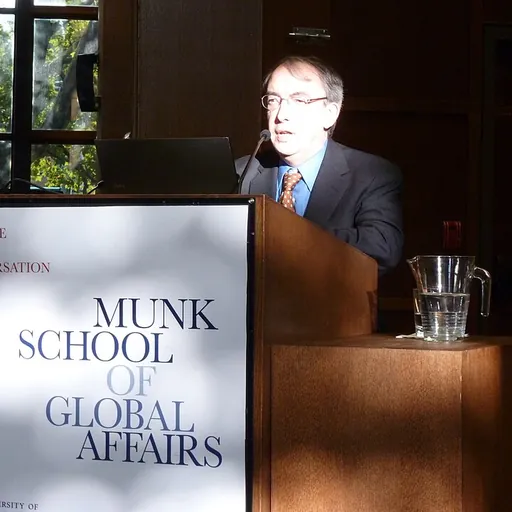
Larry M. Bartels
American political scientist
About Larry M. Bartels
Born 1956. Larry M. Bartels is an American political scientist, university teacher and academic.
Larry Martin Bartels (born December 16, 1956) He has published three books, Unequal Democracy: The Political Economy of The New Gilded Age (Princeton, 2008), Campaign Reform: Insights and Evidence, edited with Lynn Vavreck (University of Michigan Press, 2000), and Presidential Primaries and The Dynamics of Public Choice (Princeton, 1988).
His rebuttal to Thomas Frank's What's the Matter with Kansas?, entitled What's the matter with What's the matter with Kansas was published in the Quarterly Journal of Political Science in 2006. While Frank asserts that the conservative Republican Party has been able to lure working class voters away from the liberal Democratic Party, which better represents their economic interests, with value issues, such as abortion and same-sex marriage, Bartels points out that the working class, despite being socially more conservative, is still overwhelmingly Democratic, more so than in the past.
In his empirical analysis, Bartels finds that both college graduates and working-class people are mostly Democratic, the former having become more Democratic over the past years. He attributes the gain made by Republicans to the loss of the Solid South, with middle and high income whites from Southern states standing out as having become more Republican.
Bartels studied the voting patterns of the US Senate and correlated it with the responsiveness to the opinions of different amounts of Income in the United States.
In his 2008 book, Unequal Democracy: The political economy of the new gilded age, Bartels demonstrates that income inequality expanded under Republican presidential administrations and narrowed under Democratic presidential administrations since the early 1970s, when income inequality first started to expand. Under Republican presidents, rich families saw substantial net gains in their income, while poorer families saw negligible gains, producing a significant net increase in income inequality. By contrast, under Democratic presidents, poor families did slightly better than rich families proportionally, lessening income inequality.
However, all income brackets, from the bottom 20% to the top 5% of the population, saw significantly greater increases in income under Democratic presidents than under Republican presidents. In other words, had Democratic presidents been in office since the 1970s, income inequality may have lessened since the 1950s instead of growing into what Bartels calls "The New Gilded Age" of the early 21st century. Bartels's findings led him to conclude that "economic inequality is, in substantial part, a political phenomenon."
Recognition In January 2025, President Biden awarded Bartels the National Medal of Science.
Don’t just read it —
keep it.
Full-length biographies made to live with: read them, listen on the way to work, watch them tonight.
- E-book
- Audio
- Video
Instant download · yours to keep · every purchase keeps this site free
Important facts
People in Larry M. Bartels's life
Named in this biography and alive at the same time


Related people
Same field, nearest in time





Contemporaries
People whose lives overlapped Larry M. Bartels's

Frequently asked questions
Who is Larry M. Bartels?
American political scientist
When was Larry M. Bartels born?
Larry M. Bartels was born on 16 May 1956.
What is Larry M. Bartels's occupation?
Larry M. Bartels is a political scientist, university teacher and academic.
What nationality is Larry M. Bartels?
Larry M. Bartels is American.
Sources & further reading
Cite this page
APA: Biography.guide. (2026). Larry M. Bartels. https://biography.guide/larry-m-bartels/
MLA: "Larry M. Bartels." Biography.guide, https://biography.guide/larry-m-bartels/.
Chicago: "Larry M. Bartels." Biography.guide. https://biography.guide/larry-m-bartels/.
Data last updated: 2026-09-22 · Spot an error? Report a correction.
Portrait: Wikimedia Commons · author & licence
Page generated 2026-09-27 05:04 UTC